Simple structure and improved computational reliability will accelerate quantum society realization and industrial transformation
Summary
Hitachi has developed two new spin qubit*1 control technologies that will help achieve both the scalability and the computational reliability essential to the practical realization of a silicon quantum computer. The first, a novel digital control method that needs only a small number of signal lines for sending control signals from the control device, creates high-precision control signals near the quantum chip. This method reduces wiring complexity when scaling up a quantum computer, and the simple structure improves scalability and facilitates operations. The second is a new control technology that suppresses the effects of environmental noise and fluctuations, maintaining stable qubit states over an extended time period, even during computing procedures. Introducing this technology has resulted in a major improvement in silicon qubit fidelity*2—from 95% previously to more than 99% —demonstrating high computational reliability. These accomplishments represent technological progress toward the practical realization of quantum computers, which are expected to find active use in fields such as drug discovery, new materials development, and finance as platforms that contribute to solving social problems and creating new industries. In cooperation with RIKEN (Japan’s national research and development agency) and other global and domestic partners,*3 Hitachi will continue working toward the introduction of quantum technology into society on the way to provision of silicon quantum computer cloud service.*4
*1 Qubit: A quantum bit, the most basic unit of information in quantum computing.
*2 Fidelity: A performance indicator quantifying how close qubit manipulation is to the ideal; 100% indicates perfectly ideal manipulation. Achieving a quantum computer with quantum error correction requires a fidelity level of over 99%.
*3 R&D Topics “R&D is being stepped up toward practical realization of a silicon quantum computer,” October 2, 2025 (in Japanese).
*4 Cloud service making quantum computer use available in an open experimental environment. Service launch is expected by 2027.
Background and issues
The quantum computer is seen as a foundational technology that will help solve social problems that are beyond the reach of conventional computer architectures in areas such as large-scale optimization, new materials development, medical care, and finance. Hitachi has up to now developed a two-dimensional silicon qubit array, arranging silicon qubits in a lattice shape,*5 proposed a shuttling qubit method for more efficient control of qubits,*6 and advanced research on qubit stabilization technology.*7 In addition, working with partners such as RIKEN, which pursues leading-edge research in the quantum technology field, Hitachi has built up a global R&D organization toward practical realization of a quantum computer. One requirement for practical realization is achieving stable control of a million or more qubits, which entails two problems: wiring complexity, which increases with the number of qubits, and quantum state decoherence caused by environmental noise. To solve these problems, technology must be developed that achieves a simplified structure and enhances computation stability.
*5 R&D Topics “Hitachi successfully prototypes basic structure of two-dimensional silicon quantum bit array to overcome a barrier in large-scale quantum computer development,” November 24, 2020.
*6 Hitachi News Release, June 12, 2023 “Hitachi proposes a new qubit control method suited to large-scale integration toward practical realization of a silicon quantum computer.”
*7 Hitachi News Release, June 17, 2024 “Hitachi develops new qubit control method to stabilize and extend lifetimes by a hundred-fold and more, accelerating development of quantum computers.”
Features of the technology developed
To overcome these issues, Hitachi has developed the following technologies toward realizing quantum computer scalability and stable operation. Below are the main features of these technologies.
1. A digitally controlled conveyor-belt shuttling method that eliminates the need for complex wiring in a silicon quantum computer
Hitachi has developed a new digital control method able to achieve both the scalability and simple structure essential to the practical realization of a silicon quantum computer. Major barriers to scalability up to now have been the lack of wiring space due to an increase in cables with the number of qubits and the waveform distortion caused by the long transmission path.*8 In the new approach, direct current (DC) voltage is applied to the chip vicinity on only a few signal lines from generators at room temperature. These signals are then switched to a higher speed in a switch matrix circuit,*9 generating the necessary control waveforms with high precision. The amount of wiring is therefore greatly reduced, transmission-related distortion is minimized by creating the waveforms in the chip vicinity, and the overall structure is simple and highly scalable. Quantum simulations demonstrated the prospect of achieving high shuttling fidelity of 99.9%, similar to that with conventional analog control methods, confirming that this approach can meet the performance levels needed for a large-scale integrated quantum computer with quantum error correction.*10 This development shows technological progress toward quantum computer scalability and is an important step on the way to social implementation. Following up, we will conduct low-temperature testing on actual chips and develop diverse control patterns with an eye to error correction, accelerating social implementation of fault-tolerant quantum computation by a silicon quantum computer. The results of this development are scheduled to be presented in part at The International Conference on Spin Shuttling 2025 on October 9, 2025, in California, USA.

Figure 1. A comparison of shuttling technologies. In conventional shuttling, high-frequency analog signals output by an arbitrary waveform generator at room temperature are delivered for each qubit on dedicated coaxial cables to the coldest stage (tens of millikelvins) of a dilution refrigerator. Problems such as lack of wiring space and the need for fine-tuned calibration of each bit have emerged as barriers to scalability. The digitally controlled conveyor-belt shuttling method newly proposed by Hitachi, by generating the qubit driving waveforms in a cryogenic environment in the quantum chip vicinity, alleviates the wiring bottleneck of conventional approaches.
*8 Waveform distortion: Disturbances in the original signal due to reflection occurring in a connector or elsewhere.
*9 Switch matrix circuit: Circuit switches enabling multiple inputs to be connected (routed) freely to multiple outputs.
*10 Quantum error correction: Technology that uses redundant qubit encoding to correct errors occurring in a quantum computer due to noise or other influences.
2. Qubit control technology with noise tolerance, dramatically improving computational reliability
Highly precise, stable control of qubits is essential to quantum computer realization. In 2024, Hitachi introduced a concatenated continuous driving (CCD) protocol, establishing technology that extends the lifetime of silicon spin qubits, which are susceptible to the influence of noise, by a hundred-fold or more .*7
Now, the CCD protocol has been further advanced by combining the continuous driving approach of constantly applying microwave pulses with microwave phase control. The new technology has been shown to achieve high-fidelity manipulation (quantum gate operations) while maintaining the qubit states (Figure 2). This technology was further confirmed to achieve a major improvement in qubit manipulation fidelity, going from 95% to more than 99%. The resulting platform can maintain high computational reliability even with integration of large numbers of qubits, giving a strong boost to advancing technology toward social implementation of a quantum computer.
The results of this development are scheduled to be presented in part at Silicon Quantum Electronics Workshop 2025 on October 6–8, 2025, in California, USA.
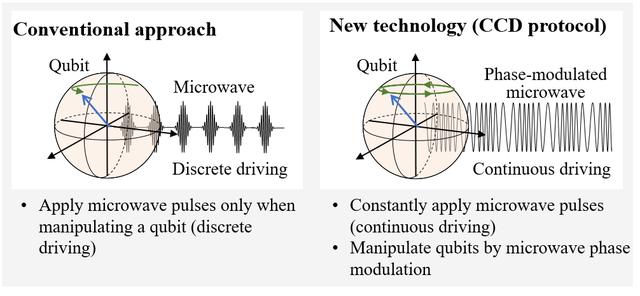
Figure 2. A comparison of qubit manipulation methods. The new technology differs from the conventional approach, in which microwave pulses are applied only when manipulating a qubit, by constantly applying microwave pulses and manipulating qubits by microwave phase modulation. Quantum manipulation of qubits protected in double-dressed state is therefore possible.
Looking ahead
In cooperation with RIKEN and other global and domestic partners, Hitachi will continue to aim for social implementation of quantum technology and the opening up of new growth areas. A particular emphasis will be on promoting industry-academia-government collaboration and international standardization that will enable the silicon quantum computer to be made available in the cloud, thereby accelerating social implementation in such forms as quantum cloud services and creation of new industries. Through quantum technology, Hitachi will contribute to the building of sustainable social platforms and industrial transformation.
Acknowledgements
This research was supported by a grant under the Japan Science and Technology Agency (JST) Moonshot Research and Development Program Goal 6, “Realization of a fault-tolerant universal quantum computer that will revolutionize economy, industry, and security by 2050” (Program Director KITAGAWA Masahiro), for the R&D Project “Large-scale Silicon Quantum Computer” (Project Manager MIZUNO Hiroyuki; grant number JPMJMS2065). Some of the results have also benefitted from joint research with the Institute of Science Tokyo, RIKEN, the Hitachi Cambridge Laboratory, and The University of Tokyo.
For more information, use the inquiry form below to contact the Research & Development Group, Hitachi, Ltd. Please make sure to include the title of the article.
https://www8.hitachi.co.jp/inquiry/hitachi-ltd/hqrd/news/en/form.jsp