
AI and digitalization are profoundly reshaping the way we work and the structure of entire industries. Alongside these shifts, global trends—such as rising geopolitical risks, intensifying technological competition, and targeted investments—are pushing the industrial world to a turning point never seen before. Leaders from industry, academia, and government across Japan, the United States, and Europe convened to address these challenges. They discussed cross cutting issues such as labor productivity, workforce strategies, energy and the environment, and advancements in AI and digital technologies.
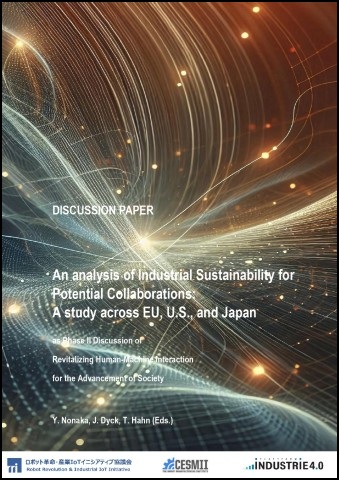
The outcome of these discussions is the trilateral discussion paper “An Analysis of Industrial Sustainability for Potential Collaborations — A Study Across Japan, the U.S., and Europe ”, jointly developed by The Robot Revolution & Industrial IoT Initiative*1 (RRI, Japan), CESMII*2 (Collaborative Ecosystems for Smart Manufacturing Innovation Institute, USA), and Plattform Industrie 4.0*3 (Germany).
In this article, Project Leader Yoichi Nonaka discusses the impacts of AI, automation, and Human‑Machine Interaction (HMI), and shares his vision for a “Harmonized Symbiotic Society” in which humans and machines can fully demonstrate their strengths together.
Industrial Sustainability: Why It Matters Now.
The backdrop to selecting this theme is the emergence of a “polycrisis,” in which multiple disruptions are unfolding simultaneously. The pandemic triggered severe supply‑chain disorder, and this was compounded by the energy crisis and constraints on global trade and evolving trade frameworks. As a result, achieving both growth and productivity through conventional approaches has become increasingly difficult.
More than a decade has passed since the introduction of Industry 4.0, yet the productivity of society as a whole has not improved as much as initially anticipated. A significant gap remains between technological advancement and its implementation in society, as well as between institutional readiness and workforce development.
This is why Human-Machine Interaction (HMI) must be integrated with digital transformation, decarbonization, the circular economy, and talent development into a unified framework.
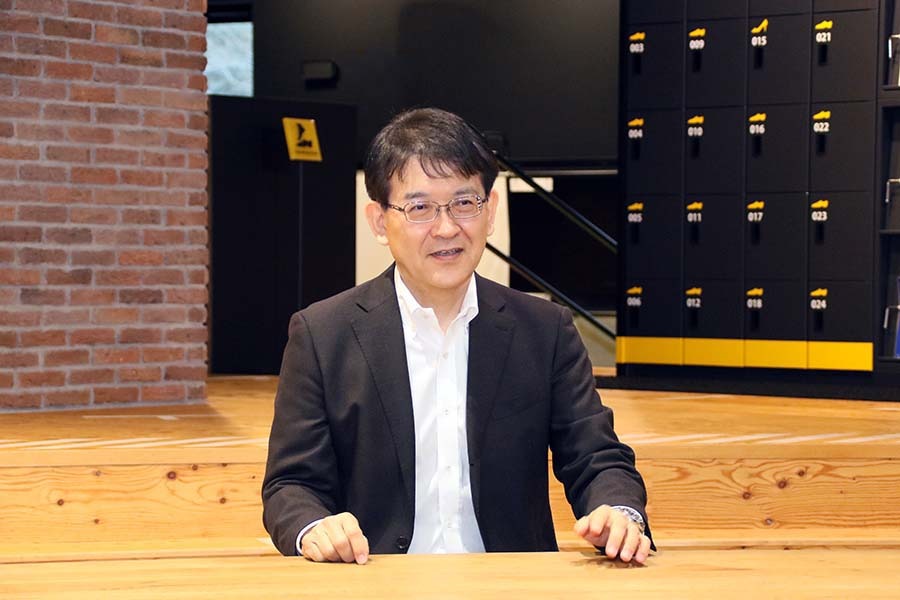
Dr. Nonaka discusses the initiatives behind the discussion paper.
As noted by organizations such as the IMF*4 and the WEF*5 , countries have increasingly turned their focus toward domestic priorities since the 2008 financial crisis. This trend has intensified a “triple pressure” driven by rapid AI advancement, climate change, and rising geopolitical tensions. Nations are now compelled to pursue greenhouse‑gas reduction, energy security, and resilience enhancement simultaneously.
When examining regional policy trends, one can observe differing approaches:
- Japan is promoting its “3E+S*6” energy strategy, advancing green transformation and rethinking the energy mix.
- Europe is accelerating its clean energy transition through the Green Deal*7 and reshaping its energy value chains under REPowerEU*8.
- The United States is strengthening public‑private cooperation through the Inflation Reduction Act*9and the CHIPS and Science Act*10.
Despite these differences, what all three regions share is a commitment to pursuing environment, safety, and economic growth in parallel.
Purpose and Key Insights from the Japan–U.S.–EU Discussion Paper
Japan, the United States, and Europe collaborated to examine industrial sustainability from multiple angles—including labor productivity, energy and decarbonization, HMI, and ELSI*11. The aim was to summarize guiding principles to close the social‑implementation gap in digitalization and accelerate technology, policy, and talent development in an integrated manner.
Through these discussions, several important insights emerged. Across all regions, common priorities include digital transformation (DX), decarbonization, the circular economy, and reskilling. However, the regions differ in their emphasis:
- Japan focuses on the citizen‑centric perspective rooted in Society 5.0.
- The U.S. emphasizes innovation led by the private sector.
- Europe places weight on regulation and interoperability of standards.
A key finding was that Japan, the United States, and Europe share a common vision: achieving well‑being*12 and economic growth within planetary boundaries*13. However, each region differs in its approach and in the areas where reinforcement is needed.
For solving global common challenges caused by those differences, the study highlights the importance of a “Harmonized Symbiotic Society”—a flexible alliance that respects regional autonomy while establishing shared principles and interoperable mechanisms.
This approach enables each region to respond flexibly to its own challenges while collaborating toward global problem‑solving.
Transformation and Challenges Brought by AI and Automation
Digital twin technologies, which enable data-driven management across the entire process—from design and production to operations and maintenance—are driving significant advances in quality control, predictive maintenance, and energy optimization. In addition, collaborative robots that work alongside humans are becoming increasingly capable, now able to handle flexible tasks and operations that require subtle skills or tacit knowledge.
However, these technological advances are also generating new challenges in the labor market. As AI and automation progress, routine work requiring mid‑level skills is increasingly being replaced by machines. Meanwhile, demand is rising for specialized work requiring creativity and ingenuity. It is also increasing for roles less suited to automation, such as cleaning, waste sorting, and other essential public services.
This raises concerns that the very technologies intended to improve human life may contribute to structural changes in the labor market, potentially leading to new forms of disparity if not appropriately addressed.
For example, studies such as the World Economic Forum’s Future of Jobs 2025 and occupational forecasts by the U.S. Bureau of Labor Statistics (BLS*14) indicate that AI and automation may increase demand for certain occupations that are currently difficult to automate, while reshaping skill requirements across the labor market. These analyses suggest that, while mid‑skill jobs are likely to decline, certain low‑skill roles will continue to expand because they remain essential to society and are challenging to fully automate.
What is essential, therefore, is positioning AI and automation not as substitutes for human labor but as tools that augment human capabilities—enhancing the physical and cognitive limits of individuals. Equally important is fostering an inclusive mindset that encourages human to view social issues as their own and motivates them to continue learning in response to environmental change.
Creating such an environment depends on developing HMI systems that prioritize transparency, offer clear explanations, and facilitate mutual auditing and cross-regional certification. In other words, a Harmonized Symbiotic Society, centered on flexible cooperation across regions with differing values and regulatory frameworks, becomes the key to enabling this transformation.
Hitachi’s R&D and International Collaboration — Advancing Social Innovation
When discussions around Industry 4.0 began to emerge globally, Hitachi initiated a sustained dialogue with acatech – National Academy of Science and Engineering and one of the key proponents of the concept—to explore the future of Human‑Machine Interaction (HMI). In the 2019 discussion paper, published even before generative AI entered mainstream debates, Hitachi proposed a vision in which humans and machines share knowledge as equals and collaborate to support society. This vision continues to serve as a reference in ongoing Japan–Germany government‑level IoT collaboration projects.
Building on the societal changes that followed, Hitachi advanced this project in partnership with RRI (Japan), CESMII (U.S.), and Plattform Industrie 4.0 (Germany). Led by Yoichi Nonaka, together with John Dyck (CEO of CESMII) and Thomas Hahn (Siemens Fellow and member of Plattform Industrie 4.0), the project brought together experts from Japan, the United States, and Europe and engaged them in intensive discussions over eighteen months.

Project co‑leaders John Dyck (left) and Thomas Hahn (right).
The project’s aim was to present practical guidance to close the social‑implementation gap in digitalization and accelerate technology, policy, and talent development in an integrated manner. This approach aligns deeply with Hitachi’s Social Innovation strategy embodied in Lumada, and directly connects to the company’s new mid‑term management plan, “Inspire 2027,” which positions the vision of a “Harmonized Society” at its core.
This perspective—emphasizing coordinated innovation across society, technology, and governance—is reflected in Hitachi’s recognition that addressing global industrial challenges requires flexible, cross‑regional collaboration grounded in shared principles and interoperable frameworks.

Dr. Nonaka explains how the project’s principles align with Hitachi’s “Inspire 2027” vision.
Message to Industry and Society
To build a future where both human and machines truly thrive, we must recognize that technology alone cannot provide all the answers. Human‑centered design, opportunities for lifelong learning and reskilling, fair recognition of socially essential labor, and transparent and explainable AI and data governance all play critical roles. It is essential to position AI as an extension of human capability—enhancing safety, quality, and opportunities for growth—rather than simply as a substitute for human labor.
Equally important is expanding initiatives that simultaneously improve safety, quality, and learning opportunities by leveraging AI to augment human work.
A Harmonized Symbiotic Society—one that enables flexible collaboration across national boundaries while respecting diverse values—provides a path for achieving a balanced integration of environmental sustainability, well‑being, and economic growth.
*1 RRI (Robot Revolution & Industrial IoT Initiative) An organization established to promote Japan’s “Robot Revolution,” based on the country’s 2015 robot strategy.
*2 CESMII (Collaborative Ecosystem for Smart Manufacturing Innovation Institute) The United States’ national institute dedicated to smart manufacturing.
*3 Plattform Industrie 4.0 The German government–led initiative representing the Fourth Industrial Revolution, promoting digitalization and automation in manufacturing.
*4 IMF (International Monetary Fund) A specialized agency of the United Nations, responsible for promoting international monetary cooperation and exchange‑rate stability.
*5 WEF (World Economic Forum) An international non‑profit organization that provides a platform for leaders in business, politics, academia, and civil society to collaborate on global challenges.
*6 3E+S (Energy Security, Economic Efficiency, Environment + Safety) Japan’s basic concept for balancing energy policy priorities: ensuring stable supply, economic efficiency, environmental sustainability, and safety.
*7 The European Green Deal The EU’s growth strategy (established in 2019) to reduce emissions while creating jobs and promoting sustainable development.
*8 REPowerEU An EU policy initiative aimed at reducing reliance on Russian fossil fuels and accelerating the transition to renewable energy.
*9 IRA (Inflation Reduction Act of 2022) U.S. legislation designed to reduce the federal budget deficit, lower prescription drug prices, invest in domestic energy production, and accelerate the transition to clean energy.
*10 CHIPS and Science Act A U.S. law enacted in 2022 to strengthen the semiconductor industry and promote scientific and technological innovation.
*11 ELSI (Ethical, Legal, and Social Issues) A framework for evaluating the broader impacts of advanced technologies on society from ethical, legal, and institutional perspectives.
*12 Well‑being A holistic concept encompassing physical, mental, and social well‑being.
*13 Planetary Boundaries A scientific framework identifying nine boundaries that define the safe operating space for humanity, including climate change, ocean acidification, and biodiversity loss.
*14 BLS (Bureau of Labor Statistics) The U.S. government agency responsible for collecting, analyzing, and disseminating labor‑economics data.
Profile

Yoichi Nonaka
Corporate Chief Researcher,
Research & Development Group, Hitachi, Ltd.
Joining Hitachi’s Production Engineering Research Laboratory in 1992, Yoichi Nonaka has been engaged in research and development in industrial robotic application systems, digital engineering technologies, and production control technologies. After serving as a visiting researcher at the Massachusetts Institute of Technology in 2001 and holding various R&D leadership roles, he assumed his current position in 2023. Since 2018, he has also served concurrently as a Collaborative Professor at the Graduate School of Informatics, Kyoto University.
He is a member of the Japan Society of Mechanical Engineers, the Japan Society for Precision Engineering, the International Academy for Production Engineering (CIRP), and the Engineering Academy of Japan. He holds a Ph.D. in Engineering.
Related Links
RRI International Symposium 2025 [Session 2] Leaders Dialogue: Industrial Sustainability