

Naohisa Iwamoto (Editor in Chief, WirelessWire & Schrodinger’s)
Promising Technology of Room Temperature Magnetic Refrigeration to Solve Social Challenges
In recent years, regulations have become tighter for hydrofluorocarbons (HFCs) used in refrigeration and air conditioning systems. To comply with them, while new refrigerants with low global warming impacts are being developed, attention is being paid to practical applications of cooling technologies without any use of refrigerant gases. At the same time, to achieve a decarbonized society, reducing energy consumption in air conditioning and refrigeration has also become a major social challenge. Hitachi is researching “magnetic refrigeration” to respond to the two challenges of refrigerant regulations and a decarbonized society.
Magnetic refrigeration is, to put it simply, a “cooling technology using magnetic entropy.” Yamamoto explains, “Magnetic refrigeration is free of refrigerant gases and has a potential for high energy efficiency. The technology had been recognized as having cooling effects at extremely low temperatures. As the magnetic refrigeration technology that enables cooling at room temperatures has been developed, there is an increasing likelihood of contributing to future social challenges. Compared to the existing cooling methods, the technology is more efficient than Peltier-effect thermoelectric cooling and is characterized by not needing refrigerant gases vital for vapor compression refrigeration.”
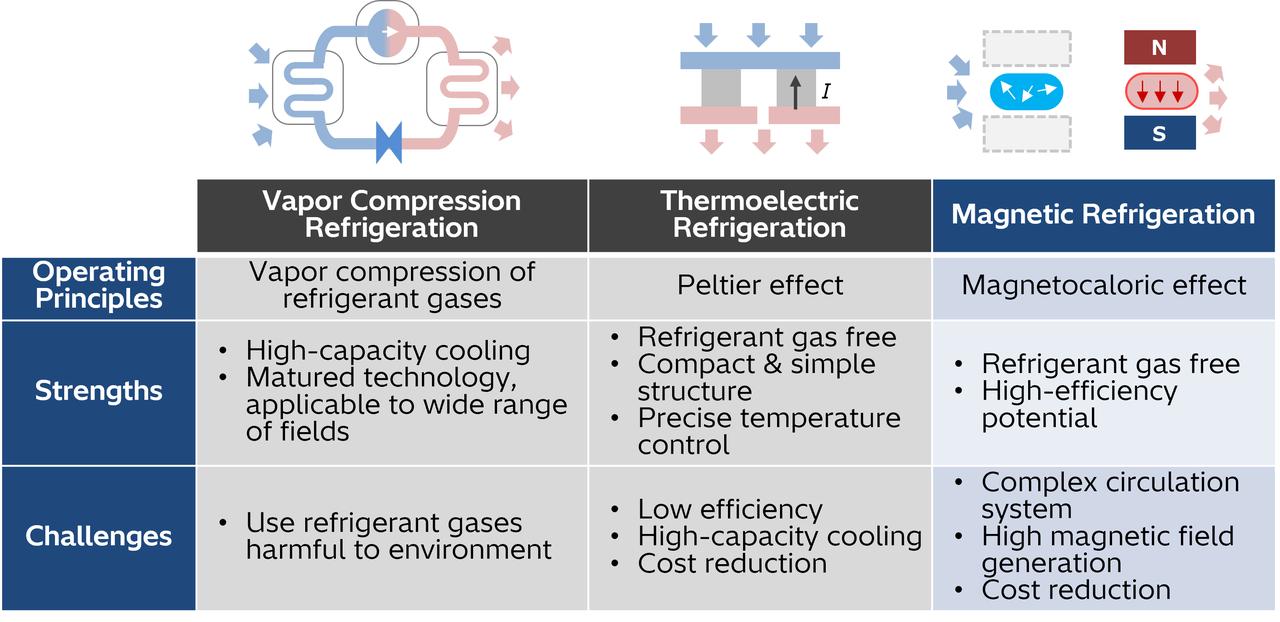
Candidate for Refrigerant Gas Free Cooling Technology
The two cores of magnetic refrigeration are “magnets” and “magnetocaloric materials.” The term called magnetocaloric materials may not be well known. These are materials whose temperatures go up and down by applying or removing magnetic fields.
Let us take a brief look at the principle of how temperatures rise and drop with magnetism. “When a magnetic field is applied to magnetocaloric materials, it aligns electron spins inside the materials, which means a decline in magnetic entropy. Meanwhile, in the material as a whole, the heat equivalent to the reduced entropy caused by aligned electron spins is released to the crystal lattice where atoms are arranged, which increases the temperature. Conversely, removing the magnetic field loosens the aligned spins, increasing entropy, which absorbs the corresponding heat from the crystal lattice structure, causing the temperature to drop. Based on this principle, cooling systems can be built by controlling magnetic fields.” (Yamamoto)
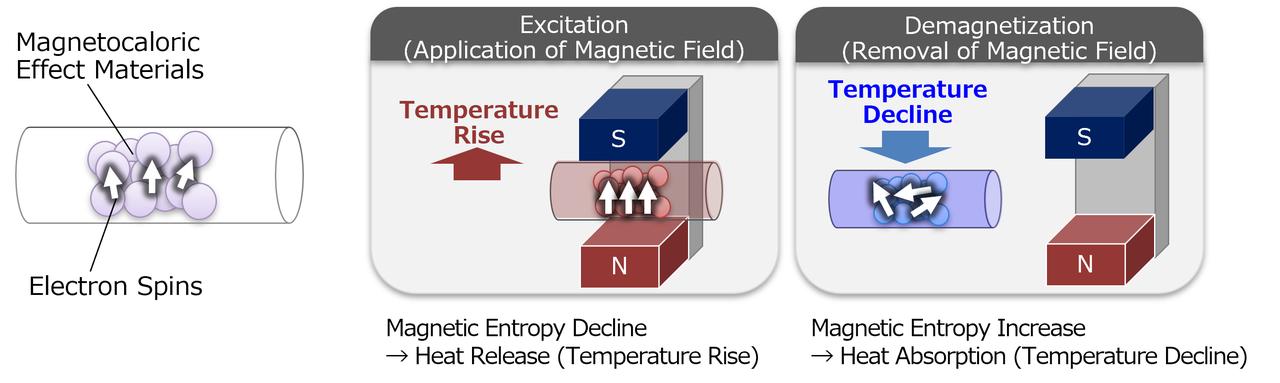
Basic Principle of Magnetic Refrigeration
The phenomenon of temperature changes in magnetic materials caused by magnetic fields was first discovered in 1881. After that, around 1920, the basic principle of magnetic cooling (often called magnetic refrigeration) was established, significantly contributing to the development of cooling technologies in the field of physics at extremely low temperatures close to absolute zero (-273 ℃). The tide changed in the 1970s when the behavior of magnetic cooling in the room temperature range was verified, which brought a major turnaround.
Then, in the 1990s, the technology of active magnetic regenerator (AMR) was developed to efficiently get magnetic cooling effects at room temperatures. This was made possible by combining a heat transfer medium such as water with the cycle of magnetic application and removal to easily create large temperature gradients at both ends of magnetocaloric materials. By adopting the AMR cycle, it has theoretically become possible to realize magnetic refrigeration systems operating at room temperatures, namely, room temperature magnetic refrigerators. From the late 1990s to the 2000s, new materials that exhibited much bigger magnetocaloric effects were discovered, which has enabled research toward practical applications to accelerate.
From Prototype Construction to Extensive Research including Materials
Though the technology of magnetic refrigeration is advancing towards practical applications, according to Yamamoto, it is not yet in the stage ready for products. He says, “The discovery of new materials with large magnetocaloric effects is a major achievement. However, there is still no established system architecture that reliably implements the AMR cycle, largely because the cycle requires a complex system. Moreover, strong magnetic fields are essential, requiring expensive magnets made from, for instance, rare-earth elements, creating a cost challenge. Another challenge is a decline in efficiency, because more energy is required to drive magnets to increase cooling output. It is also necessary to strike a balance between applications and performance so as to deliver the right cooling capacity for the right application while saving energy.”
Yamamoto had been researching permanent magnets after studies on superconducting devices and magnetic memory based on spintronics. It was in 2022 that he started focusing on magnetic refrigeration for his main research. During his search for a new topic for applied research in magnetic materials, he set his sights on magnetic refrigeration.
“Hitachi had worked on magnetic refrigerators before, but no team was specifically focused on researching room temperature magnetic refrigeration. Believing that this research holds significant potential to address societal issues, particularly by reducing environmental impact, I decided to take the initiative and start the research myself.” (Yamamoto)
Through those research efforts, he has so far developed a prototype of a room temperature magnetic refrigerator employing the AMR cycle. One of the challenges for practical applications is to achieve both high cooling power and energy efficiency. To overcome this, in addition to the improvement of material characteristics, the design of the entire system composed of functional elements becomes crucial. He built a new magnetic refrigeration system incorporating various areas of expertise, such as the selection of magnetic materials, the construction of a magnetic field generation system, the design of the entire magnetic refrigeration unit structure, and fluid controls for water used as a heat transfer medium. He is at the stage of having built a foothold in the research to achieve both refrigeration power and energy efficiency. Yamamoto says, “Hitachi has strengths in magnetic materials and related magnetic application technologies. By leveraging these strengths, I am aiming to develop high-efficiency, high-output magnetic refrigeration systems.”
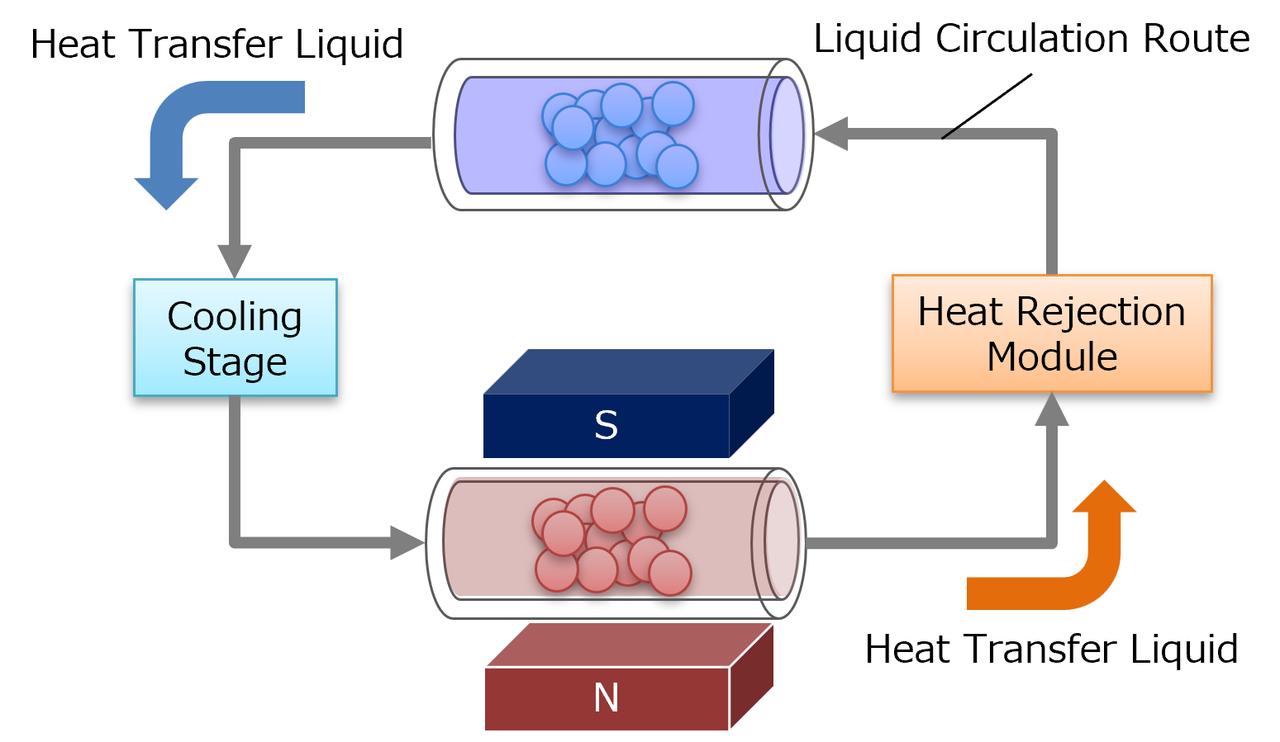
Schematic Diagram of a Room Temperature Magnetic Refrigeration System
Even just one magnetic material requires materials research on magnetocaloric effects when used in combination with rare earths and other elements. There is also the issue of how to procure high-magnetic-field permanent magnets made from rare-earth elements such as neodymium. If only neodymium magnets are used to create strong magnetic fields to get high output, the magnets alone would be expensive. Adopting them for consumer products like typical refrigerators priced at tens of thousands of yen presents a challenge to achieve a cost-performance balance. How to develop an apparatus to get high magnetic fields using materials abundant in the world is the key to practical applications.
Additionally, expertise in refrigerators as a refrigeration system is necessary. “To move our technologies from R&D into actual business applications, we need to think about how magnetic refrigeration can become a viable business. While exploring collaboration with group companies and external partners, I am conducting research toward the practical applications of magnetic refrigeration,” says Yamamoto about his initiatives beyond technical development.
From Applications Allowing Trade-Off Between Environmental Contribution and Costs to Practical Implementation
About the magnet cost issue, Yamamoto says, “I believe there is a potential solution in the effective use of existing materials. By devising appropriate combinations of permanent magnets, magnetic materials, and the structural design, together with proper magnetic circuit design, a high magnetic field can be generated efficiently while keeping the size compact.” But if the cost-performance balance is considered, applying magnetic refrigeration to products like consumer goods may be still in the distant future. Meanwhile, Hitachi is focusing on industrial applications. “I see potential for using this technology in cooling systems for high-value manufacturing equipment in plants. The idea is to use it as a highly efficient, refrigerant-gas-free cooling unit installed on existing manufacturing equipment. One possible application would be a cooling unit for chillers that circulate fluids such as cooling water,” says Yamamoto, looking ahead to the future.
What is at the bottom here is that if magnetic refrigeration is used for industrial purposes, the high introduction cost of a highly efficient, energy-saving cooling unit would not be a major disadvantage in the total system costs. Once the value of the environmental impact reduction from high-efficiency, refrigerant-gas-free cooling is recognized, he assumes that this will become the first step toward practical applications of magnetic refrigeration.
Practical applications of magnetic refrigeration involve various elemental technologies and challenges in realization. The cooling performance, the unit size, cooling temperature ranges and other requirements need to be identified to examine a target system thoroughly. “To do so, collaboration will be needed not only internally, but also with group companies and external partners. Through these collaborations, my primary focus is to realize cooling applications for large industrial equipment.” (Yamamoto)
Hitachi, while making use of its strength in magnetic materials and related magnetic application technologies, is going to drive research and development efforts for practical applications to realize magnetic refrigeration systems with higher efficiency and higher output. Furthermore, in collaboration with external material manufacturers and equipment manufacturers, the company is accelerating initiatives for social implementation of the magnetic refrigeration technology and trying to blaze a trail in the cooling technology that reduces environmental impact and enhances energy efficiency.
Naohisa Iwamoto (Editor in Chief, WirelessWire & Schrodinger’s)