News release overview
Hitachi develops new qubit control method to stabilize and extend lifetimes by a hundred-fold and more, accelerating development of quantum computers
Noise cancelling effect confirmed for qubits in silicon quantum computers
Tokyo, June 17, 2024 – Hitachi Ltd. (TSE: 6501; hereafter “Hitachi”) has moved a step closer to practical implementation of silicon quantum computer*1 by developing qubit control method that stabilizes qubits*2, and has confirmed that the lifetime of a qubit (quantum information retention time or quantum coherence*3) can be extended by more than a hundred-fold and more.
At least around one million qubits are considered necessary for a quantum computer to perform useful calculations, which is the reason why large-scale integration of qubits is said to be one of the key challenges of quantum computers. Along with this are the need to develop technology for precise control of qubits and the implementation of error correction*4. Silicon quantum computer, which has been the subject of Hitachi’s research and development, has high expectations for its compatibility with large-scale integration. However, the nuclear spin*5 of semiconductor atom generates noise and destabilizes qubits, complicating the implementation of quantum algorithms*6 and error correction.
Hitachi’s newly developed method modulates microwave phases used in qubit control to partially cancel the noise inside a semiconductor, stabilizing qubits and making it possible to extend their lifetime by a hundred times and more (Figure 1). This result is a significant step forward, not just in large-scale qubit integration, but also in the implementation of quantum algorithms and error correction and will spur the pace of research to bring practical implementation of a quantum computer that much closer.
Some of the results of the research will be presented at the 2024 IEEE Symposium on VLSI Technology and Circuits in Hawaii, from June 16 to 20.
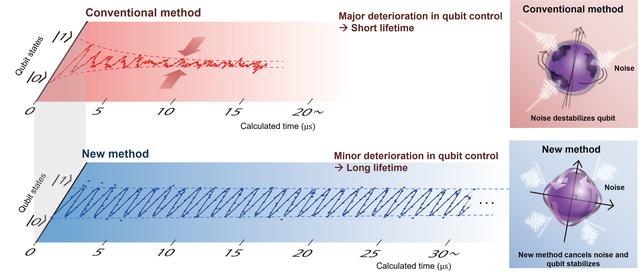
Figure 1
Upper: Qubit control results for conventional method (qubit spin destabilized by noise)
Lower: Qubit control results for new method (effect of noise reduced, movement stabilized, and qubit lifetime extended)
*1 Silicon quantum computer: A quantum computer based on the method of using electron spin inside silicon as a qubit.
*2 Qubit: A qubit (or quantum bit) is the basic unit of information in quantum computing. Making use of the superposition principle of quantum mechanics, a qubit can represent states of both 0 and 1 in any proportion
*3 Quantum coherence: The degree of quantum superposition between different quantum states. An index that shows the lifetime of a qubit.
*4 Error correction: Technology for correcting errors occurring in the process of quantum calculation. A theoretical qubit is represented by multiple qubits (redundancy) and the redundant qubits are used to detect or estimate error.
*5 Nuclear spin: Spin on an atomic nucleus. When electron spin is used as a qubit, nuclear spin interacts and causes qubit instability.
*6 Quantum algorithm: A quantum computer-specific calculation algorithm. Said to be capable of solving problems that a normal computer is unable to solve in a useful period of time.