Helping customers strengthen their competitiveness by making operations more efficient, including service quality planning and cost management
Hitachi has developed a Cloud Operations Maturity Model*1 that helps IT service operations teams focus on improving service value while reducing operational burdens and addressing IT workforce shortages in cloud-based IT service operations. The model standardizes and automates service quality planning, such as response times and error rates—an area that has traditionally relied on the operational know-how and intuition of operators in charge—as well as management of cloud usage costs, thereby optimizing operational tasks. Specifically, the model supports faster and more appropriate service quality planning and cloud usage cost management through standardized configuration of Service Level Indicators (SLIs),*2 centralized management of cloud usage costs based on the industry-standard FOCUS specification,*3 and anomaly detection for usage costs. Going forward, Hitachi will provide the model to a wide range of operators through cloud operations advisory service “Hitachi Application Reliability Centers (HARC)”*4 and other services to support greater efficiency in IT service operations and optimization of overall cloud operational costs. In addition, Hitachi will further promote operational efficiency by utilizing AI and customizing the model to suit customers’ operational environments, contributing to improved reliability and efficiency of digital infrastructure across society as one of the technologies supporting Lumada 3.0.
*1 Cloud Operations Maturity Model: A model that defines the ideal state of operations for each operational task involved in cloud operations across five maturity levels and serves as a guideline for assessment, operational improvement proposals, and the development of implementation and support tools. The progress of each task is evaluated as a level of maturity.
*2 Service Level Indicator (SLI): A metric for quantifying the quality and reliability of IT services and systems.
*3 FOCUS (FinOps Open Cost & Usage Specification): An open specification for standardizing usage cost data for IT services such as cloud services and SaaS (Software as a Service).
*4 Explore a New Era of Cloud Operations: Hitachi Application Reliability Centers (HARC): Hitachi Cloud [in Japanese]
Background and issues
As the use of cloud technologies as the foundation for digital services accelerates, companies and organizations are increasingly looking for operational frameworks that deliver high quality at low costs and high efficiency levels. However, the processes of configuring and managing service level and cloud usage cost indicators have traditionally depended heavily on individual expertise and required substantial effort. In addition, the worsening shortage of IT workforce has created major challenges in transferring operational know-how and maintaining stable operations. As DX (Digital Transformation) gains speed and IT utilization becomes increasingly sophisticated, there has been growing demand for a new cloud operations model capable of reducing operational burdens and enabling sustainable operational optimization.
Features of the technology and solutions developed to solve these issues
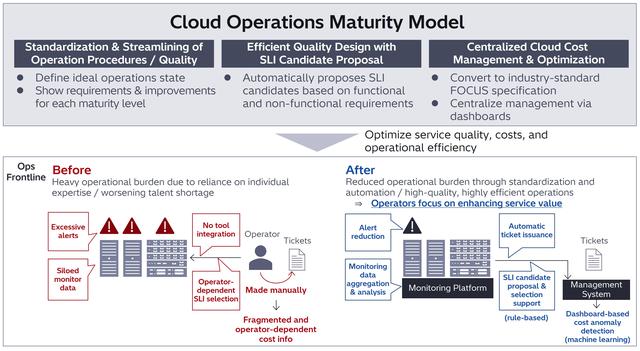
To address these issues, Hitachi developed a Cloud Operations Maturity Model that standardizes operations, reduces operational burdens, and helps IT service operations teams focus more on improving service value (Figure 1). By systematizing and standardizing operational procedures and Service Level Indicators (SLIs) required for cloud operations, the model provides a foundation for achieving stable operational quality without depending solely on individuals in charge. In addition, the model integrates technical elements such as automatic extraction of SLI candidates and centralized management of cloud usage cost data to make operations more efficient and improve cloud usage cost management. It also supports operational planning that mitigates fragmentation in operational environments, such as siloed monitoring data and increasing alert volumes. The key features are as follows:
1. Stable operations and reduced operational burdens through standardized operational procedures and quality management
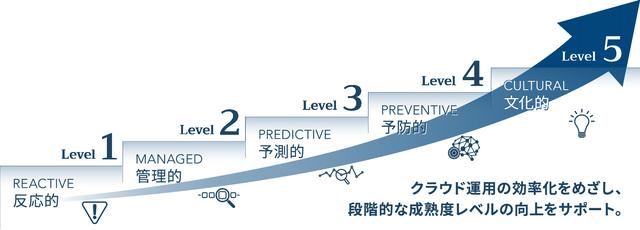
Based on the international standard IT service management framework ITIL4,*5 Hitachi established an operational maturity model that systematizes the operational assessment and improvement expertise cultivated through HARC. Specifically, the model defines the ideal state of operations across five maturity levels for each operational task involved in cloud operations, including service level planning, measurement, alert planning, on-call planning, initial response, escalation, and troubleshooting (Figure 2). It also organizes operational know-how such as operator actions, required tools, standards, issues, and improvement measures and standardizes them as operational rules. By presenting requirements and improvement measures for each maturity level (operational progress), the model makes it possible to standardize and streamline operations independent of individual operators, contributing to stable service operations while also reducing operational burdens in the field (Table 1). This also enables operational planning that minimizes fragmentation between tools.
2. Improved efficiency in service quality planning through automatic extraction of Service Level Indicators (SLIs)
Hitachi developed technology that automatically identifies appropriate SLI candidates according to the characteristics of systems such as IT services and applications operated in cloud environments by companies and organizations. Specifically, the technology automatically extracts suitable SLI candidates from a pool of 57 types via a proprietary rule-based algorithm that draws on functional requirements, including API*6 response times, error rates, and data consistency, as well as non-functional requirements, including availability, security, and throughput for specific systems and industries. This allows users to tailor service quality planning to the corresponding system and industry characteristics, which accelerates consensus building in operational environments and improves service quality. Furthermore, standardization and automation of operational environments improve work efficiency through automatic ticket issuance and other functions. In addition, the aggregation and analysis of monitoring data help reduce the burden associated with alert handling.
3. Centralized management and optimization of cloud usage costs based on the FOCUS specification
Hitachi developed a tool capable of automatically converting and integrating cost data from multiple cloud services into a unified format based on the industry-standard FOCUS specification. In addition, Hitachi established mapping tables aligned with the FOCUS specification and built a dashboard that enables centralized visualization and analysis of cloud usage cost data, including invoice item names, data structures, units, and notation formats that differ from cloud service to cloud service. This enables comparison of cloud usage costs by service and time period, while machine learning–based anomaly detection helps identify fluctuations in cloud usage costs that were previously difficult to detect at an early stage. As a result, the solution supports the management and optimization of cloud usage costs in multi-cloud environments and accelerates management decision-making.*7 It also helps reduce fragmentation of cost information and over-reliance on individual expertise in cost management.
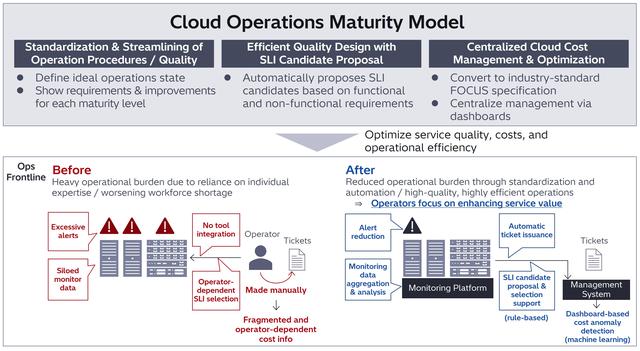
Figure 1. Overview of the Cloud Operations Maturity Model
| MATURITY | IDEAL STATE OF OPERATIONS (EXAMPLES) |
|---|---|
| Level 5 | False-positive and missed-detection rates are evaluated to reliably detect critical anomalies, while standards for reducing alert noise are continuously reviewed. Operational burdens in the field are minimized via standardization and automation. ⇒ Optimized alert planning |
| Level 4 | Based on historical records and data, alert noise is dynamically reduced without requiring individually defined rules, enabling quality improvement and efficient operations through automation. ⇒ Streamlined alert planning |
| Level 3 | Alert noise is reduced through aggregation of similar alerts and adjustment of alert triggering conditions. ⇒ Reduced alert volume |
| Level 2 | Alert noise that does not require action, such as alerts related to automatic recovery or scheduled maintenance, is filtered out. ⇒ Elimination of unnecessary alert noise |
| Level 1 (immature) | Alert planning is determined largely by individual operators, resulting in excessive alert noise that does not require action and making it easy for critical anomalies to be overlooked amid the noise. |
*5 Abbreviation for Information Technology Infrastructure Library 4. An international standard framework for IT service operations that provides best practices for operational processes and management methods.
*6 Abbreviation for Application Programming Interface. Interfaces (points of connection) and rules (protocols) that enable different software applications to exchange data and functions.
*7 Multi-Cloud Cost Management Platform with FOCUS | IEEE Conference Publication | IEEE Xplore
Looking Ahead
Going forward, Hitachi will expand deployment of this model to a wide range of customers through the cloud operations advisory service “HARC” and other initiatives to support greater operational efficiency and overall optimization of operational costs for IT services. In addition, Hitachi will further advance operational efficiency through AI utilization and customization of the model to suit customers’ operational environments. Hitachi will also strengthen collaboration with “HARC for AI,”*8 which maximizes the benefits of introducing AI agents, thereby contributing to enhanced reliability and efficiency of digital infrastructure across society as one of the technologies supporting Lumada 3.0.
*8 Hitachi begins providing “HARC for AI” to maximize the benefits of AI agent deployment: October 7, 2025 [in Japanese]
For more information, use the inquiry form below to contact the Research & Development Group, Hitachi, Ltd. Please make sure to include the title of the article.
https://www8.hitachi.co.jp/inquiry/hitachi-ltd/hqrd/news/en/form.jsp
Related information
Explore a New Era of Cloud Operations: Hitachi Application Reliability Centers (HARC): Hitachi Cloud [in Japanese]