
Masaya Tsunokake
Research & Development Group
Hitachi, Ltd.
Introduction
Large language models (LLMs) are increasingly being adopted in real-world enterprise operations. Many real-world applications require LLMs to work with proprietary knowledge in highly specialized and narrow fields — so-called micro domains.[1]
At Hitachi, we deliver solutions for mission-critical societal infrastructure, where accuracy, reliability and trustworthiness are essential. In such environments, standard LLMs often struggle to adapt to domain-specific knowledge, even as consistently high performance is required.
Domain-adaptive pre-training (DAPT) [2] is one approach to incorporate domain knowledge into LLMs. While DAPT has shown strong results in large domains such as healthcare and finance, its effectiveness in micro domains — where only limited training data is available — remains unclear.
In our recent paper [8], accepted for the EACL 2026 Industry Track, we address this question by examining not only final answer accuracy, but also where and why LLMs succeed or fail during the answer generation process.
Micro domain-adaptive pre-training (mDAPT)
To better understand the applicability of DAPT in highly constrained environments, we investigated its performance in a micro domain setting. We refer to this training setting as micro Domain-Adaptive Pre-Training (mDAPT).
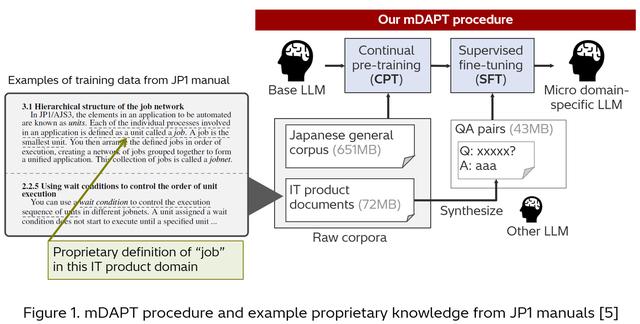
We evaluated mDAPT using a proprietary enterprise software domain. This domain provides an ideal testbed because the available documentation is highly specialized, and data volume is limited. Our mDAPT consists of two stages (see Fig. 1):
- Continual pre-training (CPT): Training the LLM on raw domain-specific corpora, such as IT product manuals
- Supervised fine-tuning (SFT): Training on synthesized question-answer (QA) pairs generated from those raw corpora, following approaches similar to prior studies [3, 4]
Multi-step evaluation framework to identify mDAPT bottlenecks
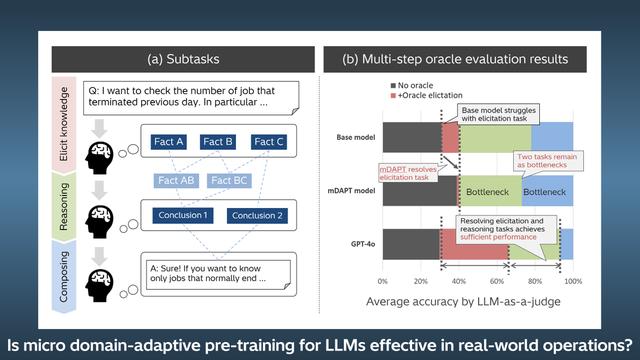
To understand where performance gains occur — and where limitations remain — we introduced a multi-step evaluation framework that breaks down the LLM answering process into three subtasks (see Fig. 2 (a.3)).
- Elicitation: Retrieving proprietary facts relevant to questions from an LLM’s knowledge
- Reasoning: Combining multiple facts to derive new conclusions
- Composing: Generating coherent, long-form answers based on the conclusions
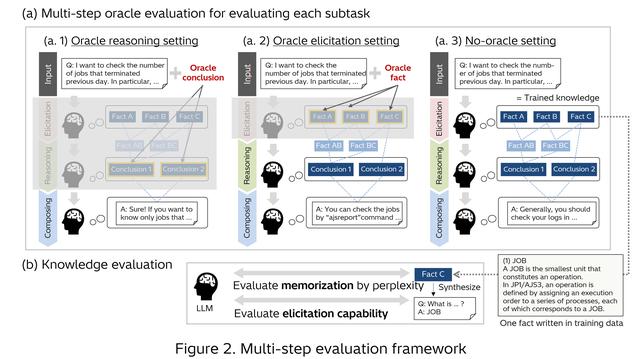
To clarify whether each subtask acts as a bottleneck, we then applied a step-by-step evaluation by inserting oracles — ideal intermediate outputs for specific subtasks — into the prompts. If the model’s overall performance improves when these oracles are inserted, it indicates that the LLM was unable to adequately solve the corresponding subtask on its own.
In addition to evaluating the full answering process, we also independently assess two foundational capabilities. First, we test LLM’s “memorization” to measure whether the LLM successfully memorized the proprietary facts by calculating their perplexity indicating how smoothly it predicts the texts of proprietary facts. Second, we test the LLM’s "elicitation capability" by asking simple questions synthesized from the proprietary facts to see how effectively it retrieves stored knowledge.
What mDAPT solves—and where challenges remain
We applied mDAPT in the JP1 domain [6], a typical enterprise software suite characterized by highly proprietary terminology and specifications. The trained LLMs were evaluated using real-world technical support questions for JP1.
Figure 3 summarizes the impact of mDAPT from two complementary perspectives: knowledge acquisition and downstream task performance. The left panel shows that mDAPT enhances both memorization and elicitation of proprietary knowledge, while the right panel reveals that, despite these gains, reasoning and composing subtasks remain key bottlenecks in end-to-end answer generation.
As shown in Fig. 3(a), both memorization and elicitation capabilities improve as the number of CPT epochs increases. Notably, the mDAPT model no longer benefits from the insertion of an elicitation oracle in Fig. 3(b), indicating that it can reliably retrieve proprietary knowledge on its own. In contrast, the base model still shows significant improvement when given this oracle. This indicates that mDAPT effectively resolves the elicitation bottleneck, and enhances knowledge acquisition and retrieval in real-world micro domain operations.
However, this improvement does not extend to all subtasks. As shown in Fig. 3(b), the mDAPT model’s performance still improves when reasoning and composing oracles are provided, indicating that these subtasks remain primary bottlenecks.
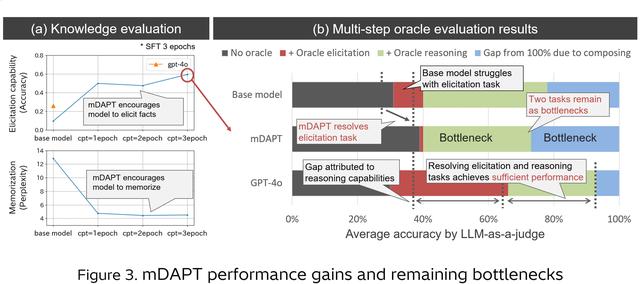
Further experiments using a more advanced model, GPT-4o [7] suggest that sufficient performance (exceeding 90%) could be achieved when both the elicitation and reasoning subtasks are effectively addressed — for example, by using a stronger proprietary model as the base model. Given that mDAPT already resolves the elicitation subtask, this highlights that strengthening reasoning capabilities over proprietary knowledge is a promising approach in realizing reliable AI performance in real-world enterprise operations.
Conclusion
Micro domain-adaptive pre-training (mDAPT) effectively injects proprietary knowledge into LLMs, but must be complemented by approaches that enhance reasoning and answer generation to achieve consistently high performance. Improving reasoning capabilities over proprietary knowledge will be key to developing reliable LLMs for enterprise operations.
By providing a structured framework to identify bottlenecks in the LLM answering process, this work supports Hitachi’s efforts to deploy trustworthy, knowledge-grounded AI systems for critical infrastructure. Readers interested in further details are encouraged to explore the full paper [8].
Acknowledgements
I would like to thank Yuta Koreeda, Terufumi Morishita, Koichi Nagatsuka, Hikaru Tomonari, Yasuhiro Sogawa, and Kana Ozaki for their valuable feedback. I would also like to thank Dr. Masaaki Shimizu for managing the large computational resources, and Hitachi Solutions, Ltd. for supporting this research.
References
[1] Y. Xue, M. Tsunokake, Y. Koreeda, E.M. Amin, T. Sumiyoshi, and Y. Sogawa. 2025. Agent fine-tuning through distillation for domain-specific LLMs in microdomains. Computing Research Repository, arXiv:2510.00482.
[2] S. Gururangan, A. Marasović, S. Swayamdipta, K. Lo, I. Beltagy, D. Downey, and N.A. Smith. 2020. Don't Stop Pretraining: Adapt Language Models to Domains and Tasks. In Proceedings of the 58th Annual Meeting of the Association for Computational Linguistics, pp. 8342–8360.
[3] Z. Jiang, Z. Sun, W. Shi, P. Rodriguez, C. Zhou, G. Neubig, X. Lin, W. T. Yih, and S. Iyer. 2024. Instruction-tuned language models are better knowledge learners. In Proceedings of the 62nd Annual Meeting of the Association for Computational Linguistics (Volume 1: Long Papers), pp. 5421–5434.
[4] I. Ziegler, A. Koksal, D. Elliott, and H. Schutze. 2024. CRAFT your dataset: Task-specific synthetic dataset generation through corpus retrieval and augmentation. Computing Research Repository, arXiv:2409.02098.
[5] Hitachi. 2025b. Manuals - Middleware - JP1.
https://itpfdoc.hitachi.co.jp/Pages/region/document_list/manuals/en/jp1v13.html (Accessed on 2025/07/30)
[6] Hitachi. 2025a. Integrated operations management JP1.
https://www.hitachi.com/products/it/software/prod/jp1/index.html (Accessed on 2025/07/30.).
[7] OpenAI (2024):. GPT-4o system card. Computing Research Repository, arXiv:2410.21276.
[8] M. Tsunokake, Y. Koreeda, T. Morishita, K. Nagatsuka, H. Tomonari, and Y. Sogawa. 2026. Is Micro Domain-Adaptive Pre-Training Effective for Real-World Operations? Multi-Step Evaluation Reveals Potential and Bottlenecks. In Proceedings of the 19th Conference of the European Chapter of the Association for Computational Linguistics (Volume 5: Industry Track), pp. 304–316.