

In “Biomanufacturing,” biotechnologies, such as those using enzymes and microorganisms, are applied to traditional manufacturing processes of the chemical industry. It is expected to help produce pharmaceuticals, regenerative medicine products, and low-environmental-impact materials and fuels. In “synthetic biology,” digital technologies including AI technology are fully used to optimize the substance production capabilities of microorganisms. The research and development in this area has great potential to contribute to achieving a sustainable society. And integration of information technology (IT), operational technology (OT), and product expertise—a prerequisite in synthetic biology—is Hitachi’s strength. We spoke about the next generation biomanufacturing with Kiyoto Ito, Manager of the Synthetic Biology Project, Next Research, Research & Development Group.
By Kazumichi Moriyama, Science Writer
Trends in Biomanufacturing Enabled by Synthetic Biology
Past economic growth has relied on manufacturing processes using fossil resources. Fossil resources, however, are directly influenced not only by climate change but also by geopolitical vulnerabilities, such as supply chain disruptions. To address these challenges, “biomanufacturing” using synthetic biology is drawing global attention as a means to solve social issues without halting economic growth. Biomanufacturing can simultaneously achieve resource autonomy independent of petrochemical processes and a Green Transformation (GX) that remains environment-neutral.
“Biomanufacturing” is a next-generation manufacturing technology that maximizes the productivity of useful resources. Biomanufacturing fully uses biotechnology and digital tools to artificially modify the metabolic networks in the cells of microorganisms, plants, or animals. This means a shift away from traditional chemical-centric manufacturing processes. By using genetic engineering and genome editing, biological metabolic pathways are designed, and useful compounds are efficiently manufactured. Biomanufacturing relies on biological processes, allowing production to be carried out at ambient temperature and pressure while using biomass, carbon dioxide, and other organic materials as raw materials. Therefore, compared with conventional manufacturing methods, biomanufacturing has the potential to reduce environmental impact, which is another reason for strong interest.
As seen in traditional Japanese fermented foods such as sake, miso, and soy sauce, the functions of microorganisms have long been utilized in manufacturing. Yeast and human cells have also been used in pharmaceutical manufacturing. Unlike traditional fermented food production and pharmaceutical manufacturing, biomanufacturing, on the other hand, requires stable control of complex biological reactions, as it must achieve high productivities or mass production demanded in the chemical and materials sectors. Therefore, the key lies in how to bridge the biological mindset to explore capabilities of organisms (science) with the mindset of process engineering to pursue stable production and scaling up (engineering).
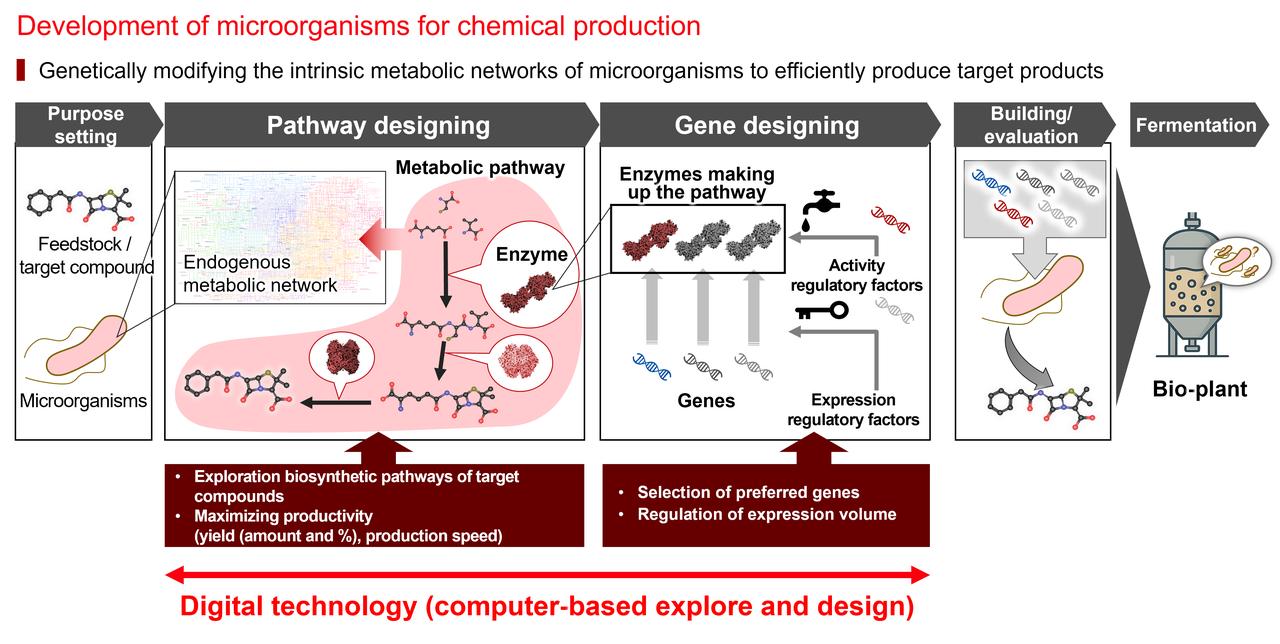
Applying synthetic biology and leveraging digital tools such as AI makes it possible to maximize the substance production capabilities of microorganisms.
The target market is multi-layered. A wide range of possibilities is envisioned from high-value-added sectors such as pharmaceuticals, regenerative medicine, and cosmetics—where profits can be secured even on a small manufacturing scale—to large-scale markets such as Sustainable Aviation Fuel (SAF) and biofuels/materials, where reducing manufacturing costs is key to market penetration. Hitachi promotes research and development of biomanufacturing using synthetic biology as the synthetic biology project.
Synthetic Biology Project by Hitachi’s Research & Development Group
The Synthetic Biology Project aims at practical use of organism-based manufacturing processes by leveraging AI and simulation technologies. Biotechnology has progressed in divided, specialized areas to decode complex biological reactions. On the other hand, the field of biomanufacturing, which applies these technologies, is relatively new, and the necessary knowledge and data are overwhelmingly lacking. This means AI for constructing logic, simulation technologies to complement missing data, and collaboration with multiple experts are crucial.
Hitachi is working on R&D to support biomanufacturing by creating digital twins of microbial behaviors during the culture and fermentation processes. The overall vision of this initiative is to combine “biological behavior modeling,” which mathematically models complex metabolic systems of organisms to quantitatively predict behavior, with “AI-enabled expert knowledge.”
As a first step, Hitachi is focusing on integration of real-world experimental data based on mathematical modeling to link changes of culture conditions and tank environments with the behaviors of microbial strains and cells. The company aims to incorporate its previously developed knowledge-extraction AI and technologies to utilize expert insight and have the technologies evolve into a highly practical culture/fermentation digital twin.
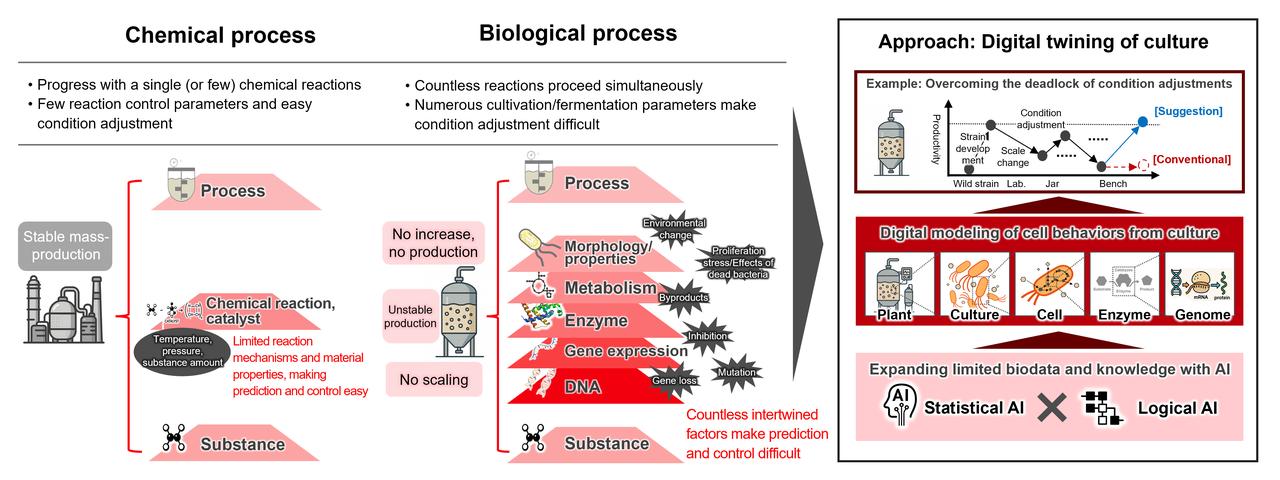
AI trained with vast amounts of knowledge from literature and other media has the potential to suggest optimal metabolic reactions and genetic modifications with an accuracy that surpasses experience-based knowledge. Hitachi’s current focus goes beyond using this learned knowledge just for strain design; it aims to model the strain behaviors in relation to changes of culture conditions and tank environments. Use of AI can fill in insufficient knowledge and data and build a model of complex culture and fermentation processes. This will break the development deadlocks, ultimately connecting the large-scale production capabilities of microorganisms (smart cells) to social implementation of biomanufacturing.
Hitachi has been developing powerful analysis and measurement technologies for a long time. Now, they serve as a foundation for obtaining data and building AI. That is one of the strengths of Hitachi.
Combining analytical and measurement technologies (operational technologies: OT) with AI and simulation technologies (information technologies: IT) serves a technical role in optimizing processes when scaling up laboratory-scale results into large-scale plant production.
Streamlining shikimic acid production improvement with digital technology
Hitachi’s quick shift toward developing its current cultivation and fermentation processes was backed by the accumulation of advanced digital technologies in the strain development phase, which the company has been working on.
One example is the improvement of the production of “shikimic acid,” a substance known as a raw material for influenza antiviral drugs. Microbial metabolic design improves target substance productivity by step-by-step modifications to a host microorganism (parent strain)—such as enhancing flux through the main pathway, suppressing unnecessary pathways, and reducing by-product formation. Modeling this design process yields a modification history tree: Parent Strain -> Modification 1 -> Modification 2 -> Modification 3 -> Next Move.
The challenge lies in identifying the “next move” to break through bottlenecks in strain development. At each modification step, researchers study immense volumes of literature to narrow down promising modification candidates. This process is dependent on individual researchers’ expertise, and only a limited volume of literature can be studied. To solve these problems, Hitachi developed a system that uses AI to replace literature searches and candidate gene identification.
(S. Nakazawa, et al., “History-driven genetic modification design technique using a domain-specific lexical model for the acceleration of DBTL cycles for microbial cell factories. “ ACS Synthetic Biology 10.9 (2021))
Two steps are involved in the method. In Step 1, modification candidates are automatically collected. With the input of the genetic modification history (a list of gene names, EC numbers, genetic modification types, etc.), relevant papers are searched and retrieved from literature databases. A key component is a literature evaluation model that quantitatively weighs the “domain relevance to metabolic engineering” of each paper. To do this, term frequencies in metabolic engineering literature are used to evaluate domain relevance.
In Step 2, the candidates are ranked based on their relevance to the history. The model extracts names of all genes from the collected papers and scores the candidate genes based on their “frequency of co-occurrence with genes in the design history.” The output is a ranked gene list accompanied by source literature, which researchers can use as candidates for the “next move.”
When this method was applied to the high-performing strain for shikimic acid production, gene candidates judged as “promising” by experts ranked near the top (verification conducted in 2020). Further, in an experimental validation, modification of four of the top suggested genes resulted in a maximum 19.5% increase in the titer of the shikimic acid produced. This implied the potential to break the world record. These results demonstrated that strain design, which previously relied on the “insight” or “intuition” of expert researchers, can now be streamlined using digital technology.
Building Models from Limited Experimental Data and Experts' Experience
In a joint study with the University of Osaka, Hitachi built a simulation model that mathematically describes metabolic fluxes within cells from a small amount of measured data to predict productivity. In biomanufacturing, it is very important to identify the bottlenecks (rate-limiting reactions) that lower the productivity of target substances from the innumerable reactions occurring inside a microbial cell. However, mathematically modeling all cellular reactions requires a huge number of parameters. In addition, there is an inherent challenge—the overwhelming lack of supporting experimental data.
To solve these issues, quantitative values from similar strains or culture conditions, as well as expert insights, were embedded into the built metabolic kinetic model as constraints, which allowed streamlining of parameter estimation and analysis. Empirical knowledge of biologists, “this substance accumulated in past similar strains,” for example, is used as a constraint. This enabled efficient estimation of parameters for each reaction and the prediction of reaction sites contributing to productivity improvements, even during early development stages when data is scarce.
When this method was applied to a system where succinic acid (a substance used as a pH adjuster in food additives and cosmetics) is produced using E. coli, the rate-limiting reactions were successfully predicted with the model built. When modifications were made to the gene at the rate-limiting reactions, an actual increase in production rate was observed, which demonstrated the model’s effectiveness.
In the ongoing culture/fermentation digital twin project, these technologies that model intracellular reactions and culture condition responses from small data serve as the foundation to support behavior prediction during culture condition optimization and scale-up.
Bridging the “Biology” and “Chemical Manufacturing Processes” through Digital Technology
Hitachi views the biotechnology field as a next growth driver for achieving a sustainable society. Its greatest motivation is decarbonization and resource diversification by moving away from petrochemical processes.
The ultimate goal for industrial implementation is to combine Hitachi's strengths in IT, OT, and products to provide digitalized knowledge to not only biologists but also to people unfamiliar with biology, such as those in the chemical sector, or to build a bridge between biology and chemistry: “connecting the world of biology with chemical manufacturing processes.” To solve the challenges that arise when scaling up lab-level research results into factory-scale plant production using digital technology, we must visualize the complex biological reactions occurring inside culture tanks and plants and build an environment where even process engineers with little specialized biological knowledge can control and operate the system.
Although it would be ideal if we can freely produce any substance with clear market needs through biotechnology, reality is not quite there yet. The application of digital technology and AI in biomanufacturing is still developing. However, “next-move inference” using these approaches can serve as a powerful tool to turn the tasks that have traditionally relied on the experience of expert researchers into tasks objectively visible and reproducible. Going forward, Hitachi plans to expand the scope of this knowledge application into process development—the key to commercialization—to accelerate the social implementation of biomanufacturing.
“We are aiming for social implementation in domains where market needs match the advantages of biological production,” said Kiyoto Ito. Let us await the “follow-up reports,” which should arrive soon.