
Railway-related technology focuses on the three pillars to achieve safety and comfort—development of rolling stock, development and maintenance of tracks and other infrastructure, and development of traffic management systems. Japan’s railway-related technology, as is widely known, supports the world’s highest levels of safety and punctual operations. However, the reality is that there is still much room for technical development in regard to energy efficiency improvement, which is the challenge of delivering maximum performance with minimum energy.
To address this, Hitachi is working on the research and development of a railway driver advisory system (hereinafter referred to as railway DAS), which proposes the optimal timings for acceleration/deceleration and coasting to drivers in real time from the perspective of punctuality and energy efficiency by taking into consideration line conditions such as gradients as well as the train schedule. Despite its potential to reduce energy consumption by 10% or more, this solution is still under development due to practical operational challenges. Nevertheless, it is expected to pave the way for a transition toward the ultimate form of energy-efficient automatic train operation (ATO) while expanding its scope of optimization to the entire railway system including power systems and passenger flows. The interviewer spoke with Chief Researcher Kentaro Maki and Manager Atsushi Oda, Autonomous Control Research Department, Mobility & Automation Innovation Center, Digital Innovation R&D, Research & Development Group about the progress on the railway DAS.
By Kazumichi Moriyama, Science Writer
Approach to Energy-efficient Railways
Railways are generally said to be a low-environmental-impact mode of transportation. However, further energy efficiency improvements are becoming an essential requirement for trains today, driven by various factors—environmental considerations, soaring electricity prices, unstable fuel costs, and dedication to enhancing the business foundation by reducing operational costs, among others.
In a train, driving energy used for traction accounts for approximately 60% to 70% of total energy consumption. There are two major means for reducing driving energy consumption. One is hardware improvement. This includes improvements of rolling stock itself such as reducing its weight and running resistance, as well as increases in efficiency of electric power regeneration systems and other onboard equipment such as motors. Significant energy savings have so far been achieved through these improvements. However, in practice, they can only be implemented when new trains are introduced or the equipment undergoes major updates.
The other is driving optimization. This approach can be implemented on existing trains without requiring the introduction of new trains or major equipment upgrades. Besides, it is expected to significantly reduce energy consumption in the order of 10%. This is where the railway DAS comes into play.
DAS Presenting Optimal Driving Operations in Real Time During Driving
The DAS is a driving support system that proposes optimal driving operation to drivers in real time from the perspective of punctuality and energy efficiency. Based on real-time data acquired from a train control and monitoring system (TCMS) and prior simulation results, the DAS assists drivers by providing the optimal target speed and the coasting timing.
Meanwhile, several other solutions for driving optimization are already widely adopted on-site. One example is conducting a review of collected and visualized driving performance data (position, speed, and power consumption) in a PDCA cycle to utilize the data for post-driving analysis and improvements. Another is displaying real-time information related to fuel economy such as eco-indicators in the cab to increase drivers’ awareness of energy-efficient operation.
Unlike these solutions, the DAS is an immediate support system that, instead of recording data for a review, provides real-time advice on the optimal timings for accelerating, coasting, and braking through on-screen display or audio guidance.
Energy-efficient driving profiles presented by Hitachi’s railway DAS are generated by making adjustments among multiple profiles so as to increase energy efficiency while meeting the target driving time, using the fastest driving profile within the speed limit as a reference. Specifically, the system limits the maximum speed to reduce unnecessary acceleration and lower the speed during constant-speed running, and employs frequent coasting on downward gradients and before braking, thereby minimizing powering (acceleration) energy consumption.
Put simply, it is like the train thinks about when and how far to accelerate while running. Case studies of introducing this system in Japan demonstrated a 16.4% energy efficiency improvement at Tokyo Monorail and up to 12% at Keio Corporation (the details will be described later).
The DAS consists of three core technologies. The first is an integrated simulation technology for a railway system that comprehensively replicates rolling stock, electric power, and signals. It is called a simulator for railway unified solutions (SiRUS), which can accurately simulate power consumption within an extremely small margin of error of 6%. The second is an online monitoring technology for transmitting and analyzing real-world driving data. It enables optimization based on hybrid data consisting of simulated and measured values. The third is a technology for generating energy-efficient driving profiles, which has been researched by Hitachi for its railway business since the 1980s. It can derive a driving profile that achieves both punctuality and energy efficiency under various line environments.
System Configuration and Core Technologies
The railway DAS collects dynamic real-time data such as the train’s current position and speed and the voltage of overhead wiring from the TCMS. It then integrates the data into a driving profile database, which contains the results of prior comprehensive simulation for forecasting what happens when driving operation changes at each location based on information such as the track shape, train performance, and schedule, thereby deriving the optimal—or most energy-efficient—driving profile.
The driving support information is presented to drivers on existing monitors or general-purpose terminals such as smart devices. The implementation only requires adding software to the existing TCMS, and thus the initial costs are relatively low, which is another advantage of the DAS.
Regarding the user interface (UI), various options are available to meet operators’ operating environments and users. One type indicates the target speed and the current speed with a round display design to intuitively convey whether to coast or accelerate to the driver; another type has a scrolling display like that of a video game to provide guidance. Although various forms of information presentation were tested in the initial development stage, the final form was designed to allow optimal information presentation suited to on-site operations through incorporation of the drivers’ opinions.
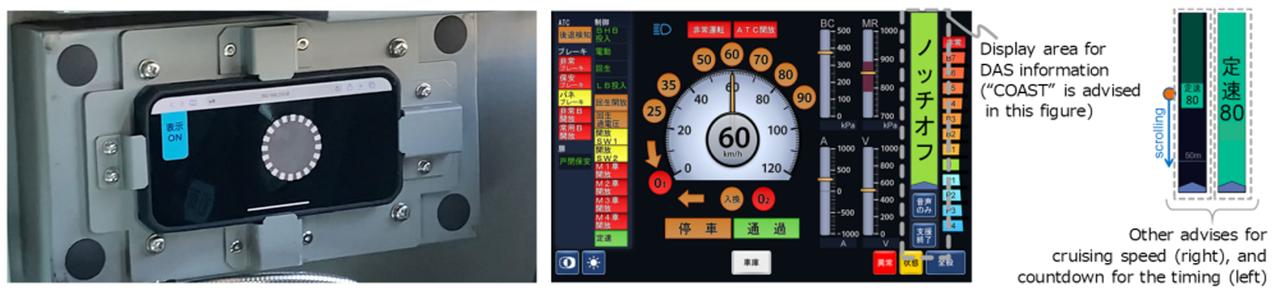
Driving support guidance screen (left: round display; right: scrolling display)
The Challenges of Driver Acceptability during Delay Recovery Operations and Deviation between Driver Experience and Computer-generated Optimal Profiles
Does the DAS work in a real world? In a trial run conducted by Tokyo Monorail on a series 10000 train, the results found that the energy consumption was reduced by 16.4%, with the maximum reduction rate between two stations reaching 26.8%. Keio Corporation also confirmed a 12% energy consumption reduction in a 9000 series train as long as the driver compatibility (compliance) with the presented profile was high. Regarding the impact on punctuality, Tokyo Monorail’s trial showed that a delay relative to the target travel time was approximately 3 seconds, demonstrating that operations within the permissible range (±5 sec) are possible. In addition, excessive high-speed driving was suppressed.
However, there is an issue with practical operations. Maki said, “The railway DAS is still under development. Improvements are required from now on.” He also noted that the driver compatibility is not high in the system, which means, in short, that the calculated optimal profile does not align with drivers' practical feel. In particular, during delay recovery operations when a train is running behind schedule, drivers prioritize fastest driving. As a result, the compatibility declines because the DAS support stays focused on energy-efficient driving.
Another issue is driver acceptability. Advice provided by the DAS may differ from drivers’ usual driving profile. The system sometimes deviates from skilled drivers’ experience, leading them to voice complaints such as: “It is not how we usually drive.” This also poses the risk of increasing psychological and safety burdens due to the need to check the UI screen during driving. In particular, drivers usually make very fine adjustments to ensure passengers’ riding comfort, and their experience-based operations often outdo operations following DAS support.
By reflecting on-site constraints such as riding comfort in the simulation through active communication with the drivers, Hitachi is aiming to achieve acceptable optimization in order to continue to produce steady effects without sticking to optimal values. This is backed by the researchers’ judgement, as seen in their comments: “We are coordinating with drivers to find out what kind of driving profile they prefer to use. This may result in diminished power saving effects, but still, far better results than those without this system have been demonstrated.”
Going forward, Hitachi will incorporate the on-site constraints in the simulation to build up steadier effects. By striking the right balance between “machine optimization” and “human acceptability,” the company will aim to develop a hybrid system that harmonizes theoretical numerical optimization with human receptivity.
Toward Future Optimization of the Entire Railway System
Hitachi has strengths in reliable physical AI by utilizing its physics-based simulation technologies while making full use of the possibilities of AI. Currently, the railway DAS is intended for single-train operation, but at the same time, it must serve as an important step toward future energy consumption reduction in the ATO system. The ATO system, which requires improvements in rolling stock or other hardware, presents high hurdles in terms of cost and equipment. Therefore, in the coming 5 to 15 years, the railway DAS will be a key step toward energy-efficient autonomous driving due to its installability to existing equipment, according to the researchers. In other words, the DAS is midway to ultimate energy-efficient autonomous driving.
Looking ahead, Hitachi aims to further optimize the entire railway-related system—going beyond a single train to include train fleets comprising preceding and following trains, power systems for supplying power from substations, and constraints such as station congestion and passenger flow. By leveraging expertise in the railway DAS and other control technologies that have so far been cultivated by Research & Development Group, the company seeks to connect ground facilities to rail mobility and enhance the energy efficiency and punctual operations of the entire railway system.