
As is widely recognized, advances in digital technology, driven primarily by AI, continue to accelerate. While smartphones and generative AI have certainly become widespread rapidly, new technologies and services are not necessarily accepted by society. New challenges accompanying the spread of technology have also emerged, including concerns about privacy violations, the fragmentation of information spaces, and the risk of leaving behind those with limited access to or proficiency in digital technologies.
In response, Hitachi’s Research & Development Group is researching methodologies for making technology an integral part of society. One outcome of this research was the “activity patterns for social implementation” introduced in 2024. Hitachi is now building on these patterns to develop “Social Implementation RAG.” We spoke with two members of Digital Innovation R&D—Tatsuya Nakae, Ph.D., Senior Manager of the Business Architecture Research Department, Systems Innovation Center, and Atsuko Bandou, Design Lead in the Strategic Design Department, Design Center—about this initiative.
By Kazumichi Moriyama, Science Writer
Accelerating Digitalization and the Barrier to Social Acceptance
Traditionally, innovation has focused on “introducing technology into society”—deploying technologies only after they have been fully developed. However, as accelerating digitalization brings a succession of new technologies and services into society, ensuring that people use them appropriately and with full understanding and acceptance requires moving away from “unilaterally introducing technology into society” and instead “working with society to introduce technology as part of society.”
Technical superiority alone does not determine whether a new service succeeds or fails. Enhancing social acceptance by gaining the understanding of diverse stakeholders, including government agencies, local authorities, and users, and coordinating with them has become a key prerequisite for realizing innovation. However, the knowledge required to achieve this often remains buried in the personal experience of those involved. To address this issue, Hitachi is developing “Social Implementation RAG” (Retrieval-Augmented Generation), a system that enables generative AI to leverage experiential knowledge of social implementation.
“Activity Patterns for Social Implementation” to Help Innovation Take Root in Society
Through its involvement in numerous new business ventures, Hitachi has accumulated a wide range of knowledge, encompassing not only technologies themselves but also ways of engaging stakeholders. However, Nakae and Bandou were concerned that this knowledge had not been sufficiently codified within Hitachi and, as a result, was not being used effectively. The result was the “activity patterns for social implementation,” a codified body of knowledge that consolidates practical know-how on the non-technological aspects of making innovation an integral part of society, including legal and cultural considerations and consensus building.
In new business ventures and infrastructure projects, barriers arise not only from technical challenges but also from issues involving people and organizations. Who needs to be brought on board, and how can trust be built with them? How should existing institutional frameworks and regulations be navigated? Practical know-how about social implementation often remains tacit, residing with individuals and depending on their dedication and fortuitous circumstances. The “activity patterns for social implementation” were designed to transform this know-how into generalizable knowledge that can be applied throughout the organization.
Specifically, they set out actions for overcoming non-technological challenges, such as complying with laws and regulations, adapting to social norms (culture and practices), establishing rules, and coordinating with stakeholders. They also provide concrete guidance on engaging in dialogue with society to make technologies an integral part of it, rather than simply introducing them into society. To develop the patterns, Hitachi analyzed 21 past co-creation projects, including both successes and failures, and distilled the findings into 24 practical patterns presented in a “pattern language” format organized around situations, problems, and solutions.
The more widespread digital technologies become, the more change and adjustment are required at various levels of society, including laws and regulations, culture, practices, and trends. To organize and share this non-technological knowledge, the research team turned to the concept of a “pattern language,” proposed by architect Christopher Alexander. It is a method for organizing the experience-based insights of accomplished practitioners into a common language that anyone can use.
Hitachi applied this concept to social implementation, developing a card-based knowledge framework, a pattern language tailored to social implementation, that can be used according to the circumstances and challenges of each project.
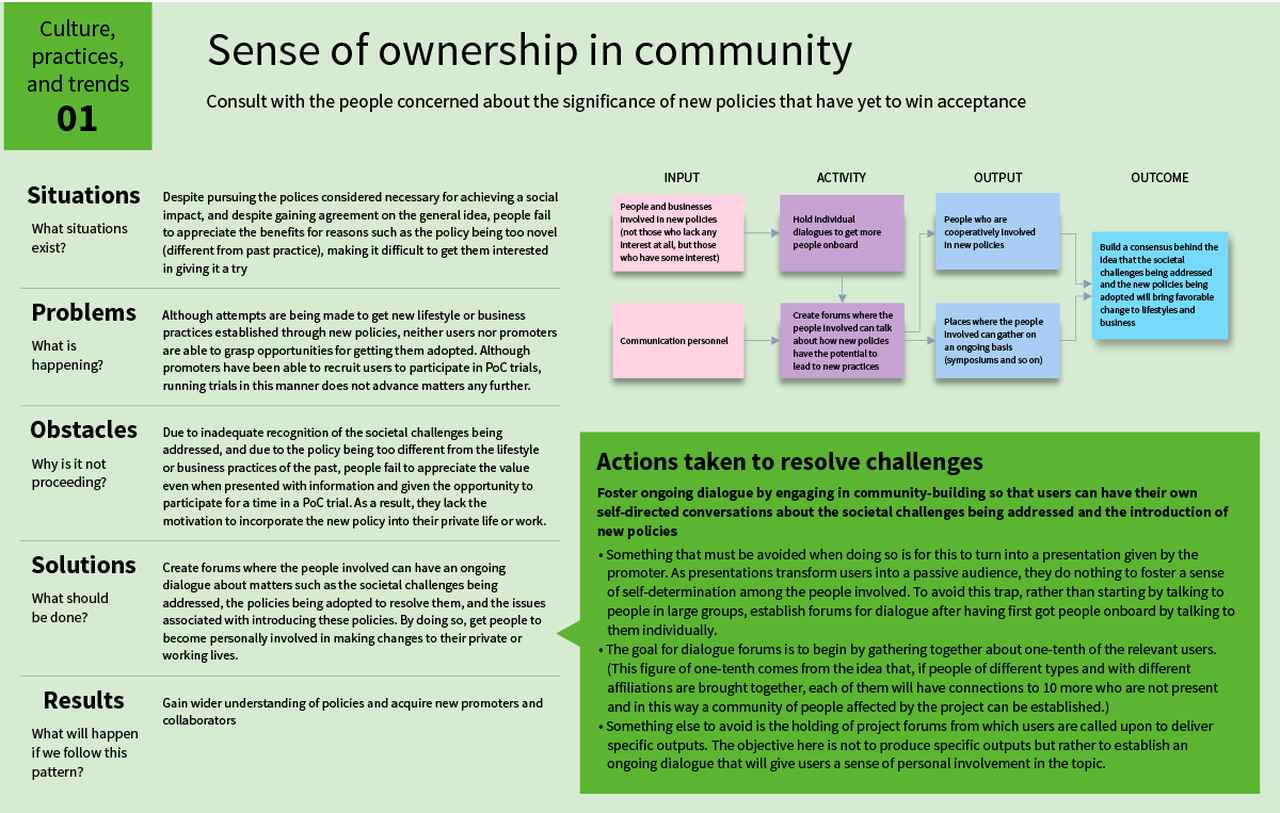
Example of an activity pattern for social implementation
Through this process, Hitachi codified knowledge on non-technological aspects, encompassing responses to developments in laws and regulations that go beyond mere compliance; adaptation to social norms, including culture, practices, and trends; rulemaking and governance across organizational boundaries; and know-how related to coordination with stakeholders, including building trust and aligning expectations among the parties involved.
These patterns are intended to help practitioners think through the issues they encounter when pursuing new business ventures and social implementation projects. However, as efforts were made to promote their use within Hitachi, new challenges came to light.
Having Knowledge Is Not the Same as Knowing How to Use It
The most significant issue was that people had the knowledge but did not know how to put it to effective use. Users identified three main challenges.
First, users were unsure how to find suitable co-creation partners. Addressing societal challenges requires collaboration with a diverse range of organizations, but determining whom to approach and what kind of relationships to build is not straightforward.
Second, users found it difficult to translate the knowledge into specific actions. Because the patterns are expressed in generalized terms, users must interpret them in the context of their own projects. As a result, they may be unsure what to do next, causing progress to stall.
Third, users lacked insight into the context underlying successes and failures. For example, simple summaries struggle to convey such important details as why partner companies agreed to collaborate, how internal sponsorship was sustained, and how expectations were managed. Meaningful learning cannot take place without an understanding of the broader context and narrative.
This led to the development of “Social Implementation RAG,” a system that uses Retrieval-Augmented Generation (RAG).
“Social Implementation RAG,” an AI That Acts as an In-house “Living Encyclopedia”
RAG is a technique that combines a large language model (LLM) with an external knowledge base to generate more accurate responses. “Social Implementation RAG” is a generative AI service that supports innovators at Hitachi by drawing on a database of narrative accounts of past successes and failures. In short, it is a system that enables generative AI to draw on past project case studies.
The process begins with in-depth interviews covering both successful and unsuccessful projects. Information on project overviews, hypotheses, validation results, key decisions, stakeholder relationships, unexpected developments, and pivotal events is organized and stored as detailed, long-form case studies. The team then built a knowledge database and connected it to generative AI, enabling users to consult the system for advice.
For example, if a user asks, “I want to pursue a co-creation project with a railway company, but I am concerned about whether older adults will be able to use the digital service effectively,” the system searches for similar cases and presents the problems encountered and solutions applied in those cases. It can also explain the insights derived from those cases in a way tailored to the user’s circumstances. In effect, it serves as a one-stop internal support service.
In essence, this initiative seeks to make the experiential knowledge of seasoned professionals within Hitachi accessible through generative AI. It could be described as an attempt to use AI to replicate the role of an in-house “living encyclopedia” or mentor.
There are, in fact, people with extensive project experience throughout Hitachi. However, access to their knowledge depends on personal networks and organizational affiliation. “Social Implementation RAG” is designed to bridge this gap.
The Challenge of Framing Questions Cannot Be Solved by RAG Alone
While the effort to codify lessons learned from failure was highly regarded as addressing a challenge shared across many departments, internal trials also revealed further limitations. The obstacle they encountered lay in users’ limited ability to frame questions.
The greatest challenge was that users needed a broad range of background knowledge to formulate questions for the RAG system. “At each stage of a project, those responsible need to understand what the stakeholders know and what they are trying to achieve; otherwise, they will not know what questions to ask.” Without insight into stakeholders’ unspoken intentions and expectations, which constitute the tacit knowledge of those on the ground, or sufficient situational awareness, users do not know what to ask the AI in the first place.
Moreover, maintaining situational awareness becomes increasingly difficult as the number of stakeholders grows. The research team therefore believes that, in the future, it may also be necessary to use AI agents that model the perspectives and expectations of individual stakeholders.
A similar challenge arises in interviews conducted to capture this knowledge. The value of “Social Implementation RAG” lies in documenting not only success stories but also the struggles, failures, and decision-making processes behind them. However, eliciting such tacit knowledge requires advanced interviewing skills.
Why was that decision made? What were they afraid of? What objections were raised? What factors contributed to the project’s success? If these questions are not asked at the appropriate time, the most important insights may never come to light. The research team is therefore also exploring the potential of an “AI interviewer” designed to augment the skills of human interviewers.
In short, a significant gap remained between accumulating knowledge and putting that knowledge to use. At a fundamental level, people cannot ask questions about what they do not know. Going forward, it will likely be important to develop not only systems for retrieving knowledge but also systems that help people formulate the right questions.
Knowledge for Navigating “Social Systems”
Profitability is one of the key indicators used to assess the likelihood of successful commercialization and social implementation. How to incorporate economic outcomes is another important consideration in making knowledge about social implementation more useful. The research team also captures information on business models and revenue structures as part of the knowledge base.
However, “Social Implementation RAG” serves a different purpose from conventional sales support systems. Hitachi also maintains a knowledge base containing materials that can contribute to relatively short-term business results, such as proposals and collections of case studies. In contrast, “Social Implementation RAG” has a much broader scope across time and space and across networks of stakeholder relationships. It encompasses the body of knowledge required to transform social systems themselves, including laws and regulations, culture, social practices, and relationships with government authorities.
In other words, “Social Implementation RAG” can be described as a repository of knowledge on how to navigate broader social systems that extend beyond conventional company-customer relationships. This is what was meant at the outset by “introducing technology as part of society.”
To Continue Building Trust with Society
The research team believes that “there is no definitive methodology or guide for social implementation.” The stakeholders to engage, the business model to adopt, and the value proposition to offer differ from project to project. There is no universal framework or manual that guarantees success.
Ultimately, projects are driven forward by the dedication of those involved, their willingness to roll up their sleeves and tackle challenges head-on, and serendipitous encounters with others. Yet that is precisely why records of the hard work, struggles, and painful failures of those who came before are so valuable. The barriers encountered by others in the past can be revisited as a source of knowledge. The AI presents the many struggles faced by their predecessors in narrative form, enabling users to relate those experiences to their own situations and internalize the lessons. The research team suggests that this process itself may be crucial to innovation.
As technology continues to evolve, many new developments will arise in the relationship between people and society. “Making technology an integral part of society” is fundamentally about building trust with society. “Social Implementation RAG” may represent the first step toward accumulating and passing on both the practical wisdom needed to help society accept technology and the experiential knowledge needed to bridge the many divides within society.