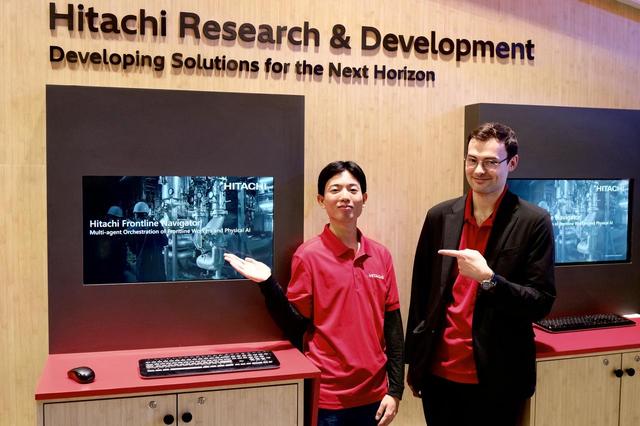
A Conversation with Yasunori Hirakawa and Adrien Gregorj of Hitachi R&D
A major challenge facing Japan and other advanced economies is the growing shortage of frontline workers driven by a declining labor force and the difficulty of passing on expert skills from experienced professionals to the next generation.
To address these challenges, Hitachi has developed the AI Partner designed to support frontline workers in real-world operational environments.
Hitachi’s AI Partner was showcased at CES 2026 in Las Vegas and it has attracted significant attention around the world.
At CES 2026, Yasunori Hirakawa and Adrien Gregorj, researchers behind the development of the AI Partner, spoke about its core features, the journey to building this innovative AI agent, and their vision for the future.
Enabling Frontline Workers to Work More Efficiently and Safely
Q: Could you tell us about Hitachi’s AI Partner?
Hirakawa:
One of the most pressing global issues today is the shortage of frontline workers due to the declining labor population. In many operational sites, workers are required to perform tasks at night or in hazardous environments. This can place a significant psychological burden on frontline workers.
In addition, transferring the advanced skills of experienced workers to the next generation takes time, and those skills aren’t adopted so easily. This raises serious concerns about how to maintain the quality of on-site operations.
If these challenges persist, it may become increasingly difficult to sustain operations that rely solely on human labor—and, by extension, to maintain the societies and lifestyles we have come to expect.
Against this backdrop, we began exploring whether digital technologies such as AI and the metaverse could be used to support frontline workers, enabling them to perform their tasks more efficiently and safely.
Navigating the Frontline with AI
Adrien:
We developed the AI Partner as an AI agent that supports decision-making in on-site tasks such as manufacturing, inspection, and maintenance. From a technical perspective, the solution has the following key features:
Key Technical Features
・On-site augmentation and task support through the integration of AI agents and metaverse technologies
・A risk and hazard prediction support system that visualizes site-specific risks and recommends mitigation measures
・Visual guidance that highlights work procedures and potential hazard points within 3D models
・Multimodal AI technologies, including acoustic analysis and image recognition
・Automatic extraction of expert knowhow from interviews and documents, consolidated into a structured knowledgebase
・Transparent and explainable decision-making enabled by multi-agent AI
Hitachi has long been engaged in businesses focused on Operational Technology (OT), accumulating structured expertise from experienced professionals—including causal knowledge, practical know-how, intuition, and hands-on experience.
The AI Partner integrates all of this knowledge, enabling it to truly understand on-site conditions. It can intuitively communicate context-specific instructions to frontline workers by visualizing procedures and equipment locations within a virtual space.
This approach improves the efficiency of less-experienced workers while also enhancing their psychological safety.
Furthermore, frontline workers can use the Partner to collaborate with remote experts within a metaverse environment, sharing information as if they were working together in the same physical location. In this way, the solution connects on-site knowledge with people, serving as a trusted “collaborator” that facilitates smooth communication.
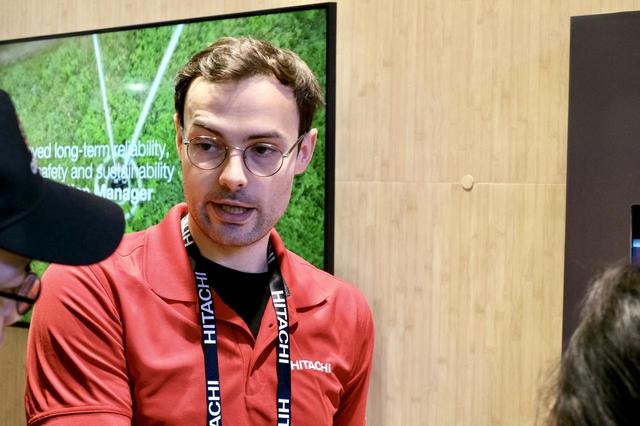
Adrien Gregorj
Why Hitachi Can Capture Tacit On-Site Knowledge: Decades of OT Expertise
Adrien:
During its development, we conducted in-depth interviews with experienced professionals in Hitachi’s OT domains to extract tacit knowledge, which includes practical tips, intuition, and experiential know-how.
While many companies are working on AI agents, Hitachi’s deep expertise in OT enables us to extract this tacit knowledge and transfer it into AI systems. This is one of our key strengths.
In addition, Hitachi is actively engaged in robotics research, enabling us to combine AI with robotics. We believe the AI Partner will demonstrate strong potential in the evolving field of Physical AI.
Designing Technology That People Will Actually Use
Hirakawa:
While developing the Partner, we also placed strong emphasis on usability and user interface design. We believed that if we were going to build this technology, it had to be something people would genuinely want to use in real operational settings.
To achieve this, we worked closely with Hitachi’s design teams and continuously refined the user interface. Developing from the user’s perspective—and ensuring the technology is truly usable on-site—is one aspect of what makes Hitachi’s approach distinctive.
Connecting Experts, Workers, and Robots
Q: How will the AI Partner change the way workers operate?
Hirakawa:
Imagine a future where a single expert oversees multiple factories. If a sensor detects an abnormality in a piece of equipment, an autonomous robot patrolling the site can move to the location, capture images, and send them remotely.
After reviewing the images, the expert may determine that the task typically requires two people—but only one worker is currently on-site. In such cases, the expert can remotely summon a nearby robot to assist with the task.
In addition, the Partner records not only robot sensor data but also data from sensors embedded in workers’ uniforms. This information is accumulated as knowledge within the metaverse, along with logs of how experts operated the robots. Over time, real-world operational data itself becomes a valuable source of learning for autonomous robots.
By connecting frontline workers, remote experts, and robots, the Partner acts as a bridge that enables tasks to be completed safely and efficiently.
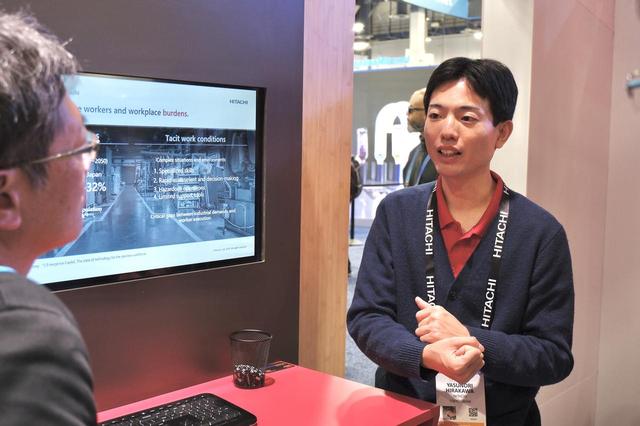
Yasunori Hirakawa
Demonstrated Results and Feedback from the Field
Adrien:
In internal demonstrations at Hitachi, the Partner was able to improve the task execution capability of less-experienced workers by approximately 30% and reduce issue resolution time as well.
These results indicate that the solution can reduce psychological stress for frontline workers and contribute to improved well-being and stronger on-site performance beyond physical constraints. Going forward, we aim to apply the Partner in areas facing particularly severe labor shortages, such as plants and substations.
Reactions from CES 2026
Q: The AI Partner was showcased at CES 2026. What kind of reactions or feedback did you receive from visitors?
Hirakawa:
The Hitachi booth was extremely lively throughout the event. We were constantly approached by visitors and found ourselves explaining the solution again and again—it was that kind of atmosphere.
At CES, we spoke with people from a wide range of industries, and regardless of their field, many of them strongly felt that labor shortages at on-site operations are a serious challenge. Seeing this shared sense of urgency across industries left a strong impression on us.
Adrien:
CES is held in Las Vegas, but the audience is truly global. We met visitors not only from the United States, but also from Japan and many other countries, which really highlighted the international nature of the event.
Some people came specifically to the Hitachi booth to learn more about the AI Partner. From these interactions, we felt that the solution—and Hitachi’s initiatives in Physical AI—are attracting growing attention on a global scale.
“Supporting Frontline Workers” — That Is Our Core Motivation
Q: Finally, could you tell us about the AI Partner’s future evolution and the vision you are aiming for?
Hirakawa:
We want the Partner to connect not only with robots, but with all kinds of equipment. In a factory, if all machines and robots were connected to the solution, it could monitor operating conditions, collect all relevant data, and respond to alerts automatically.
In such a future, simply asking the Partner a question would allow it to explain the entire operational status of the factory, while robots automatically handle flagged issues. This would enable people to focus on more essential, value-added work.
Adrien:
We also want the AI Partner to understand physical space. For example, if a worker asks where a specific piece of equipment is located, it should be able to provide clear, human-like guidance.
The Partner is not a technology designed to replace frontline workers. It is a solution created to support them. We want to preserve the know-how and experience of skilled professionals. That belief is our motivation—and our driving force.