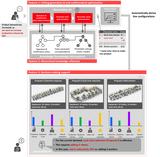
Automatically constructs diagnostic models from equipment manuals and incorporates on-site findings to present probable causes of failure in order of probability
Hitachi has developed an AI-based failure identification technology that leverages AI to analyze equipment manuals and identify possible causes of failures, enabling maintenance personnel at equipment manufacturers and factories using the equipment to respond quickly to equipment issues. Conventional failure-identification systems have typically relied on machine learning*1 to identify probable failure causes based on historical records of on-site failure and corrective actions. However, when implementing these types of systems, personnel would need to read the manuals for each equipment model and manually define the relationships between causes and symptoms, requiring significant labor. Additionally, on the operational side, the process tended to rely heavily on the experience of individual personnel, resulting in inconsistent decisions and responses. The newly developed technology uses generative AI to automatically read flowcharts and tables describing troubleshooting procedures in equipment manuals. It then organizes the relationships between decision branches and items, incorporates relationships between symptoms and causes, and uses branching conditions as initial knowledge in order to construct*2 a probabilistic inference model called a “Bayesian network.”*3 This makes it possible to present probable causes of failures in order of probability, enabling even less-experienced personnel to determine priorities more easily and contributing to quicker recovery times. As the technology also incorporates confirmed failure causes and corrective actions from worksites into the model, diagnostics can reflect changes in failure trends due to factors such as equipment aging. Reducing the troubleshooting required to isolate causes of failures aids in decreasing downtime and reducing maintenance workloads, thereby strengthening foundations for sustainable manufacturing. Using this technology as a starting point, Hitachi will further improve maintenance operations by integrating AI with equipment-specific maintenance know-how. As it works to enhance worksite capabilities by combining IT, OT, and products, the company aims to help build a sustainable industrial foundation.
*1 A technology that performs predictions and classifications based on patterns and rules learned from data.
*2 Assessments confirmed that the workload from manual reading to model construction can be reduced to approximately one-tenth compared with conventional processes (in which personnel analyzed manuals, organized the relationships among causes of failures, symptoms, and confirmation procedures, and then constructed models).
*3 An AI technology that represents relationships among multiple factors or events in a graph structure and enables probabilistic inference.
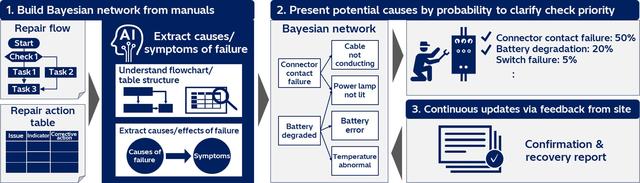
Figure 1. How the technology is applied (from analyzing manuals and presenting probable causes to updates through feedback from worksites)
Background and challenges
Maintenance personnel at equipment manufacturers and factories must respond quickly to a large number of equipment failures at manufacturing sites, which often involve different models and types of equipment. With conventional technologies, defining the relationships between equipment-specific symptoms and causes of failures required personnel to analyze equipment manuals and manually organize the relationships among causes of failures, symptoms, and troubleshooting procedures to construct diagnostic models. This process required significant labor. The task of organizing information tends to rely heavily on the knowledge of experienced personnel, making it difficult to promote knowledge transfer and standardize maintenance operations in the face of staff turnover and labor shortages.
Features of the technology and solutions developed to solve these issues
To address these issues, Hitachi has developed an AI-based failure identification technology that uses equipment manuals as a starting point to support the entire process, from organizing the knowledge required for failure identification to actual diagnosis and improvement. The key features of this technology are as follows:
- Automatic construction of Bayesian networks for diagnosis from manuals
AI combines image recognition and natural language processing to analyze flowcharts and tables that cover troubleshooting procedures within manuals. It then extracts relationships among causes of failures, symptoms, and confirmation procedures, which provide the basis for constructing a Bayesian network, a type of machine learning model. - Presentation of probable causes by probability to clarify confirmation priority
When users input information on symptoms occurring in the equipment into the Bayesian network, the technology presents probable causes of failure in order of probability. This allows maintenance personnel at equipment manufacturers and factories to prioritize checks more easily within a limited time frame. - Continuous updating of Bayesian network through feedback from worksites
By integrating feedback from manufacturing sites, such as confirmed findings on failure causes and recovery reports, the technology continuously updates the probabilities in the Bayesian network. This allows diagnostics to reflect changes in failure trends caused by equipment aging and other factors.
Future prospects
Going forward, in addition to improving the accuracy of failure and symptom extraction, Hitachi aims to expand the application of this technology to a broader range of maintenance-related documents, such as procedure manuals and inspection records. By implementing this technology as a mechanism to support rapid recovery and knowledge transfer in the field, Hitachi aims to help reduce equipment downtime and promote sustainable manufacturing.
A portion of these results is scheduled to be presented at CIRP LCE 2026 (33rd CIRP Conference on Life Cycle Engineering), which will be held from March 11 to 13, 2026.
For more information, use the inquiry form below to contact the Research & Development Group, Hitachi, Ltd. Please make sure to include the title of the article.
https://www8.hitachi.co.jp/inquiry/hitachi-ltd/hqrd/news/en/form.jsp