News release overview
Hitachi develops world’s first insulated piping technology for 10 kV-class hydrogen production systems; successfully completes a dielectric withstand test
New technology reduces electrolyser footprint by up to 50%, enabling hydrogen production in urban areas and space-constrained existing plants
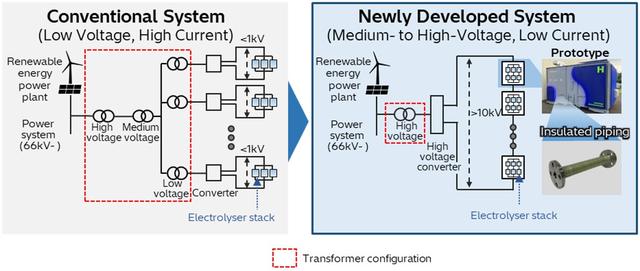
Figure 1. Comparison of a conventional electrolyser and Hitachi’s newly developed system
Tokyo, February 25, 2026 Hitachi, Ltd. (TSE:6501, "Hitachi") has developed the world’s first*1 insulated piping technology for electrolyser systems (hydrogen production systems) that is compatible with 10 kV-class (medium-voltage; commonly referred to as “high-voltage” in Japan) operation and successfully completed a dielectric withstand test using a prototype system. Applying proprietary insulated piping technology that leverages its expertise in high-voltage inverters and composite materials, Hitachi confirmed that no abnormalities, such as dielectric breakdown or leakage, occurred under 10 kV-class conditions in the presence of both hydrogen gas and water.
In conventional electrolysers, medium- to high-voltage grid power is stepped down in stages to low-voltage levels using power transformers, and the electrolyser stack*2 is driven at voltages below 1 kV to produce hydrogen. With this newly developed technology, the stack can be supplied directly with 10 kV-class voltage, significantly reducing the number of power transformers required for voltage conversion. As a result, this technology is expected to reduce the installation footprint of electrolysers by up to 50%. Increased system design flexibility will broaden options for distributed deployment and enable flexible system installation tailored to conditions at individual sites. This will be particularly beneficial in urban areas by enabling limited space to be utilized more effectively. It will also help facilitate the phased introduction of hydrogen at existing plants in the steel, petroleum, and chemical industries by making efficient use of available space.
Going forward, Hitachi will work to develop and demonstrate this technology on large-capacity systems in the MW-class (megawatt-class) and above through collaboration with domestic and international partners and research institutions. In addition to deploying this technology in urban areas, Hitachi will expand the scope of application to a diverse range of sites, including renewable energy power plants, industrial zones, and manufacturing bases, contributing to the widespread adoption of green hydrogen*3 and the realization of a carbon neutral society.
*1 World's first: Based on a prior-art search conducted by a patent firm, no prior examples were identified, within the scope confirmed by Hitachi, of "insulated piping" for 10 kV-class electrolysers that can be used in mixed hydrogen gas/water environments and that possesses pressure resistance, heat resistance, corrosion resistance, and hydrogen gas barrier properties (survey by Hitachi; survey date: August 2025; scope of survey: patent information on domestic and overseas inventions published or registered in Japan). The "world’s first" claim refers to 10 kV-class electrolysers. Application to higher-voltage classes will be pursued going forward.
*2 Electrolyser stack: A device in which multiple electrolysis cells are stacked and supplied with a direct current to split water into hydrogen and oxygen.
*3 Green hydrogen: Hydrogen emits no CO₂ at the point of use and can be utilized in a variety of industrial applications. Green hydrogen refers to hydrogen manufactured through methods with extremely low greenhouse gas emissions, such as water electrolysis using electricity derived from renewable energy.