Combining AI models to support rapid, high-quality decision-making and operational efficiency based on workplace needs
Hitachi has developed a conversation-based AI orchestration technology*1 that identifies synergies*2 between AI models by simply having them engage in pairwise conversations*3 and automatically composes high-performing AI teams in multi-agent systems where multiple AI models*4 collaborate to solve complex tasks. In recent years, multi-agent approaches have emerged as a way to address complex, workplace-specific challenges. Rather than relying on a single, large AI model, this multi-agent approach coordinates a team of small-scale AI models with specializations in specific domains to work together. However, achieving effective collaboration requires thorough knowledge of each AI model’s characteristics, and it has been difficult to identify optimal combinations when their internal architecture and other features are unknown. Hitachi’s new technology analyzes the semantic coherence of conversations between AI models to quantify and represent their relationships as a language model graph, revealing complementary collaboration and domain expertise, and then applies community detection to automatically extract high-performing clusters of AI models tailored to workplace requirements (Figure 1). Synergy is identified solely from conversations (AI model outputs), meaning that no knowledge of internal architecture or prior performance evaluations is required. This allows the technology to propose AI team configurations from a wide range of models, including black-box AIs*5 accessible only via APIs.*6 By combining AI models that reflect Hitachi’s extensive workplace expertise with AI teams uniting diverse AI models, this technology supports rapid, high-quality decision-making and operational efficiency. It can be applied to address a variety of complex challenges that require domain-specific expertise, ranging from societal infrastructure like railways and energy to manufacturing, healthcare, and other fields.
Moving forward, Hitachi will deploy this technology both internally and externally to accelerate value creation and workplace problem-solving in societal infrastructure and industrial fields through HMAX, a suite of solutions that embodies Lumada 3.0.
This technology is scheduled to be presented at the LaMAS 2026 workshop of the 40th annual AAAI Conference on Artificial Intelligence (AAAI-26), an international conference in the field of artificial intelligence that will convene from January 20th to 27th, 2026.
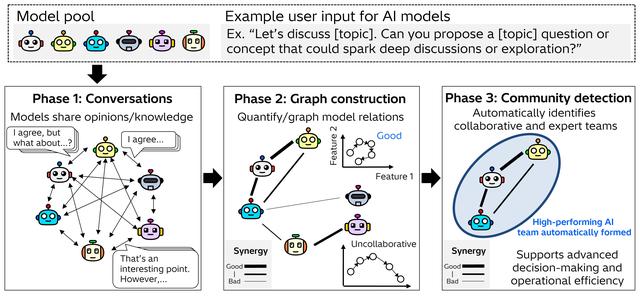
Figure 1. Overview of conversation-based AI orchestration technology: Automatic high-performing AI team composition
*1 A mechanism that links, integrates, manages, and automatically coordinates multiple AI models, tools, and systems to address complex tasks that are difficult for a single model to handle alone.
*2 A quantitative measure of the semantic coherence of AI models’ utterances during conversation and how effectively they demonstrate collaboration and domain expertise.
*3 A process in which AI models autonomously generate and exchange text responses without human intervention.
*4 In this article, language models are referred to as AI models.
*5 AI models whose internals are not visible to users. While inputs and outputs can be observed, training data and internal processing details are not disclosed.
*6 Application Programming Interface, an interface and set of rules that allow differing software to exchange data and functions.
Background and issues
In recent years, policy initiatives such as AI Strategy 2022*7 and the Artificial Intelligence Basic Plan*8 have promoted efforts to address societal challenges and establish a sustainable society through the strategic development and utilization of AI. Amid these developments, general-purpose AI models (large language models) have found broader use in support operations and decision-making across various fields. On the other hand, in societal infrastructure and industrial domains, operations often involve highly specialized and complex challenges that vary from one workplace to another. In such cases, it can be difficult for a single, general-purpose, large-scale AI model to address all requirements uniformly, creating a need for systems that leverage multiple small, domain-specific AI models. As a result, multi-agent approaches, in which diverse AI models with unique strengths are brought together to collaborate as a team, are drawing attention for their ability to flexibly address specialized, complex tasks that are difficult for a single model to handle and create new value as a result.
Still, forming effective teams to tackle complex tasks from the vast number of AI models available worldwide requires full knowledge of each model’s characteristics, which includes understanding the combinations matched to the task. Identifying optimal team structure is challenging and has traditionally required extensive trial and error by experts. This challenge is particularly prevalent when using commercial models, many of which are black-box AI systems with undisclosed internal architecture. These factors make it extremely difficult to assess their characteristics in advance.
*7 Overview of AI Strategy 2022
*8 Artificial Intelligence Basic Plan
Features of the technology developed to address these challenges
Hitachi has developed a conversation-based AI orchestration technology to visualize latent relationships between AI models through their conversations and automatically compose high-performing AI teams without requiring access to their internal states. The main features are as follows:
1. Building a language model graph of relationships between AI models and automatically composing high-performing teams
With this technology, AI models engage in pairwise conversations on specific topics, and teams are automatically formed based on the resulting interactions. Specifically, features indicating inter-model relationships, such as collaboration and domain expertise, are calculated based on conversation histories that reveal semantic coherence.*9 These relationships are then presented visually and structured into a language model graph. Analysis of this graph then makes it possible to identify clusters of synergistic AI models automatically through community detection without the need for manual trial and error. Unlike conventional top-down (task-centric) approaches that assign roles based on task requirements, this technology adopts a bottom-up (interaction-centric) approach that identifies synergy through conversations and then composes teams suited to the task. By changing conversation topics according to the domain or operations, the technology can automatically identify AI models with the required roles and expertise, enabling the building of AI teams that combine broad workplace knowledge with the strengths of diverse AI models.
2. Objective evaluation and use of diverse models, including black-box AI
As team composition is based solely on conversations (outputs) between AI models, the technology does not require any information about internal architecture (training data or parameters, for example) or performance-evaluation data. As a result, API-accessible commercial models and open-source models alike can be evaluated objectively and fairly based on their responses and degree of collaboration. This enables flexible combinations that are not dependent on specific vendors or cloud environments, encouraging the use of diverse AI models and supporting customers that are pursuing multi-cloud and multi-vendor strategies to overcome challenges. Even when customers have access to only a limited set of AI models, the technology can still propose team configurations tailored to their workplace challenges.
*9 A record and analysis of the semantic coherence of AI models’ utterances over the course of a conversation, enabling evaluation of collaboration and domain expertise.
Confirmed results
Through experiments combining multi-vendor AI models that specialize in mathematics or medicine with general-purpose AI models, it was confirmed that high-performing teams can be automatically formed for the individual domains. In tasks requiring advanced mathematical reasoning or specialized medical knowledge, automatically formed teams achieved up to a 13% higher accuracy rate than randomly selected teams and demonstrated performance comparable to teams manually assembled by experts based on AI model specifications. With the automatically formed teams consisting of AI models that specialize in their respective domains (mathematics and medicine), the experiments also demonstrated the effectiveness of the technology in capturing model characteristics from conversations and utilizing them in team composition.
Looking ahead
Hitachi will deploy this technology both internally and externally to help companies deliver solutions at higher speeds and quality levels by forming AI teams suited to specific workplace use cases, including societal infrastructure like railways and energy, as well as manufacturing and healthcare. Through proof of concept (PoC) initiatives with customers and partner companies, Hitachi will promote collaboration with diverse AI models and the flexible utilization of data accumulated at worksites. These efforts, drawing on the HMAX platform, will enhance societal infrastructure and maximize workplace value by linking IT, OT, and products.
For more information, use the inquiry form below to contact the Research & Development Group, Hitachi, Ltd. Please make sure to include the title of the article.
https://www8.hitachi.co.jp/inquiry/hitachi-ltd/hqrd/news/en/form.jsp