©Expo 2025
Related Article
The Future City Envisioned by Society 5.0
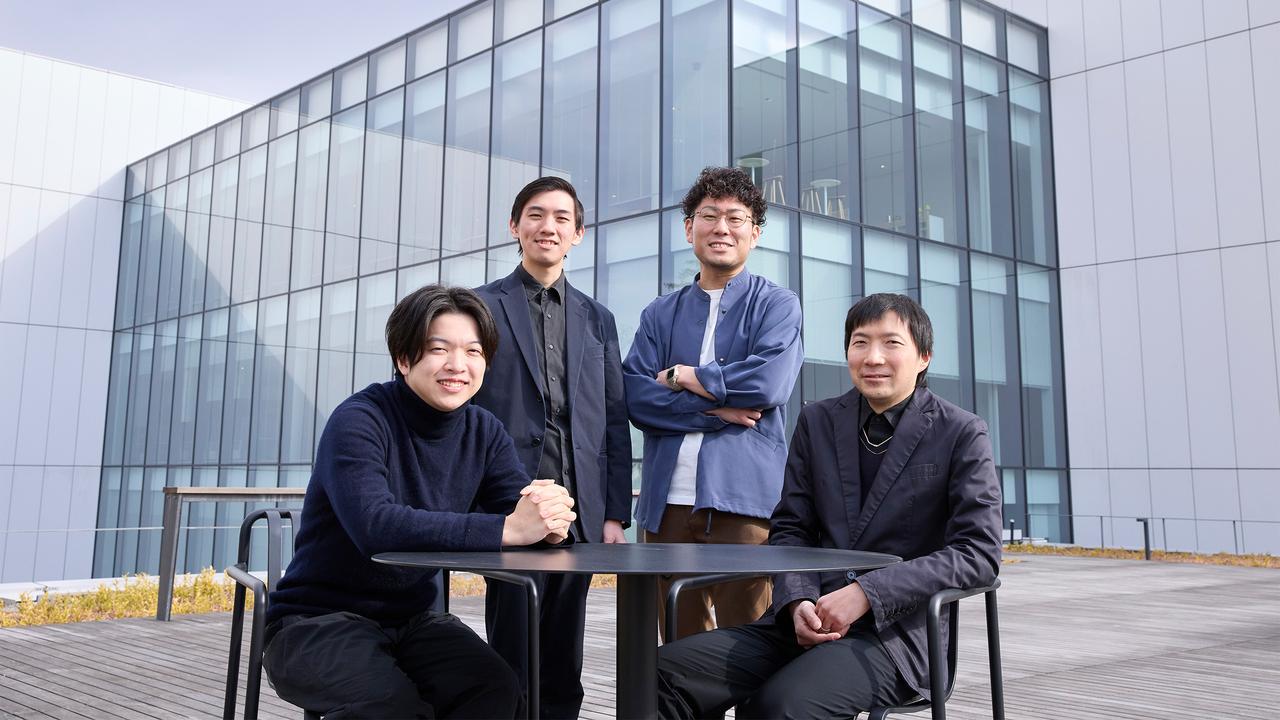
Expo 2025 Osaka, Kansai, Japan opened in April 2025 and was held for 184 days. As a Platinum Partner of the Future Life Expo: Future City, Hitachi staged a joint exhibit with KDDI under the theme “Society 5.0 and the Future City.” Planning began roughly three years before the Expo opened, with the Research & Development Group at the heart of the project from its launch.
In line with the Expo’s main theme, “Designing Future Society for Our Lives,” the Future City Pavilion was a co-creation between the Japan Association for the 2025 World Exposition and 12 companies and organizations, presenting the people-centered future city envisioned by Society 5.0, where economic development and solutions to social challenges go hand in hand.
With innovative technologies poised to reshape the way we live, the Research & Development Group was given a major responsibility: to design an exhibit that conveys to visitors what life will look like in 2035, when Society 5.0, a society in which people can lead vibrant, fulfilling lives, has been realized. A compelling and achievable vision of the future cannot rest on technological and business capabilities alone; it also requires a clear focus on creating solutions to social challenges. By painting a picture of a future that is both attractive and achievable, our aim was to demonstrate how Hitachi creates social value and where its technology and businesses are headed.
For some time now, the Research & Development Group has also been active in the design space, through such efforts as Vision Design, which paints concrete and varied portraits of the future under Society 5.0, and NEXPERIENCE, a methodology for discussing the creation of new social value and possible solutions to challenges through co-creation with multiple stakeholders. Drawing on the strength of having in-house designers and researchers with these capabilities, and using the exhibit’s planning process to virtually experience pathways toward solving social challenges, we treated the project as a valuable opportunity for Hitachi to think through the elements that will be needed to create solutions in the years ahead. The project also drew in many younger designers who will go on to lead the way into the Society 5.0 era.
The Hitachi–KDDI Joint Exhibit: Mirai Meeting
The Hitachi–KDDI joint exhibit served as the guide to the bigger picture of the future city under Society 5.0 that all 12 sponsoring companies and organizations of the Future City Pavilion brought to life. Picking up where the journey from Society 1.0 to Society 5.0 leaves off, the exhibit offered a vision of the people-centered society that Society 5.0 aims to deliver: one that provides value tailored to the diverse needs and lifestyles of all kinds of people. Building such a people-centered society takes more than designing technologies and institutions around human beings. It also calls for a participatory society, one in which every citizen plays an active part in shaping how society is designed and run. With this in mind, based on the concept “We can change the future,” we aimed to give every participant the experience of changing the future city of 2035 themselves, so they could see a participatory society as something that affects them personally.
The interactive exhibit, named Mirai Meeting, comprises two parts: Mirai Theater and Mirai Arcade.
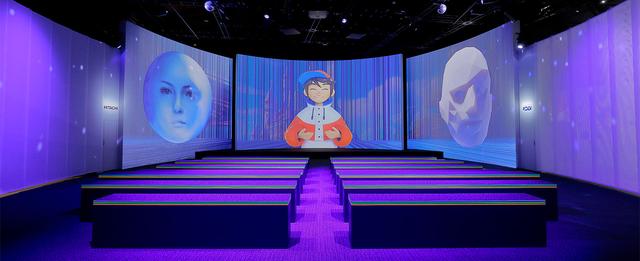
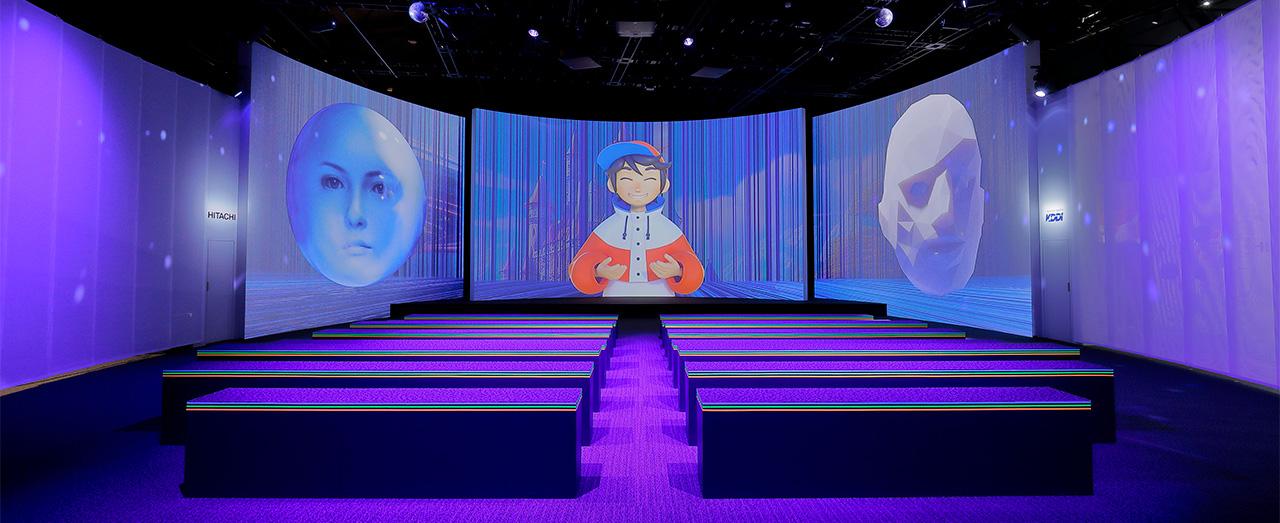
Mirai Theater is a hands-on exhibit where 120 visitors at a time set out to change the future of 2035. Through everyday themes such as food and health, or choosing a career, visitors are invited to consider how their own choices might transform a 2035 that, after the relentless drive for efficiency, has come to feel somewhat dystopian. A 6-meter-tall, 15-meter-wide screen renders the future world at full life size; visitors are drawn into the story through their exchanges with Milli, the MC who plays a navigator from 2035; and by casting votes from their own smartphones, they get a simulated experience of citizen participation.
Mirai Arcade is an interactive exhibit modeled on an arcade game, in which teams of three work together to change the future of 2035. Touching the displays, participants introduce solutions powered by Cyber-Physical Systems (CPS) into a 2035 facing a wide range of social challenges, transforming it into a vibrant, bright future. By using their whole bodies to operate the large displays, visitors learn about solutions to the social issues of 2035 in an engaging, hands-on way.
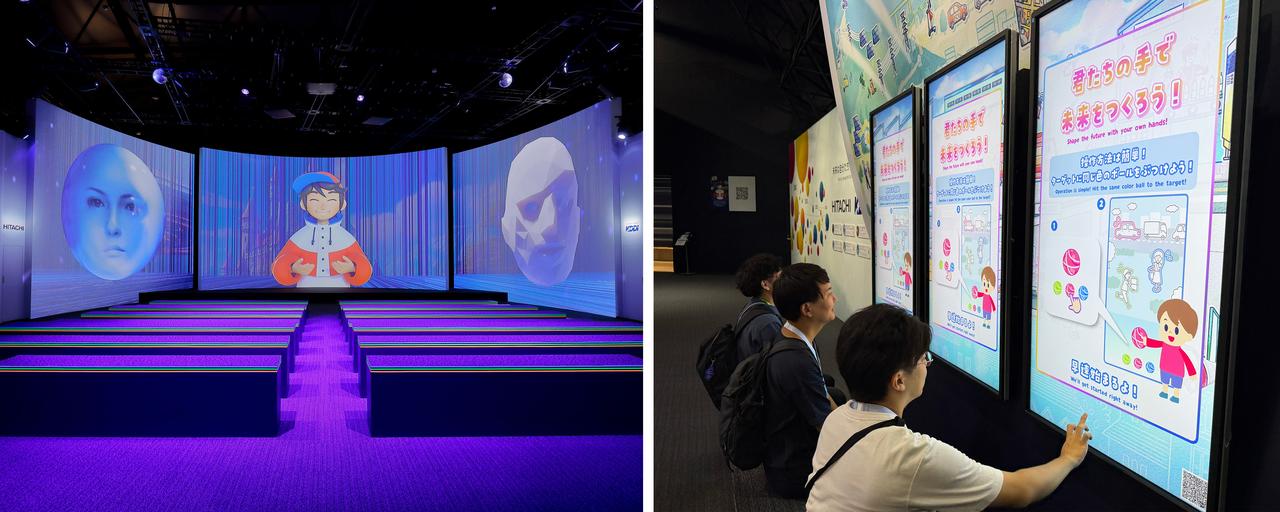
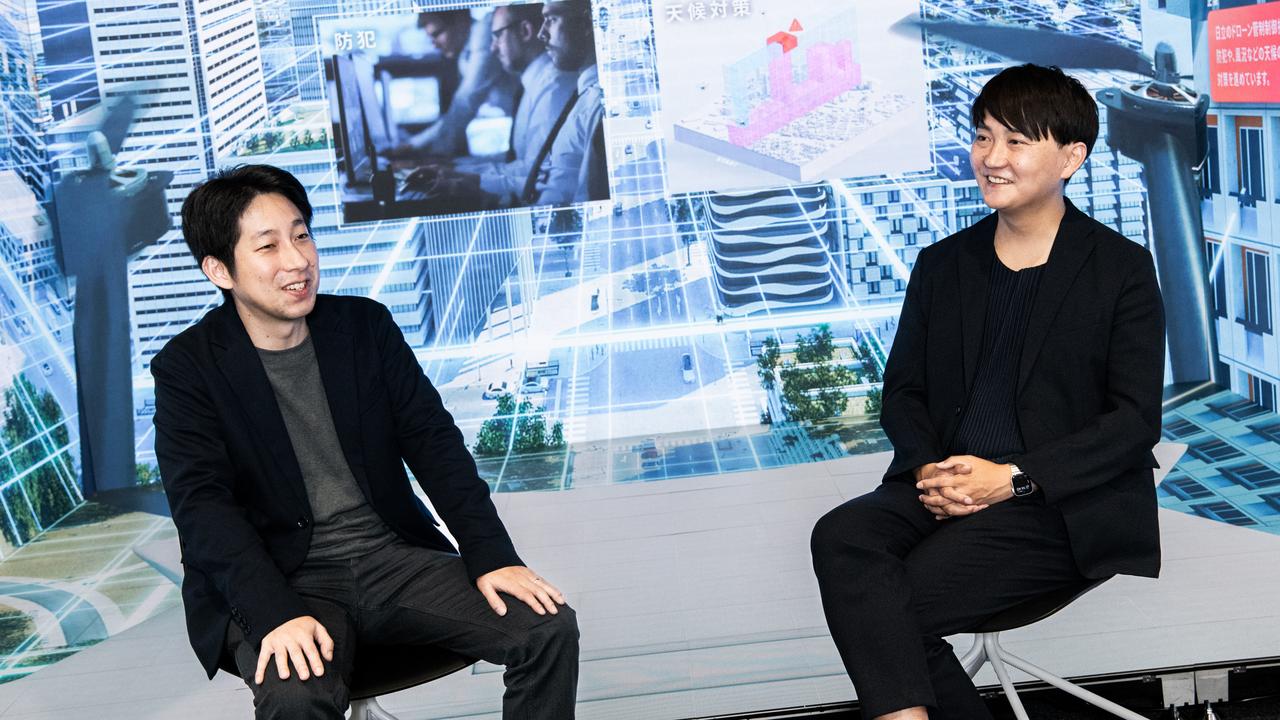
Left: Mirai Theater / Right: Mirai Arcade
Key Turning Points Shaped by the R&D Group
Mirai Meeting was planned by drawing on the design methods and broad research expertise that the Research & Development Group has built up over the years.
To decide where to begin, we first laid out an overall concept for the future city. Grounded in Hitachi’s vision of a society that balances planetary boundaries with well-being, the concept put a clear idea at the heart of the exhibit: bringing to life new values and aspirations that make for comfortable living within a sustainable society. From there, we identified the points to consider for getting there, namely the social challenges to be solved, the resources required, and the venues needed to shape rules and run real-world demonstrations. We also recognized that drawing all of these perspectives together would call for co-creation with multiple stakeholders, and that recognition became our starting point for designing the exhibit.
In planning an exhibit aligned with the Expo’s theme, “Designing Future Society for Our Lives,” we worked through ideas for solutions to social challenges and for business scopes by linking future visions of society with corporate capabilities, then progressively shaped the exhibit design. Building on the overall concept at the core of our planning, we anticipated what society might look like from 2025 onward and narrowed down the business scopes that would let us depict the future of urban life. We eventually settled on eight business scopes, with designers and researchers working hand in hand to discuss the exhibit design for each. R&D researchers brought a broad understanding of Hitachi’s corporate capabilities from a technological and business standpoint, while designers used that information to explore how people might live their lives. Designers, in turn, sketched out social visions and researchers considered which technologies could be used to achieve them. In this way, we examined the space between social vision and corporate capability through the dual lenses of designer and researcher. Finally, we brought together the exhibit design ideas from all eight business scopes and visualized them in what we called the Society 5.0 Blueprint, giving the overall direction of the exhibit a clear form.
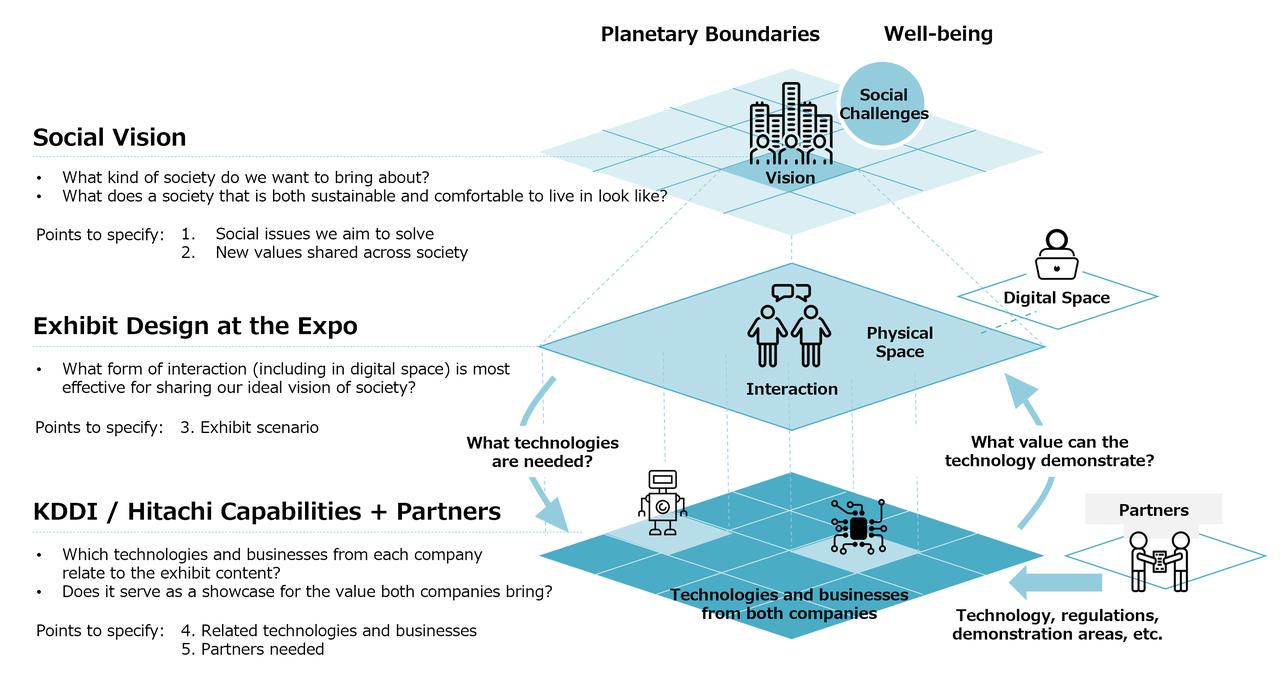
Designing the exhibit’s presentation around social vision and corporate capability
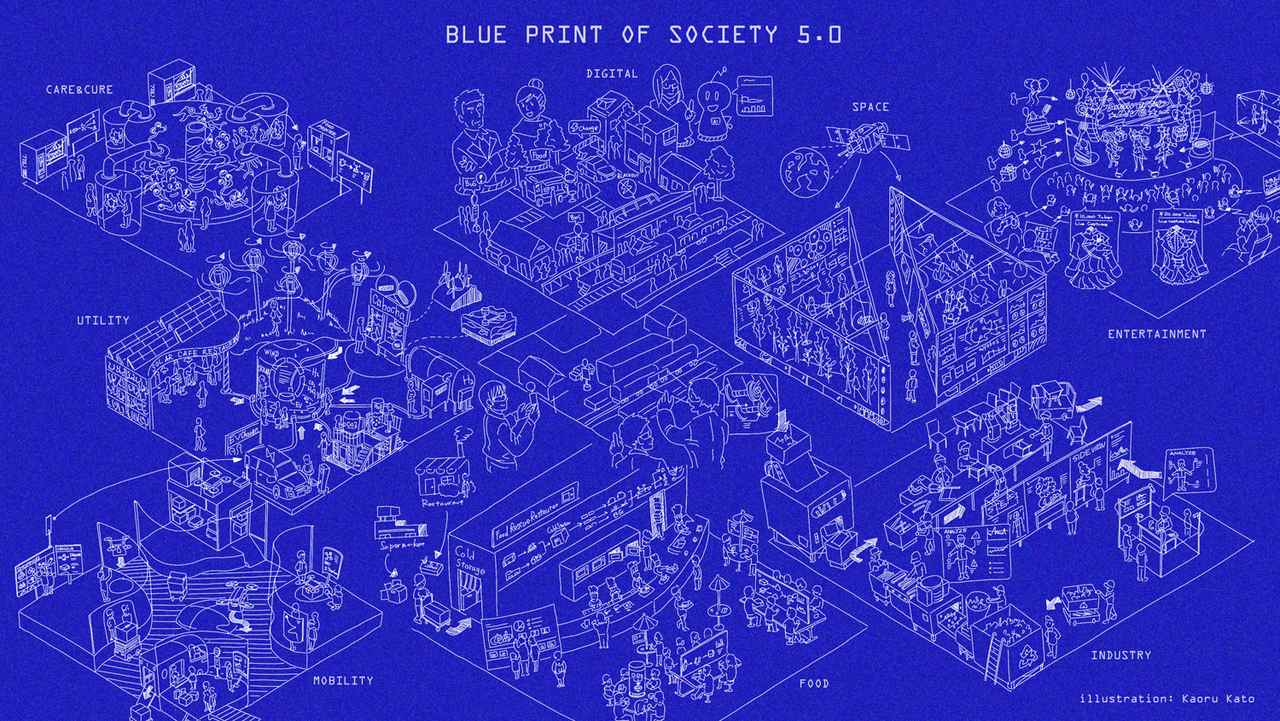
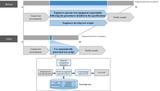
The Society 5.0 Blueprint, summarizing the exhibit design proposals across eight business scopes (created October 2022)
As discussions progressed within these narrowed-down business scopes, a concern began to surface: Would the work end up confined to bottom-up ideas built on existing corporate capabilities? To address this, we drew on research into advanced lifestyles in which individuals design their own approaches to food, learning, and work, and set about drafting future scenarios from the perspective of the people who would live them. From there, we used illustrations to visualize daily-life scenes across a wide swath of the city, from the urban core out to the suburbs. The result was a vision of a future society anchored firmly in the lives of its inhabitants, taking in the city as a whole and the full breadth of everyday life, while still maintaining its ties to corporate capabilities.
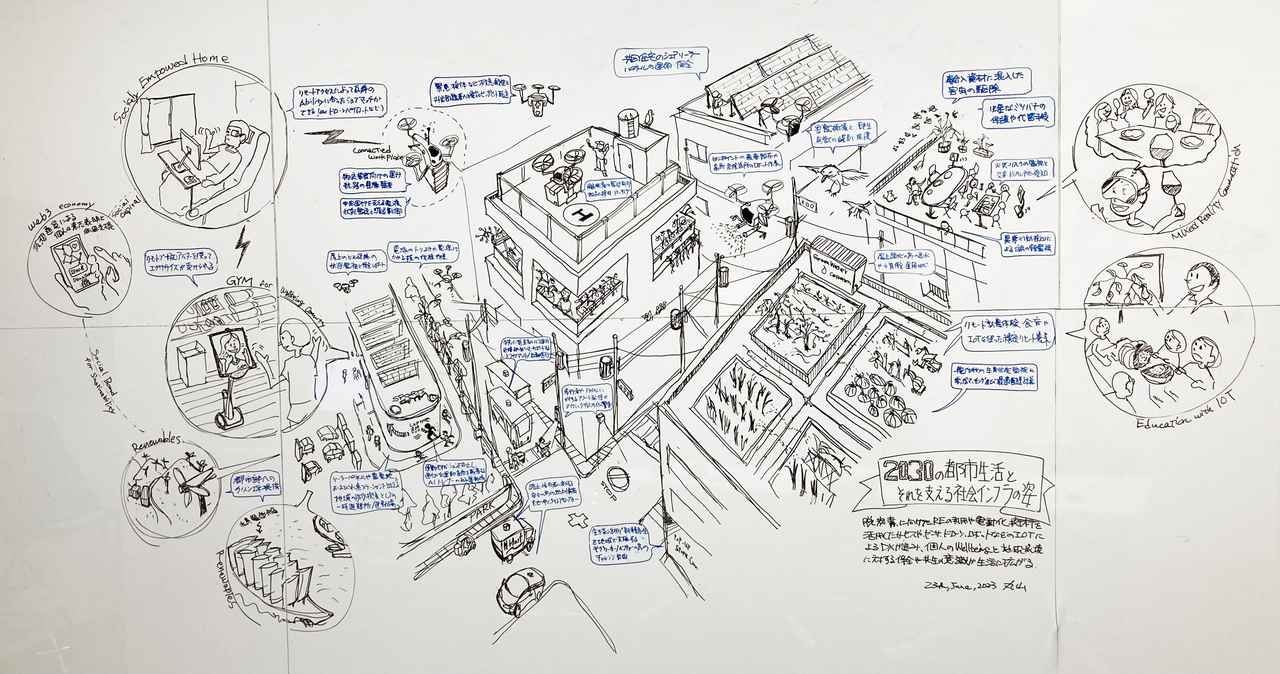
Urban life in 2030 and the social infrastructure that supports it (initial version: June 2023)
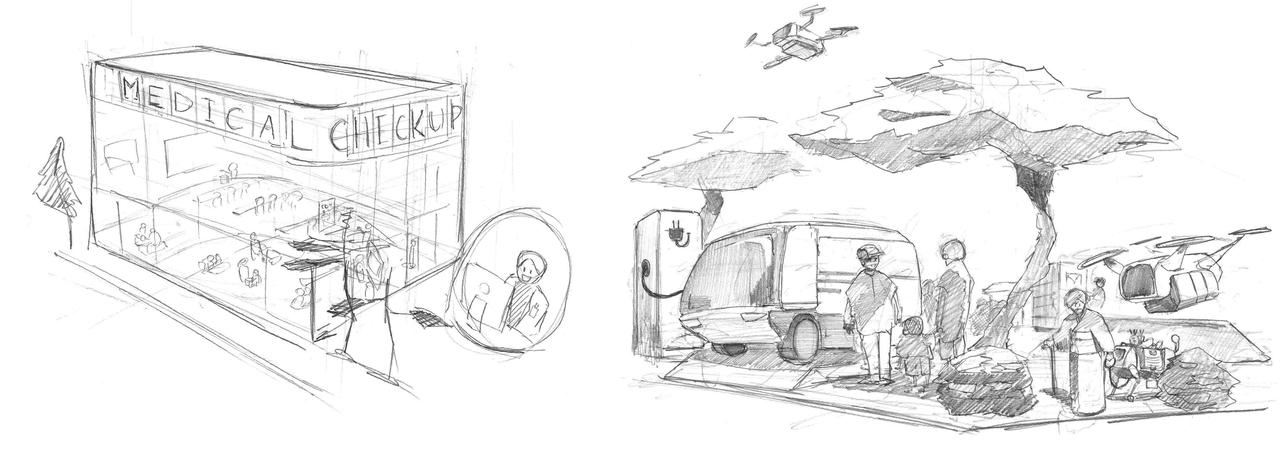
Daily-life scenes in the future society of 2035, visualized through illustrations (created August 2023)
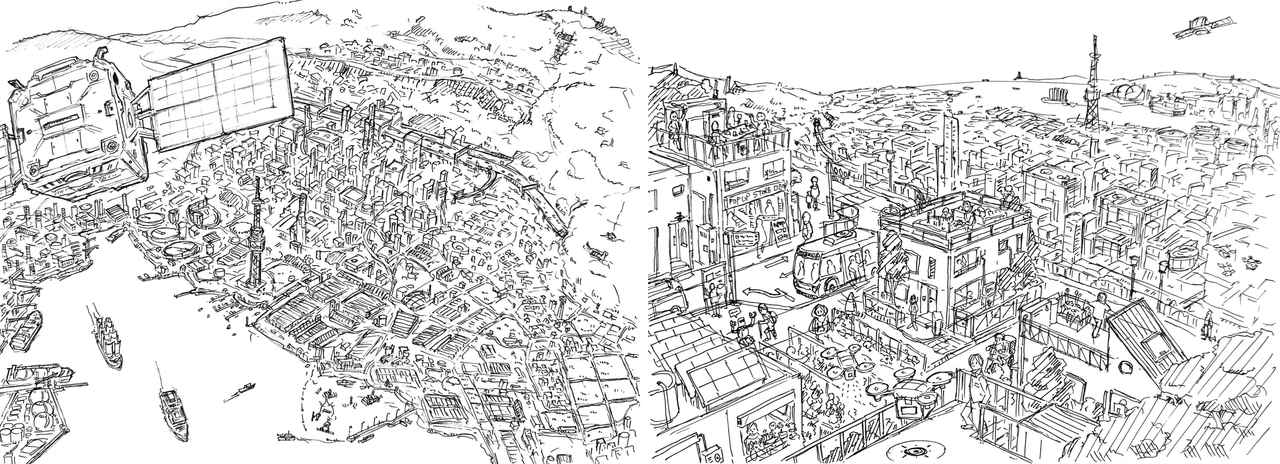
A panoramic view of the future society from city center out to the suburbs (created August 2023)
Once the vision had taken concrete form, the next question was how to share it with visitors at the Expo. Simply lining up illustrations of the vision around the venue would not be enough to convey what a participatory future society really is. The challenge was how to make a participatory future society feel personal to visitors. To deepen their sense of immersion, we adopted a presentation in which life-sized footage of the future society was projected on a large screen inside a theater. To bring out a sense of taking part in designing and running that future, we drew on Vision Design, an approach to envisioning the future that the Research & Development Group has been developing for years. Vision Design does not depict any particular technology or solution. Instead, it offers a future to spark conversation, posing the kinds of questions that draw people in and make them want to share their thoughts on the social systems of tomorrow. We based the storytelling framework for Mirai Theater on the process of backcasting—identifying the gap between a forecasted future (as an extension of the present) and a truly desirable future, and then bridging that gap. After laying out a future without citizen involvement and the issues that come with it, we offered new scenarios that could serve as transition pathways to a more desirable future, and visitors chose between them on their own smartphones, experiencing for themselves the idea that we can change the future.
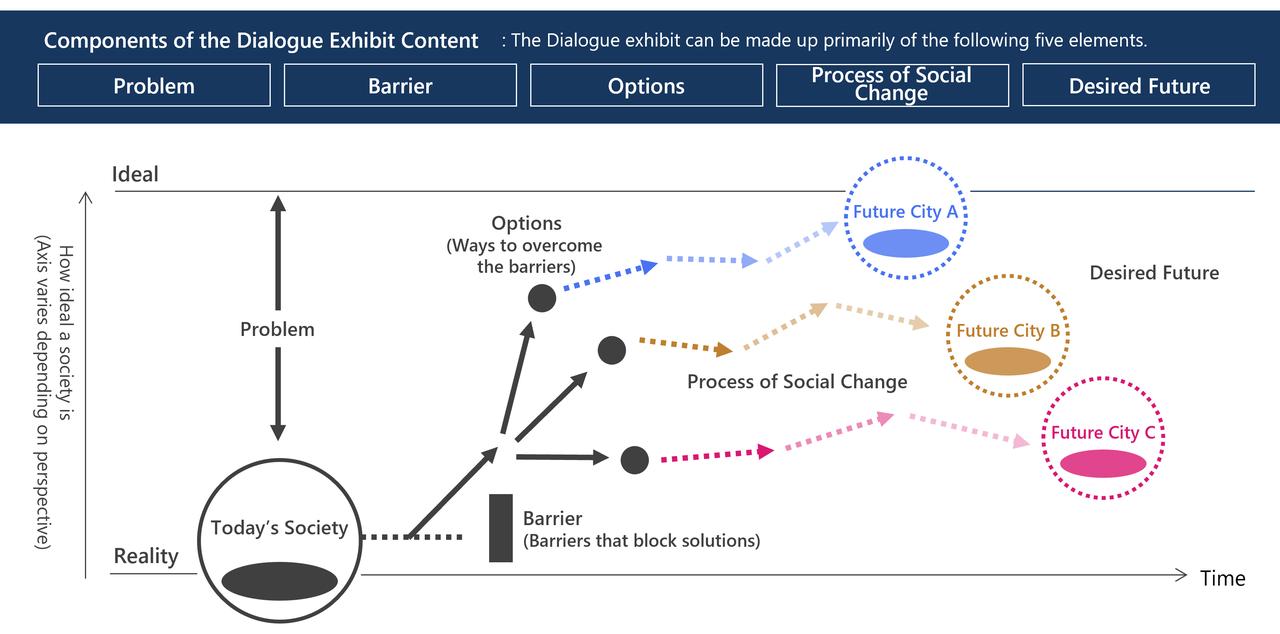
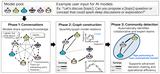
Mirai Theater (Dialogue): components of the exhibit content (created April 2024)
Beyond the physical exhibit, Hitachi also sponsored Virtual Mirai City, an experience KDDI offered during the Expo run, opening up a more flexible view of the future city to people who could not visit in person. Virtual Mirai City builds the people-centered urban space envisioned by Society 5.0 inside a metaverse, where visitors use avatars to encounter what a future in which social challenges have been solved might look like and the technologies that support it, in ways only a virtual space allows. Rather than simply copying the real city into a virtual one, each sponsor sketched a new future city from its own perspective, with the freedom to imagine beyond what is physically possible. The Research & Development Group focused on the challenge of an aging society leaving fewer specialists to maintain social infrastructure. Built around the idea of social infrastructure that everyone helps support, including local residents, we created content centered on regional rail infrastructure maintenance. Through a game story in which players seek out spots in stations and along the tracks that need maintenance, we offered a glimpse of a new future by inviting visitors to think about the possibilities for citizen participation in infrastructure upkeep.
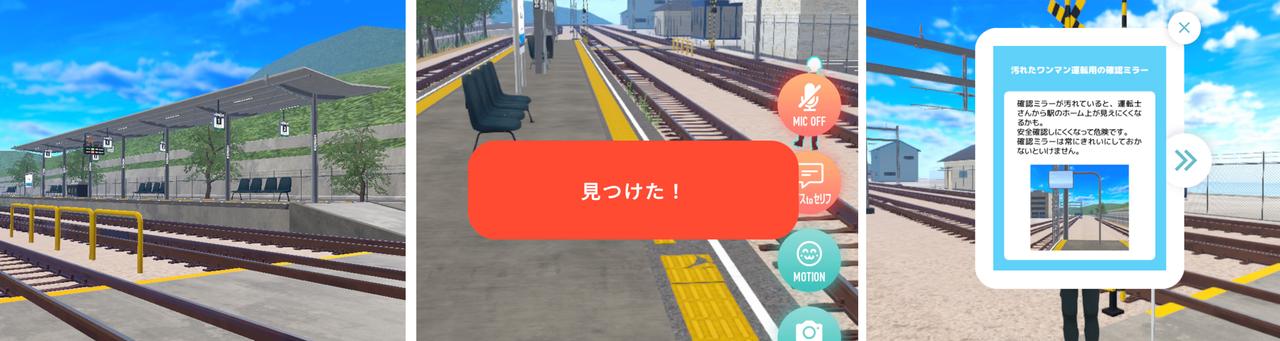
Virtual experience of railway maintenance support in the Hitachi-curated area of Virtual Mirai City
Mirai Theater and Virtual Mirai City showed future scenarios along with the new services that go with them, all of which we plan to bring to life through co-creation with a wide variety of stakeholders going forward. To help more participants use this experience as a springboard for deeper conversation about the society of the future, Hitachi has gathered the scenarios and services into the form of a pattern language. Pattern language, a method first proposed in architecture in the 1970s for describing the features of streets and buildings, has been adapted here to describe visions and services for a future society. Each scenario or service is captured on a single card, and 14 patterns are compiled into a booklet titled Perspectives for co-creating a Future City*. Drawing on the vision of the future society that emerged from planning the Expo exhibit, we hope this set of clues will broaden the co-creation network needed to bring the new services we presented through these exhibits to life.
* Perspectives for co-creating a Future City (PDF file)
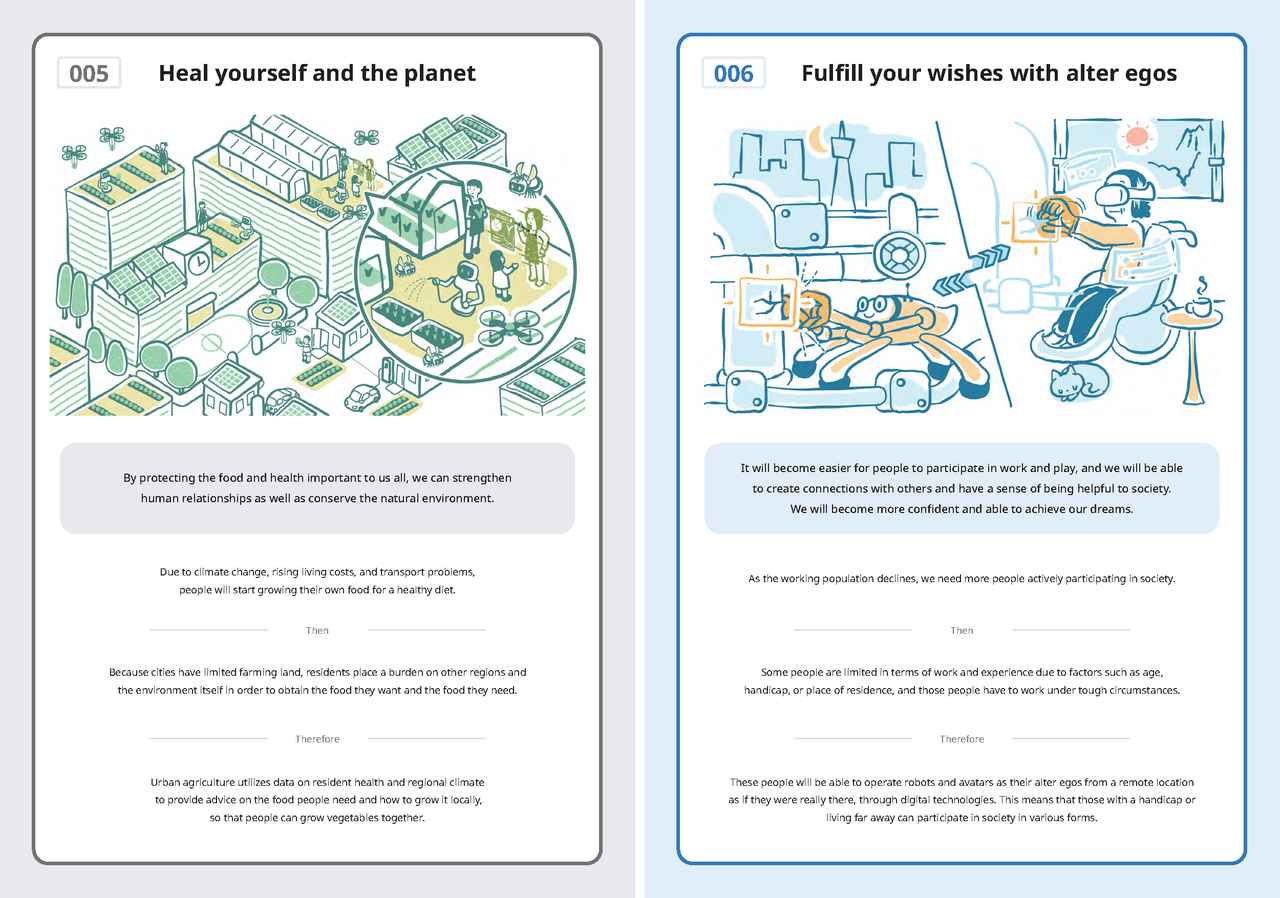
Cards from the booklet “Perspectives for co-creating a Future City” (created April 2024)
Reflecting on the Expo and What It Means for R&D
Through the full arc of work for Expo 2025 Osaka, Kansai, Japan, from initial planning through to the run itself, the Research & Development Group brought to life the future city as Society 5.0 envisions it. Starting with proposals that linked future visions of society to corporate capabilities, and drawing on the design and research activities the R&D Group has built up over the years, we gave shape to a participatory future society in many forms, from on-site exhibits to virtual applications. Throughout the Expo, we used these exhibits to share with visitors and sponsors at the Future City Pavilion the concept of social infrastructure supported by everyone through citizen participation.
The wide-ranging ideas and visions for a Society 5.0 future that came out of this work are now feeding into co-creation around new social infrastructure maintenance businesses. Our work does not end with the closing of Expo. Together with many partners, we will continue to co-create the participatory society of 2035 and the AI and digital platforms that will support it.