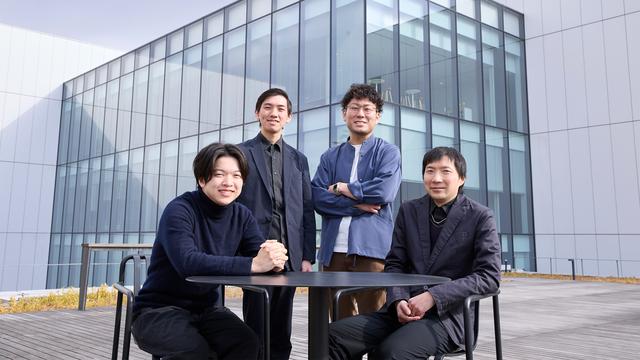
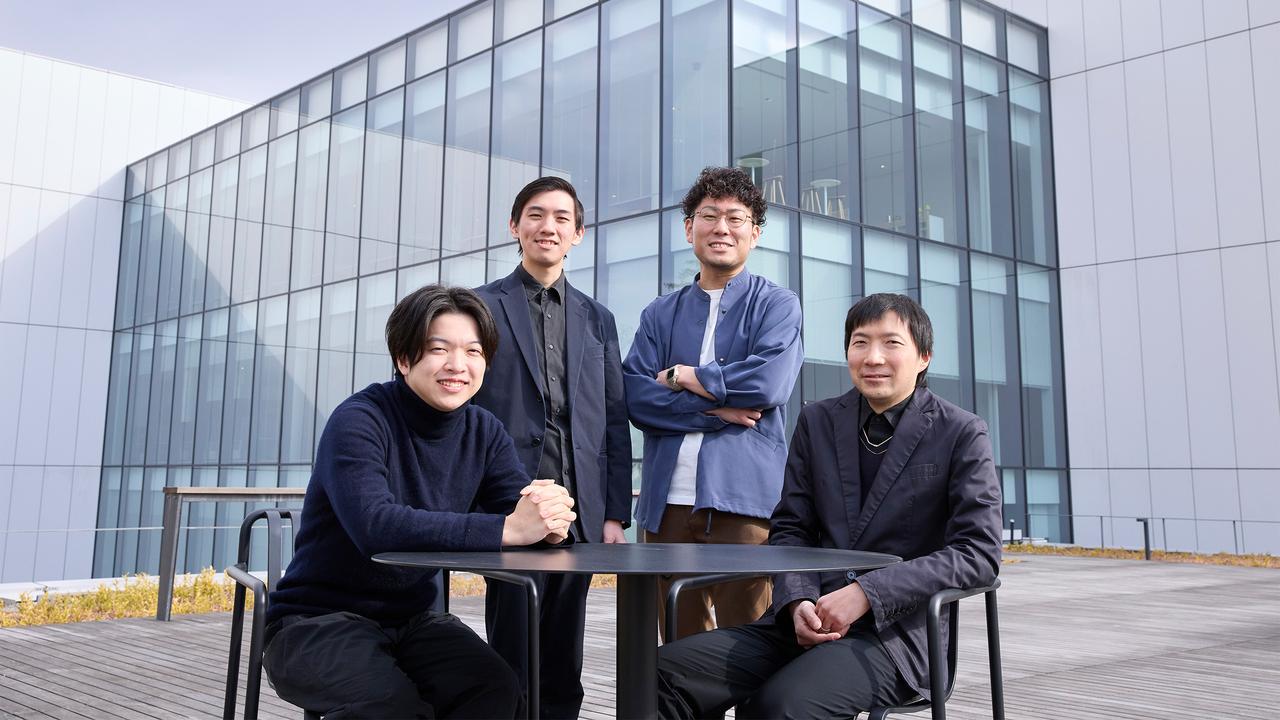
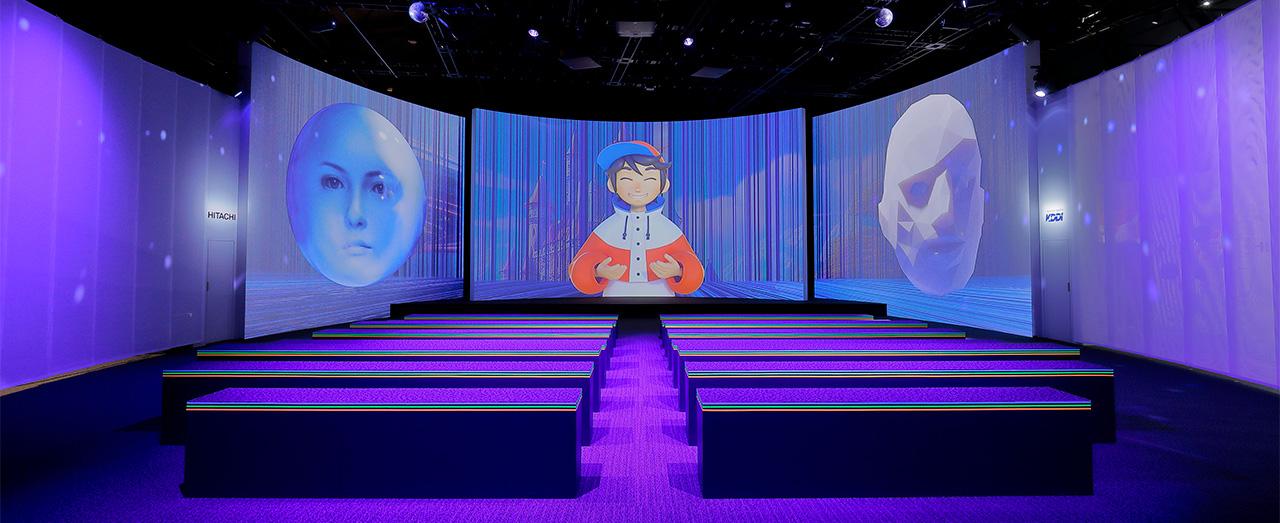
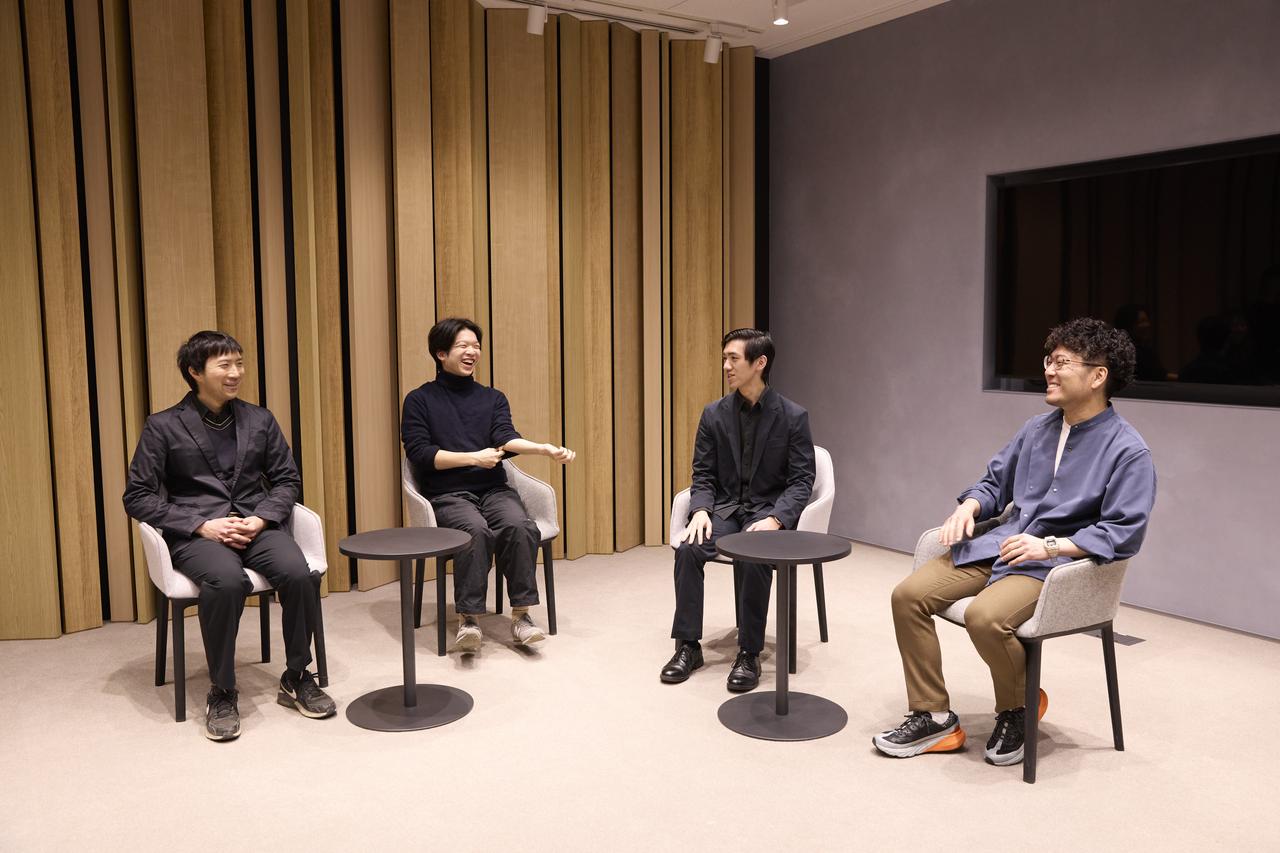
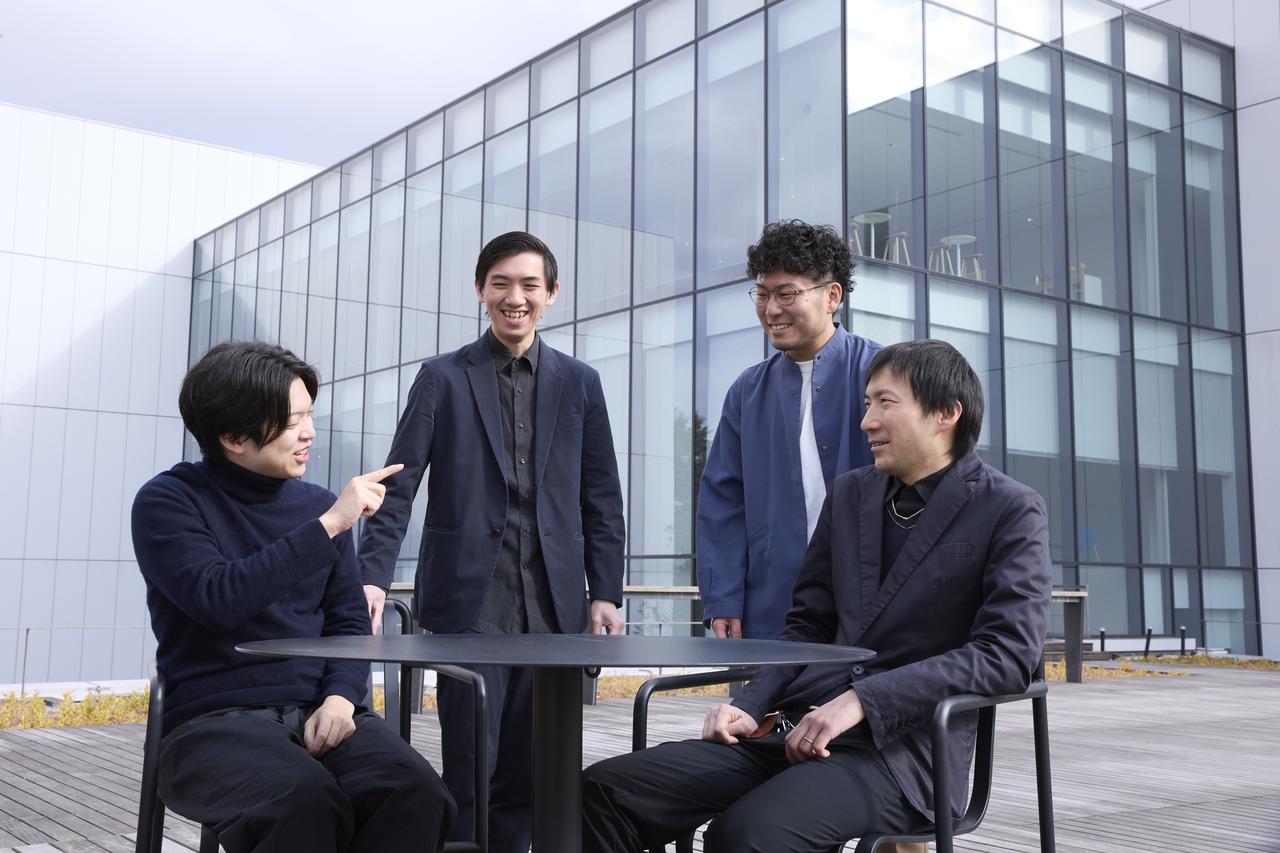
In the future society of 2035, with Society 5.0 in place. How will people live there, and how will society change? The challenge was not to lay out a list of technologies, but to design an experience that lets every citizen genuinely feel that we can change the future. Taking on that challenge were four young designers from the Design Center within Hitachi Research & Development Group: Kaoru Kato, Mashu Mori, Taiyo Yamaguchi, and Shota Konishi.
We sit down with them to talk about their ability to make the future visible, drawing on the work they put in at the front line of the project, from the earliest planning stages through implementation and on into the activities aimed at bringing it all into society.
©Expo 2025
Related Article
Cutting Through a Tangled Conversation with a Single Picture
── With so many stakeholders involved, including Hitachi, KDDI, and 10 other co-sponsors, the process of bringing the Future City into concrete form must have been one difficulty after another. In the early stages especially, what kinds of challenges did you face, and how did design help you get past them?
Kato: The project began from the perspective of how to bring the technologies that Hitachi and KDDI each have to the world. What our design team was asked to do was take stock of both companies’ technology assets and draw a picture of a future where they had been put into use.
The first thing I made was the Society 5.0 Blueprint. Using isometric projection (a type of parallel projection where the angle between the x, y, and z axes equals 120゜), I drew how technologies in categories like communications, space, healthcare, and food would actually be deployed in a city. We hadn’t even decided how large our exhibit space would be yet, so it was a way of visualizing ideas like “Maybe we could put together this kind of exhibit using this technology.”
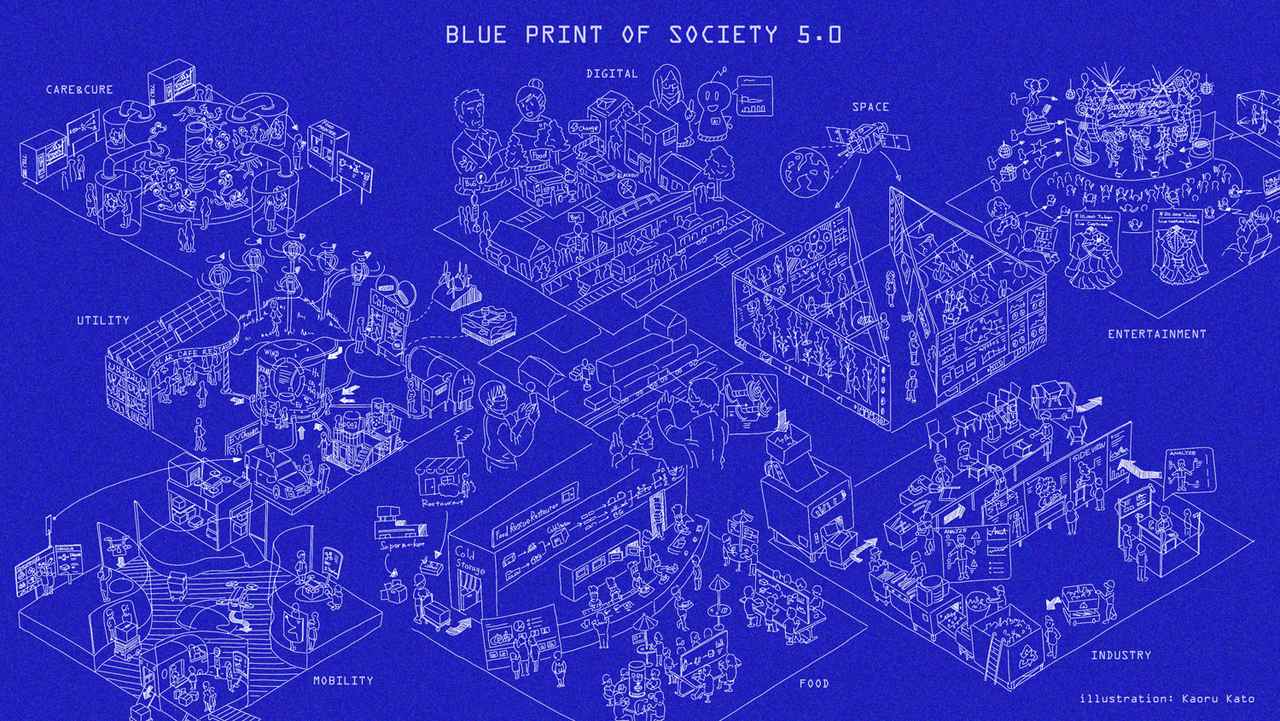
But once it was drawn, the problem became clear. It had that feeling you often get at tech expos, where a company is one-sidedly declaring that “this is the future.”
Mori: My honest reaction when I saw that picture was that “it’s flashy and aspirational, but it feels miles away from my own life.” It looked like a future for a handful of people with money or power. The Expo was supposed to be aiming at a participatory society, yet the everyday residents at the heart of the matter felt entirely absent.
Kato: Exactly. So we decided to redraw it starting from everyday life, rather than from the technology.
For instance, my hometown in the countryside holds a big festival. Even when the timing doesn’t work out for me to come back, it could be nice to take part by using remote technology to send up drone fireworks, and be one of the people helping liven things up. Working from my own experiences like that, I drew picture after picture of daily-life scenes in this order: “If I had this kind of feeling, what technology would I want to use?”
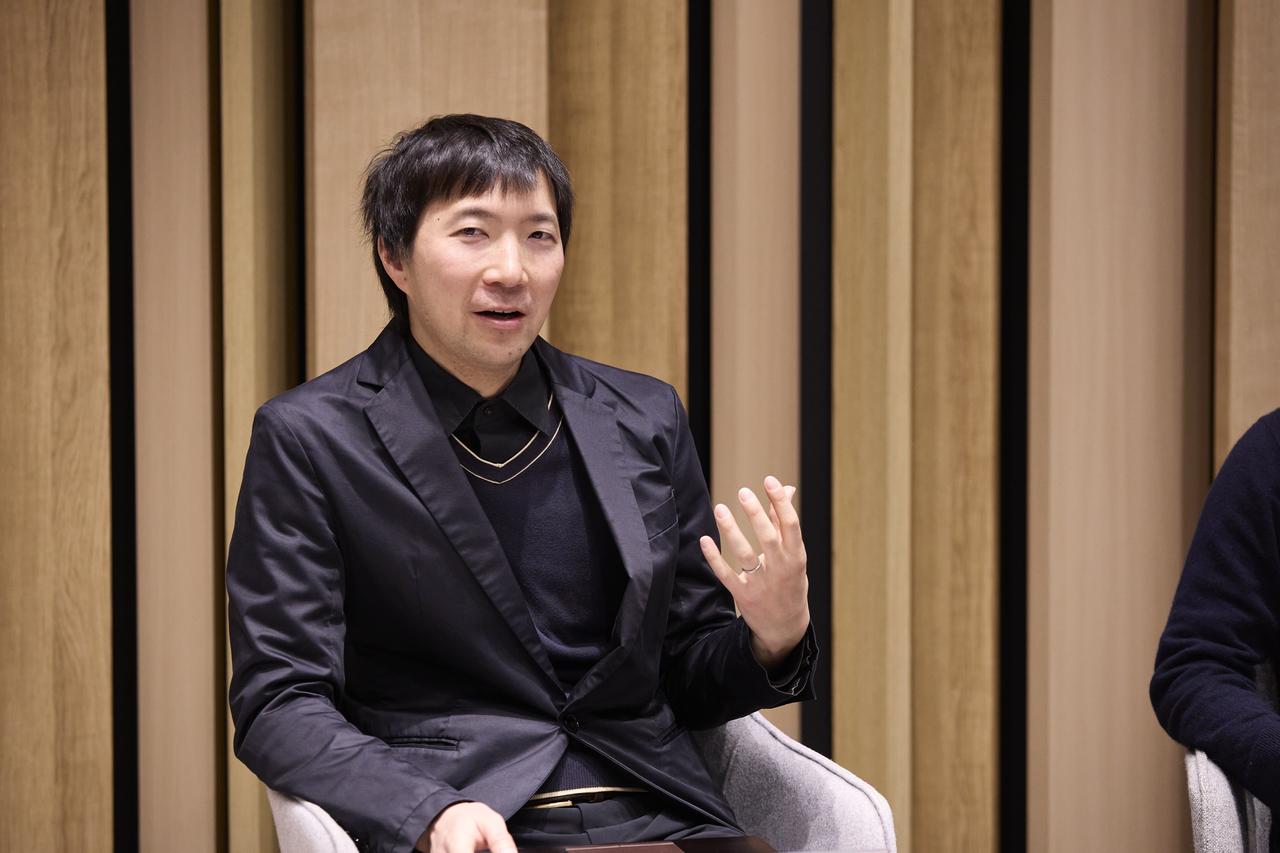
“I made a point of putting people, what they’re doing and the look on their faces, at the center of the picture, more than the technology,” Kato says
—— It sounds like an approach where you build up from fragments of daily life. But with 12 organizations putting it together, weren’t you also up against the problem that fragmented scenes alone make it hard to see the bigger picture?
Kato: The expectation was that the exhibit would offer a unified perspective bringing together the thinking and work of all 12 organizations.
While each sponsor came in with concrete product proposals, the question of how those products would function within the city as a whole and how they would tie into people’s lives tended to fade into the background. So, to integrate the scattered technologies and ideas of all 12 organizations into a single picture of a city, we drew the Panoramic View of the Future Society from City Center Out to the Suburbs, taking in everything from the port to residential neighborhoods to the suburbs.
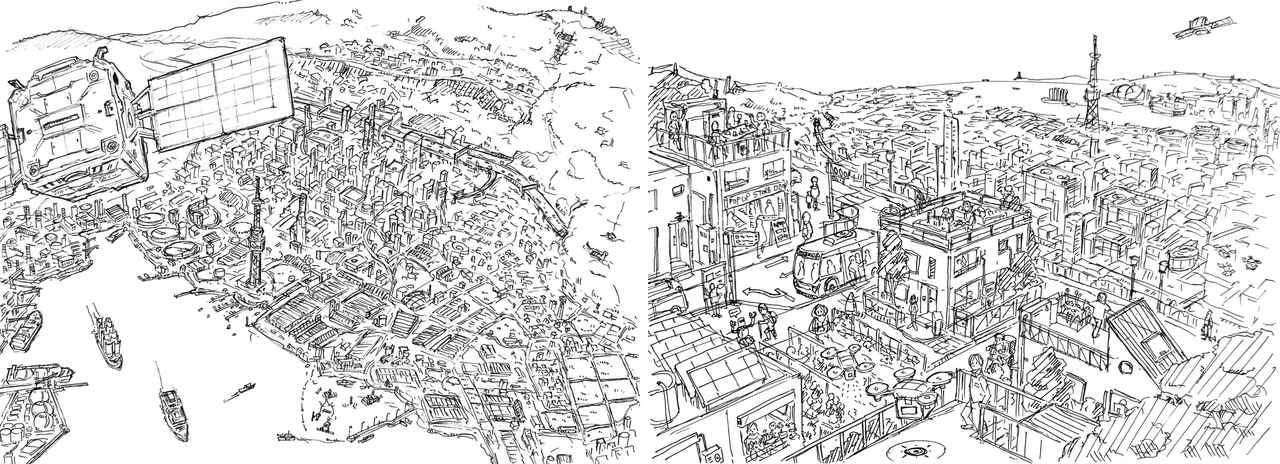
In this picture, we deliberately drew everything in the city as connected. The robots and mobility working at the port only mean something once the cargo they unload is moved through infrastructure out to the suburbs and reaches people’s hands. Rather than carving up the city, saying “this part is Company A’s area, that part is Company B’s,” we put a city where everything links up onto a single sheet. That was the moment everyone involved could finally see the same future. Discussions that had been stuck in the abstract, all words and no traction, shifted once we put up a concrete visual. People started saying things like “In this context, our technology would actually come into its own.”
Mori: Looking back, I think it really mattered that this picture was hand-drawn by a designer rather than generated by AI.
These days, you can use generative AI to create a detailed picture of the future. The thing is, AI ends up putting more focus than necessary on the elements you call out in the prompt. However, what we needed this time was something closer to intentional vagueness. We had to incorporate each sponsor’s technology, keep the city internally consistent, and put the everyday residents’ perspective at the center of it all. Holding that balance, deciding “we’ll show this here, we’ll deliberately leave that part open” was something only a designer drawing by hand could do. Specifying that with prompts, at least for now, is fairly difficult.
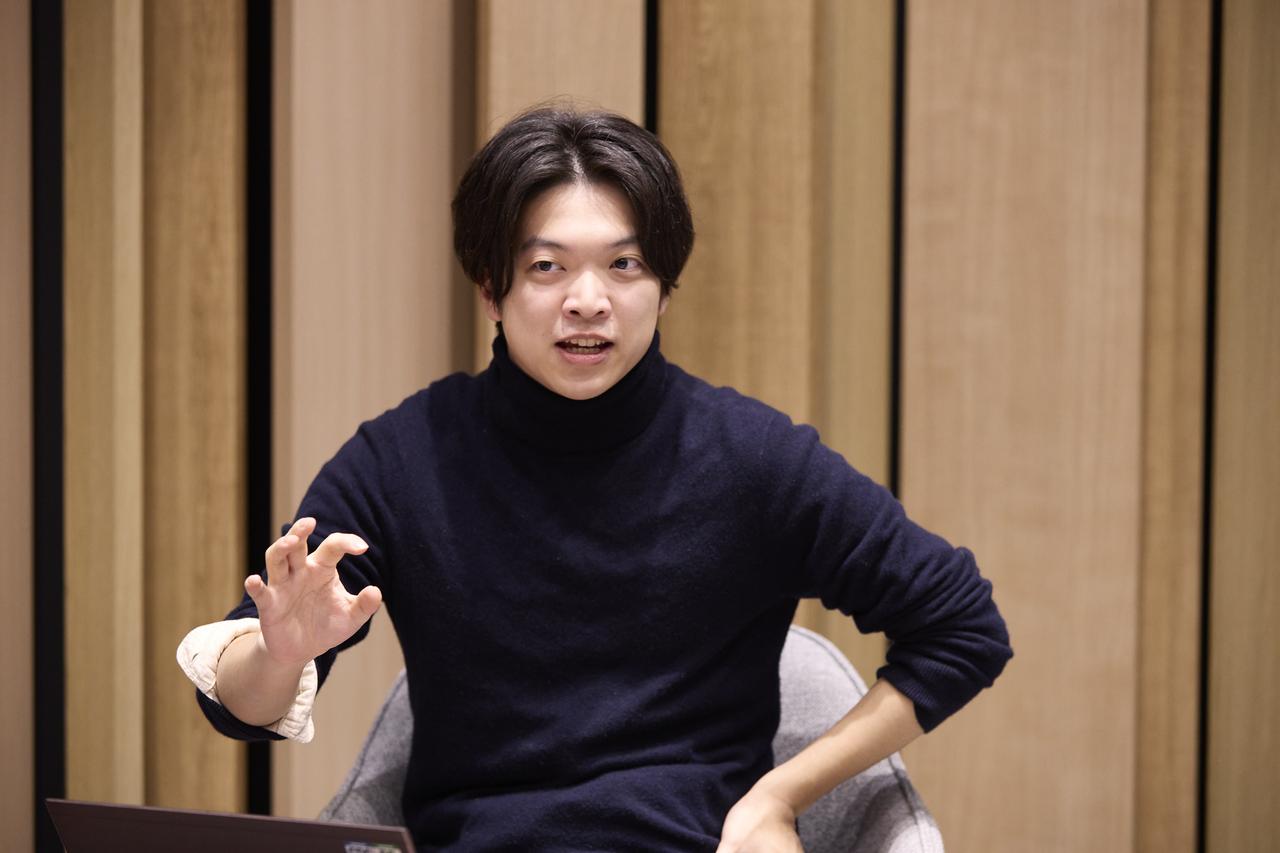
“It worked precisely because it was hand-drawn rather than AI,” says Mori
Using Fun to Make Social Challenges Feel More Personal
——This time, Mirai Meeting was made up of Mirai Theater, a theater-style exhibit, and Mirai Arcade, an interactive game. Mirai Arcade is mainly aimed at children. In dealing with complex social challenges and technology, why did you choose a game?
Mori: Mirai Arcade is an interactive exhibit modeled on an arcade game, using three large vertical touch displays. Visitors take a 2035 future where various social challenges are emerging, touch the solutions that appear on screen, and turn it into a vibrant, bright future. Early on, we considered explaining the technology with panel exhibits and the like, but the Expo draws a lot of families with kids in tow. We wanted children, who will lead the next generation, to be able to grasp difficult themes like technology and social challenges intuitively, and to enjoy doing it. For that, a game format where you move your body and watch the city change felt like the right call.
—— How did you strike the balance between understanding the technology and the fun of the game itself?
Mori: That took quite a bit of agonizing. At first we considered something more elaborate, like reflecting Hitachi’s Harmonized Society concept in the game using a scoring system. But anywhere it looked like things were getting too complicated, with no small reluctance, we pushed it back toward fun. The whole point of the exhibit, after all, is for people to see the process of using technology to solve social challenges and change the future as something that’s their own.
Technologies like Cyber-Physical Systems (CPS) appear in the game, but we depicted them with illustrations that would feel approachable even to children.
One thing we did was prepare stickers to hand out after each game. Konishi took the lead in planning these. We turned the technologies and characters from the game, along with the daily-life scenes where they were being used, into stickers, and added a link on the back to a more detailed explanation of the technology. We put fun first at the venue, in an intuitive way, and designed it as a two-stage experience that could lead to deeper learning once people took the stickers home.
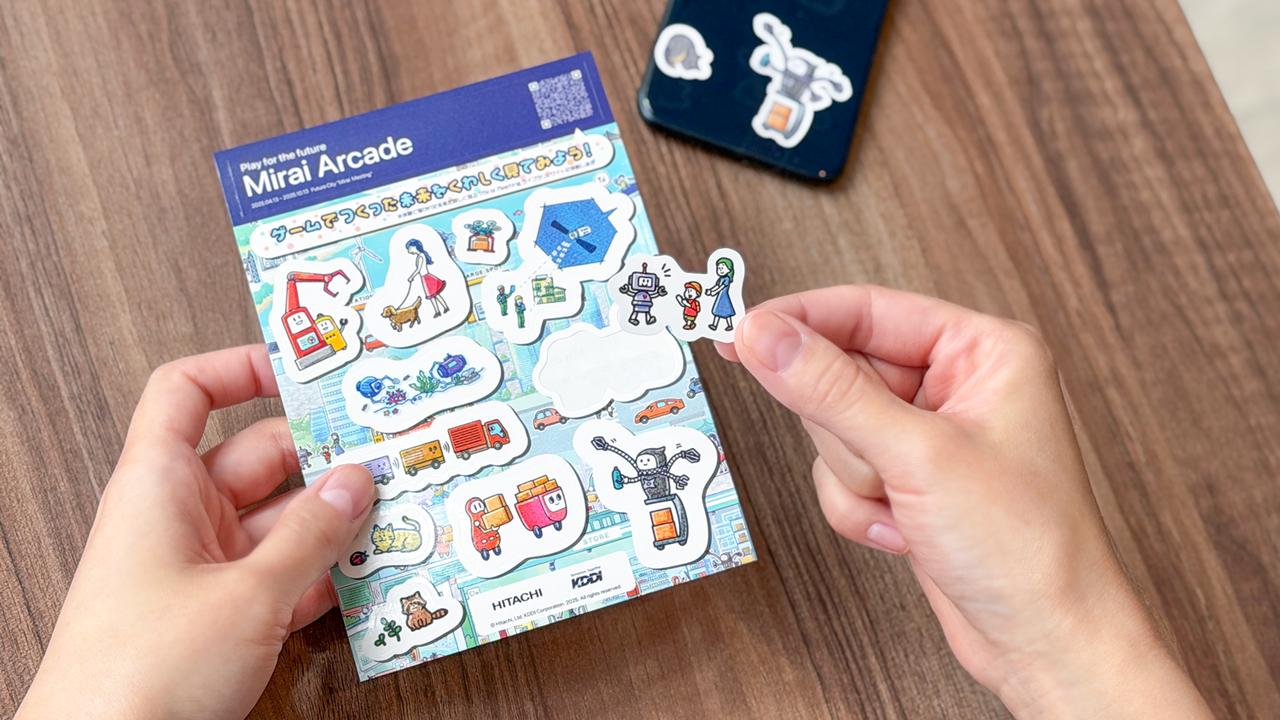
Konishi: Watching the venue in person, I saw a lot of parents and kids posing for photos in front of the screen showing their game results. That’s the kind of scene you wouldn’t see at an exhibit where you just sit and watch a video. While they were absorbed in the game, it was probably hard for them to take in every fine detail of the technology. But I’d be glad if, when families look back on what made the Expo fun for them, they realize there was actually something meaningful behind the game, and use that as a starting point to think about the future.
—— Beyond the physical venue, you also rolled out a Virtual Mirai City inside the metaverse. Yamaguchi, you were in charge of designing the experience there. How did you think about the trade-off between real-world constraints and the freedom of virtual space?
Yamaguchi: I was involved in things like creating content for citizen-participatory infrastructure maintenance inside the metaverse.
When people talk about the metaverse, attention tends to go to experiences you can’t have in real life, like flying. What I focused on was the opposite question: Precisely because it’s a virtual space, what kinds of constraints should we put in place?
For example, in the content where you experience maintenance work at a railway station, we don’t let players walk freely onto the tracks. This isn’t simply a movement restriction. It’s grounded in the premise that, in real life, citizens aren’t allowed in for safety reasons, so you take part in the maintenance work from a safe spot on the platform. Adding meaningful constraints like that gives players a real sense that, come 2035, this might be how they take part in society. That, I think, is where the key to realism lies.
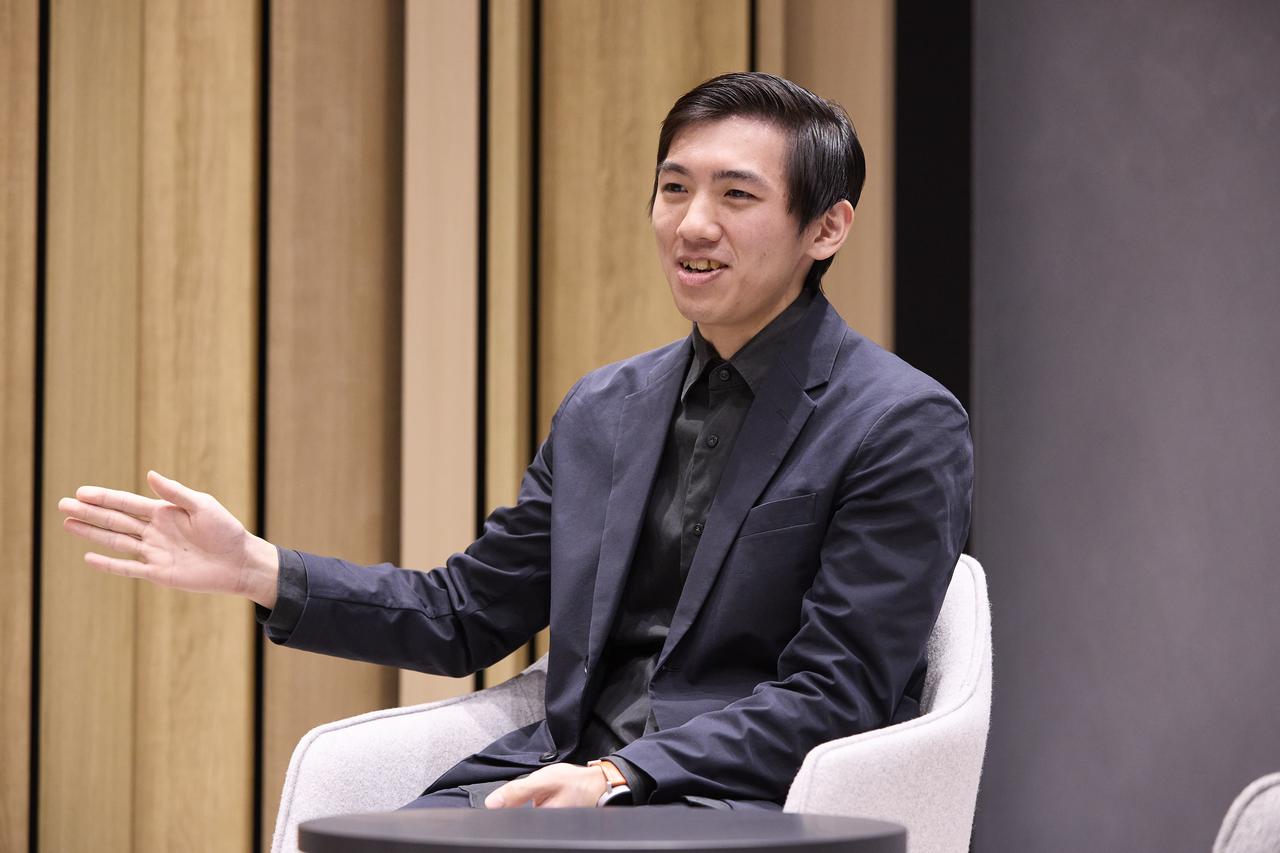
“For the metaverse content, meaningful constraints were what gave it a sense of realism,” Yamaguchi explains
——You can see how the physical and virtual play complementary roles.
Yamaguchi: That’s right. The physical venue was packed with visitors, so it was hard to slow down and really take in the information. The virtual space, on the other hand, was something you could reach from your smartphone at home or anywhere else, and explore at your own pace.
You feel the heat of making a choice at the physical venue, then go into the virtual space to explore the social challenges and the technical details behind it, deepening your understanding. Going back and forth like that, we thought, would give people a sharper image of the future society.
Clues for the Future, So the Conversation Doesn’t End at the Exhibit
——You also created a piece of related content called Clues for Building the Future City Together (a pattern language). What was the thinking behind it?
Konishi: Mirai Meeting put forward future scenarios packed with technologies and ideas for tackling social challenges. But there’s no real point if it ends up consumed as just a story and forgotten. We wanted people who saw the exhibit to keep thinking about the future after they left the Expo grounds. As a vehicle for that, we used a method called pattern language to organize the information that had been on display.
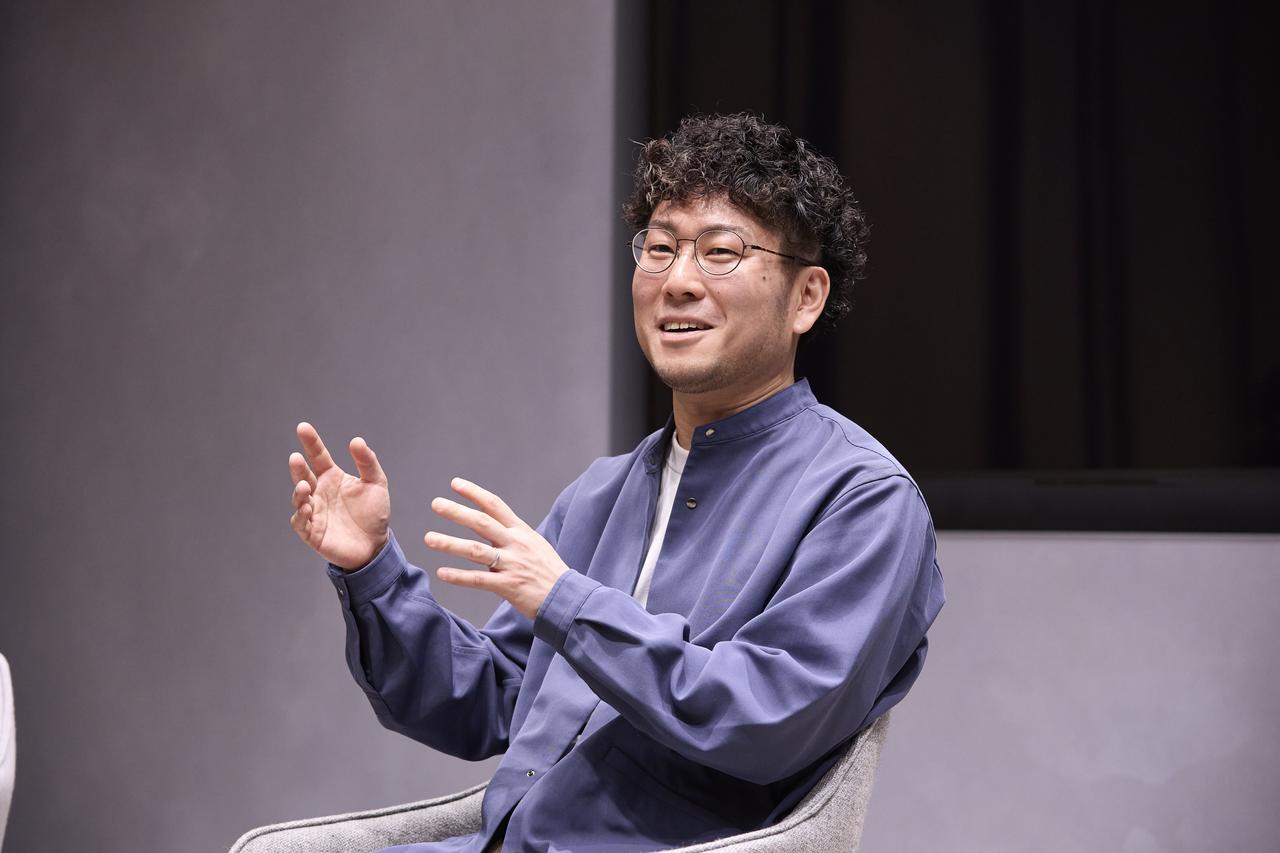
Konishi talks about pattern language
Pattern language was originally a method used in architecture, where you take the forms and techniques behind successful examples and extract them as patterns. We took problems that might come up in the future city and paired each with the technologies that could solve them along with the kinds of behavior individual citizens might engage in, gathering each set into a single card, or clue.
* Perspectives for co-creating a Future City (PDF file)
Konishi: The crucial thing about these clues is that we don’t take the stance that Hitachi or KDDI has the answers. Our aim was to make a tool that asks people questions, such as “What would you like the future neighborhood you live in to be like?” and “What technologies and solutions would you want to use to make that happen?”, and gets a conversation going.
We designed it as a communication tool that lets anyone who cares about the place they live, including children, take part in conversations about how a community should grow, regardless of whether they have specialist knowledge of urban planning. We have also run visiting classes at elementary and junior high schools across Japan, where we use the tool together with the kids to think through the issues their own communities face and possible ways to address them.
Rather than companies unilaterally deciding what a community’s problems are and handing over solutions, this is about giving the people who actually live there a starting point for building the future themselves. That, I believe, is the entrance to what we mean by a participatory society.
Rewriting the Requirements with the Power of Design
—— How will Hitachi connect what came out of the Expo to its Social Innovation Business? What changes have you felt since this project was wrapped up?
Kato: I’m now involved in a project that’s drafting a vision of society for 2040, and I feel like the experience from the Expo carries over directly.
Working through the Expo planning, I’ve absorbed an approach to drawing the future from a people-centered perspective, asking questions like “When 2040 comes around, how will people’s values have changed?” and “What kind of life will they be living?”, and then working backward to figure out the technologies needed to get there.
Closing the gap between what technology can do and what people want to do, and rendering the result as a convincing picture of the future. Capturing the many sides of how people live, and asking questions that respond even to their conflicting feelings, is work I believe designers should be at the center of, making sure it gets done.
Mori: When we co-create with researchers, they take the challenges put in front of them very seriously and work hard at coming up with technical solutions. Precisely because of that, it’s important that we as designers raise the quality of both the challenges to be solved and the solutions, alongside them.
Using future foresight tools and methods, we form hypotheses like “If the future plays out this way, these new challenges should arise.” Then we think the solutions through together. By doing that, the technologies and knowledge that researchers have can connect to society in more meaningful ways. Things that fall through the cracks if you only use words come into clearer view once you turn them into pictures or experiences. The way conversations begin shifts as a result. That’s something I really feel.
—— Konishi, you have a background in product design. Have you noticed any changes?
Konishi: It’s not a huge change, but I’ve started paying more attention to what’s around the product and to the timeline.
For example, on a project to design an electric vehicle (EV) charger, fitting it in with the place where it’s installed has always been part of the goal. But now, beyond simply making the shape attractive and the experience easy for users, I’m far more conscious of questions like “When this gets placed in a community, how will the flow of people change?”, “Could a single product or service be the spark that shifts the relationships among the people who live nearby?”, and “How will this product or service look to the people who don’t use it?”
It isn’t just designing a product within the requirements you’ve been given; it’s offering proposals that take in the future context the product will sit in. Expanding your viewpoint that way, I believe, also raises the value of the product itself. Holding onto questions like these and translating them into concrete product designs, with all the constraints involved, is still very much a work in progress for me, but it’s something I want to keep tackling.
Yamaguchi: I’m now working on the actual system development needed to bring the kind of participatory society we drew at the Expo into reality.
At the Expo we drew a future where citizens take part, but honestly, if you ask me, “Would you really want to take part in maintaining infrastructure yourself?”, I can’t quite say yes with confidence. After all, it comes with responsibility.
That’s exactly why we need mechanisms where people take part because it’s fun, and where they can see it as their own concern. I want to use my engineering skills to bring it down to a level where it can actually be implemented.
—— Finally, could you share what you’re looking to do from here?
Kato: What is being asked of designers shouldn’t only be making the user interface (UI) you’ve been handed or producing illustrations. We need the kind of resolve to rewrite the requirements specification itself.
Rather than just turning the requirements you’ve been given into a finished form, you put forward proposals proactively, saying things like “Isn’t the real challenge over here?” or “In 2040, this kind of value is going to be needed.” This Expo project, I think, was three years of doing exactly that: hands-on work, again and again, on the things no one was raising but that needed to happen.
Yamaguchi: That’s right. I also think it’s important to keep getting our work out into the world.
Don’t keep things contained within the company. Even if it’s unfinished, put it out there and grow your circle of collaborators outside. The Expo project itself was built on co-creation with outside partners. If you put something out there with the kind of energy that says, “this is interesting!”, the people who feel the same way will come together. From there, something new starts. That’s the kind of motion I want to keep going.
Mori: The big stories matter, but at the same time, I want to value an approach of letting things soak in gradually.
Not only at landmark events like the Expo, but in the everyday work, bringing in a future-facing perspective little by little. Without overdoing it, but steadily. Lately I’ve been thinking that piling up that kind of work is, in the end, probably the most sustainable way of doing things.
Konishi: The Expo has been wrapped up, but the insights and networks we built through it carry on. Our outputs are still very much works in progress, and I want to keep exploring a participatory future. If anyone reading this article is intrigued, please, let’s build something together. I’ll be waiting.
Profile
Note: Titles and affiliations are as of the time of the interview.
Kaoru Kato
Future Society Project Member and Senior Designer
UX Design Department,
Design Center, Digital Innovation R&D,
Research & Development Group, Hitachi, Ltd.
Since joining Hitachi, Ltd., Kato has worked across a broad range of fields, including service design, scenario design, and user interface/user experience (UI/UX) design for the Cyber-PoC business value simulator, investment services, and authentication services. After developing Mirai Meeting, he has been engaged in service design for envisioning future societies, along with use-case design and UI/UX design for AI agents that support frontline operations.
Mashu Mori
Future Society Project Member and Designer
Strategic Design Department,
Design Center, Digital Innovation R&D,
Research & Development Group, Hitachi, Ltd.
Mori joined Hitachi, Ltd. in 2023 after completing a master’s degree in Design at Tokyo University of the Arts. He has been involved in a wide range of design projects, including content development for the Expo 2025 Future City exhibit, future foresight workshops, service design and UI design, and the design of workshops for talent development.
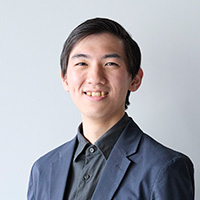
Taiyo Yamaguchi
Future Society Project Member and Designer
Strategic Design Department,
Design Center, Digital Innovation R&D,
Research & Development Group, Hitachi, Ltd.
Yamaguchi joined Hitachi, Ltd. in 2022. He has worked mainly on design engineering tasks such as prototyping, and is also involved in planning and running PR activities for internal and external events.
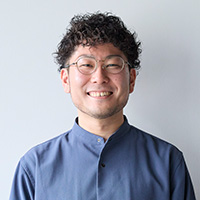
Shota Konishi
Future Society Project Member and Senior Designer
UX Design Department,
Design Center, Digital Innovation R&D,
Research & Development Group, Hitachi, Ltd.
Konishi joined Hitachi, Ltd. in 2021 after working on product design at an office equipment manufacturer and UI/UX design at an HR-tech startup. He has worked on product and UI/UX design for industrial equipment, and on future foresight activities and solution development in the home appliance space. Since the close of the Expo, he has been engaged in service design aimed at promoting electrification and the use of renewable energy at the local level.