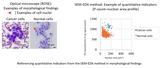
Machine learning analyzes flow cytometry test data and presents multiple candidate diseases with probabilistic output
Hitachi, Ltd. and the National University Corporation Kyushu University Hospital (hereinafter “Kyushu University Hospital”) have developed a machine learning-based AI technology that supports physicians using flow cytometry (FCM)*1 in the differential diagnosis*2 of hematologic malignancies.
Because treatment methods differ significantly depending on the disease subtype of hematologic malignancy, narrowing down candidate diseases is essential to selecting the most suitable treatment for each patient. FCM assays are important tests that aid in diagnosis by measuring markers that indicate cellular characteristics. However, the interpretation of test data requires a high level of expertise and experience, and increasing numbers of cases have led to a growing analysis workload. The newly developed AI technology utilizes marker positivity rates*3 within cell populations as features and performs classification in a way that closely reflects the actual diagnostic process. By presenting multiple candidate diseases with probabilistic output across a total of 16 classes,*4 including leukemia, lymphoma, and multiple myeloma, the technology helps organize information to support decision-making and facilitates new clinical insights. Training and evaluation using more than 500 clinical cases from Kyushu University Hospital confirmed performance with an area under the curve (AUC)*5 of 0.9 or higher in multi-class classification across multiple diseases.
Going forward, Hitachi will expand evaluation through proof of concept (PoC) testing with medical institutions and testing companies and aims to implement the technology as a diagnostic-support tool that helps enhance both the quality of healthcare and sustainability.
*1 Flow cytometry (FCM): A testing method that measures cells individually to determine the presence and intensity of markers, such as those expressed on the cell surface.
*2 Differential diagnosis: The process of narrowing down a disease name (disease subtype) from among diseases with similar symptoms.
*3 Marker positivity rate: The proportion of cells determined to be positive for a specific marker within a target cell population.
*4 16 classes: The number of candidate disease categories covered by this AI, representing the combined total of the leukemia model and the lymphoma/multiple myeloma model.
*5 AUC: An evaluation metric that expresses discriminative performance on a scale from 0 to 1; the closer the value is to 1, the more accurate identification of disease classes is.
Background and issues
Cancer incidence is expected to continue increasing worldwide. According to the latest statistics from the International Agency for Research on Cancer (IARC), the number of newly diagnosed cancer cases reached 20 million worldwide in 2022. Against this backdrop, differential diagnosis for selecting the most appropriate treatment for each patient, along with systems that help limited healthcare personnel interpret test results, is becoming increasingly important. Because treatment methods for hematologic malignancies vary significantly depending on the disease subtype,*6 differential diagnosis relies on tests of collected cell/tissue samples after abnormalities are identified through blood tests. Flow cytometry (FCM), which plays an important role in this process, measures markers that indicate cell types and characteristics by irradiating cells with laser light and analyzing the resulting test data. However, the interpretation of test data in FCM requires a high degree of expertise and experience, including gating*7 and the subsequent assessment of combinations of marker information. Furthermore, with the number of tests climbing, the associated analysis workload is also growing. There is thus a need for technologies that can present information that supports decision-making for differential diagnosis in a more understandable manner, enabling efficient analysis while appropriately narrowing down candidate diseases.
*6 Disease subtype: Hematologic malignancies are broadly classified into three categories: leukemia, malignant lymphoma, and multiple myeloma.
*7 Gating: The process of selecting the cell population to be analyzed from FCM test data.
Features of the technology and solutions developed to solve these issues
To address these challenges, Hitachi and Kyushu University Hospital developed a machine learning-based AI technology that supports differential diagnosis by classifying candidate diseases for hematologic malignancies from FCM test data and presenting multiple candidates with probabilistic output. The key features of the technology are as follows.
1. AI model utilizing marker positivity rates to enable classification similar to physicians’ diagnostic approaches
The AI model uses marker positivity rates obtained through FCM assays (the proportion of cells exhibiting specific characteristics) as features and is designed to follow the interpretation process performed after gating. As a result, physicians can review output using indicators that they routinely employ, which is expected to help standardize diagnostic work.
2. Differential diagnosis support through presentation of multiple candidates with probabilistic output
Rather than presenting a single disease name, the technology provides multiple candidate diseases (currently 16 classes) with probabilistic output, offering physicians information to support decisions in differential diagnosis. This has the potential to facilitate diagnostic reasoning by enabling physicians to confirm consistency with their preliminary hypotheses when narrowing down candidate diseases and identify potential candidates that may not have been considered previously.
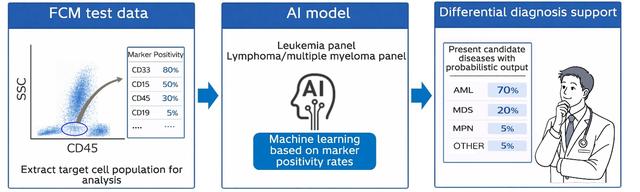
Figure 1. Conceptual image of Differential Diagnosis Support AI utilizing FCM test data(Note) Some illustrations in this figure were created using generative AI.
Confirmed results
Two models were developed: one for leukemia and another for lymphoma and multiple myeloma. Training and evaluation were conducted using more than 500 clinical cases from Kyushu University Hospital. In the multi-class classification of multiple diseases, we confirmed performance with an AUC of 0.9 or higher, which is one of the evaluation metrics.
Looking ahead
Going forward, Hitachi will expand evaluation through proof of concept (PoC) testing with medical institutions and testing companies and will continue improving the technology to enable seamless use within clinical workflows. In addition, Hitachi will position the technology as one of the technologies supporting Lumada 3.0 and aims to implement it as a diagnostic-support technology that contributes to both the quality of healthcare and sustainability through the integration of AI and domain knowledge in the healthcare field.
Part of these results was published as an abstract at the European Hematology Association (EHA) 2026 Congress, held in Sweden from June 11 to 14.
For more information, use the inquiry form below to contact the Research & Development Group, Hitachi, Ltd. Please make sure to include the title of the article.
https://www8.hitachi.co.jp/inquiry/hitachi-ltd/hqrd/news/en/form.jsp