

Today’s industries face a range of challenges, including a sharp decline in the workforce, disruptions in the transfer of skills and know-how, increasingly complex global geopolitical risks, and supply chain fragmentation. Against this backdrop, expectations are rising rapidly for Agentic AI, or AI agents, which can autonomously identify issues and execute tasks. The catalyst was Anthropic’s release of the Model Context Protocol (MCP) in November 2024, establishing a standard protocol for using AI agents. MCP eliminates the need for user companies to create custom application programming interfaces (APIs). Recognizing this development early, Hitachi, Ltd. developed an internal AI agent platform. Yuya Isoda, Chief Researcher, Data & Knowledge Management Research Department, Digital Infrastructure Innovation Center, Digital Innovation R&D, Research & Development Group, Hitachi, Ltd., explains the initiative.
(Note: Titles and affiliations are as of the time of the interview.)
By Kazumichi Moriyama, Science Writer
AI Agent Platform Supporting Hitachi’s “Customer Zero” Strategy
Viewing itself as its first customer, or “Customer Zero,” Hitachi is actively putting AI and digital technologies into practice. By making the outcomes of the initiative available to customers and partners for their own use, Hitachi is working to build an AI ecosystem and contribute to society. The Research & Development Group is advancing research and development of an AI agent platform supporting this strategy. By consolidating AI agents that incorporate the Hitachi Group’s diverse skills and know-how on the platform, building an ecosystem, and developing multi-agent technologies capable of handling complex and wide-ranging operations, Hitachi seeks to transform business processes for the AI era.
The initiative is distinctive in that Hitachi is conducting internal validation with a particular focus on back-office operations, where the return on investment is expected to be high. This approach is intended to improve operational efficiency across the Group and to provide customers with proven AI agents and know-how. Going forward, the Group will promote the rollout of successful use cases and the reuse of AI agents, while ensuring robust data protection. By sharing and utilizing AI agents across organizational boundaries, Hitachi will accelerate operational efficiency improvements and the creation of new value.
Hitachi views the target operations in a three-tier structure: business line operations in specialized domains; back-office operations such as risk management, QA (quality assurance), and procurement; and general operations such as translation and meeting minutes preparation. Among these, Isoda and his team are focusing on back-office operations. Given the hundreds of similar business processes across the Hitachi Group, successful use cases demonstrated in one part of the organization can be rolled out across the Group, delivering a high level of cost-effectiveness. For general operations, by contrast, the Group opted to use existing AI tools provided by other companies, while focusing on back-office operations, where it can create value unique to Hitachi.
Emergence of Standardized Technologies for Inter-Agent Collaboration and Tool Integration
In July 2025, a report released by the Massachusetts Institute of Technology (MIT), The GenAI Divide: State of AI in Business 2025, sent shockwaves through the industry. The report stated that “95% of generative AI projects have either failed or run into serious challenges,” highlighting the difficulty of using generative AI effectively.
Meanwhile, a survey published by Deloitte in 2024 found that nearly 90% of Japanese companies considered generative AI beneficial, and that nearly 60% had already begun in-house development. However, a one-year follow-up survey showed that a shortage of AI talent, insufficient governance, and the need to build AI and data infrastructure remained challenges. Many Japanese companies are looking to adopt generative AI but have yet to make it work effectively.
The period from 2022 to 2024, in particular, was marked by rapid technological change and a proliferation of technologies, including generative AI models, RAG (retrieval-augmented generation), and fine-tuning. Isoda notes that the 95% failure rate cited in the MIT report reflects factors such as the difficulty of assessing return on investment in such a complex environment, as well as companies’ struggles to keep pace in developing the necessary governance and infrastructure.
From the second half of 2024, however, the landscape began to change. Standardized mechanisms for inter-agent collaboration and tool integration became available, including Anthropic’s MCP (Model Context Protocol), Google’s Agent2Agent (A2A), and Agent Skills, which extend the capabilities of AI agents. A series of high-performance models also emerged. With these developments, the core functions required for an AI platform were in place.
Establishing a Shared Platform to Create the Collective Intelligence of “One Hitachi” and Bringing the “Adventurers’ Guild” to Life
The AI agent platform project entered full-scale development in April 2025, driven by Isoda’s growing sense of urgency. Across the Hitachi Group, hundreds of generative AI projects were already moving forward in parallel, with each department developing its own AI agents, using them separately, accessing data on its own, and then discarding them. Without an integrated framework for managing these agents, compliance and governance could break down. Failure to properly separate agents from data could also make effective access control impossible. As individually developed agents built up over time, they could ultimately become liabilities with little return on investment. These problems would become especially serious once the projects entered full-scale operation.
In response, Isoda envisioned a shared platform that would serve as a hub for AI agents and create the collective intelligence of “One Hitachi.” The Hitachi Group operates across an extremely diverse range of businesses, including mobility, energy, industry, IT, and finance. In such an organization, barriers between departments are often high, making communication and knowledge sharing costly. Even so, it is essential for the Group to create synergies and increase earnings by realizing a conglomerate premium.
Isoda and his team wanted to use agents to break down barriers among departments. They positioned AI agents not merely as automation tools, but as an infrastructure foundation for circulating knowledge.
Generative AI is used to bring together knowledge and know-how across barriers among business domains, customers, departments and divisions, regions, and languages. The know-how held by individual personnel is transferred to AI agents. Sales support agents, market research agents, presentation support agents, compliance-check agents, and others are shared on a common platform and can be combined as needed, enabling knowledge to be reused across departments. The concept is an “Adventurers’ Guild,” a hub where business professionals gather.
Three Strategic Pillars: SaS, Ecosystem, and Democratization
The project is built on three pillars. The first pillar is the evolution from SaaS (Software as a Service) to SaS (Service as Software). While conventional SaaS requires users to operate services directly through a GUI (Graphical User Interface) or API, SaS enables them to do so indirectly through agents. Context management therefore shifts from humans to agents.
Carrying out business operations requires dealing with laws, internal rules, and enterprise systems for attendance management, procurement, finance, and other areas, all of which are interrelated in complex ways. As a result, the inability to identify where necessary resources are located leads to a decline in operational efficiency. The ideal state is one in which agents equipped with rules and user manuals perform business tasks in compliance with the relevant requirements. This makes it possible to achieve productivity-enhancing IT, such as improving operational efficiency, and risk-control IT, such as strengthening compliance and governance, in an integrated manner.
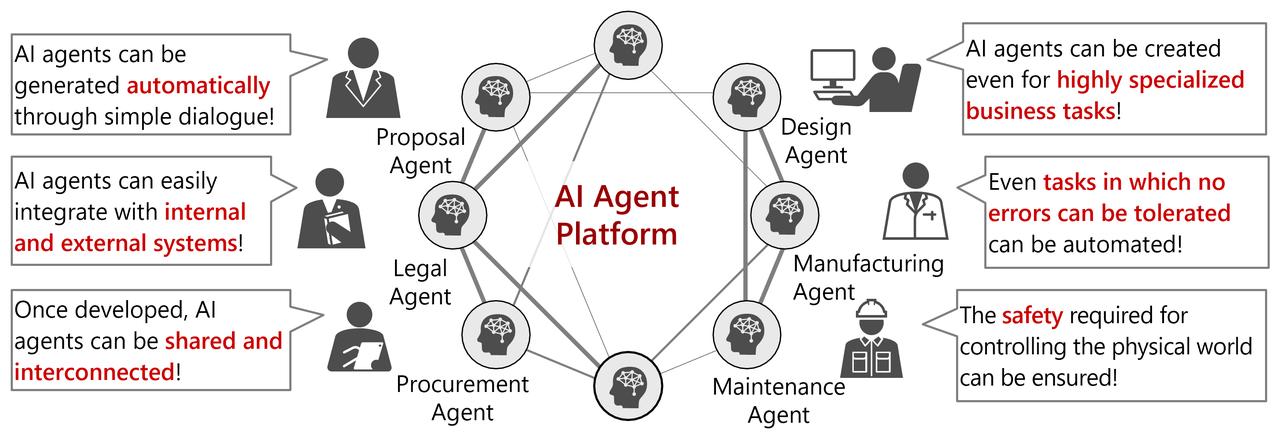
Conceptual diagram of ideal support enabled by an AI agent platform
The second pillar is sustainable system growth through an AI agent ecosystem. A single agent is limited in what it can accomplish. By combining multiple agents, however, it becomes possible to support a wide range of business tasks. As AI assets accumulate, the range of applicable business tasks and available options expands, while new development costs decrease. Turning agents, MCP tools, RAG, workflows, and other related resources into shared assets streamlines future AI agent development. Furthermore, when users proactively develop and use agents themselves, the “democratization of AI” can be achieved while keeping development costs low. This growth model is being pursued through the initiative.
In practice, AI agents are used by frontline teams. The third pillar is Agent Maker, a mechanism designed to resolve operational issues and promote the broader adoption, or democratization, of AI agents across frontline operations. When an employee submits a request such as, “I am currently having difficulty with work related to XX. Please create an agent to support it,” Agent Maker can analyze the background and issues in detail, identify applicable use cases, automatically generate a suitable agent, and register it.
The generated agents are then registered in the AI agent platform database, where anyone in the company can search for and use them. As of May 2026, several thousand task-specific agents have been registered and made available for search and use. They also undergo vulnerability and quality assessments before being rolled out across the Group. For departments handling highly confidential information, the platform provides an “agent dispatch” function. Access control is implemented by sending agents to where the data is stored, rather than moving the data itself.
Providing a Mechanism for Seamless Handover of Tasks Between Humans and AI Agents
The system consists of two core services: an agent service and a workflow service. The former serves as a single entry point for calling agents in a chat format. Users only need to select an agent and give instructions in natural language; the agent then operates internal and external systems accordingly.
The latter is a platform for managers and IT departments to design and automate complex business processes. It supports a wide range of use cases, including custom RAG development, approval workflows, batch processing, and reporting to supervisors.
An essential design feature is that humans and AI agents can use the same workflow. Workflows are designed and tested by humans and, if no issues are found, handed over to AI agents without modification. Seamless handover from humans to AI is incorporated as a system requirement. The backend supports industry-standard interfaces such as MCP and A2A, enabling connection to a wide range of internal and external SaaS applications and systems. Technologies developed by the Research & Development Group are also shared across the Hitachi Group through the platform, which serves as a venue for proof-of-concept testing.
Project KPI: Increasing the Number of Fans
“Services are developed, but no one uses them.” Unfortunately, this is a common issue. The AI agent platform project is also actively pursuing onboarding initiatives to turn the platform into a practical capability and ensure its sustained adoption. Steady activities are also being carried out to build a culture around AI agent use, including AI agent workshops in which participants gain hands-on experience with AI agents, templates that allow anyone to try agents and workflows at any time, short videos, consultation sessions, and community management.
Setting KPIs is the most critical. “The number of agents and the time savings in operations are important indicators. However, we place even greater emphasis on improving satisfaction among users and citizen developers: having frontline teams enjoy using the platform and increasing the number of fans,” says Isoda.
AI implementation often fails because organizations struggle to achieve adoption, rather than because of the technology itself. Adoption will not progress without an environment that motivates users to engage with the platform. Only when users become fans can the ecosystem grow autonomously. Promoting the technology alone does not increase acceptance among frontline teams.
A phased approach is essential for incorporating AI agents into business operations. Consider customer service, for example. Today, representatives respond directly to customer inquiries. In the first phase, Human-in-the-Loop, agents prepare draft responses, which humans review and send. In the second phase, Human-on-the-Loop, agents respond autonomously while humans monitor the process. As accuracy improves further, the process moves to full automation. This phased implementation promotes frontline adoption and ensures quality and compliance.
As a practical example, Isoda cited data integration between a sales support system and Excel. The sales department needed to automatically generate Excel reports based on information in the system. Agent-based automation achieved this, but it also revealed a new issue: data was being maintained in duplicate in the system and Excel. Isoda and his team therefore proposed redesigning the process itself so that AI-generated reports would be returned to the system and viewed as dashboards. They supported not only automation but also feeding the generated reports back into the system and changes to the process as an integrated set. This form of closely engaged support is leading to business transformation that goes beyond mere tool deployment.
As a result, more than 1,000 agents have been made available internally. Agents that deliver strong results are deployed in production, achieving reductions of tens of thousands of work hours per year.
The Essence of AI Agent Competition Is Organizational Design
Isoda says the team has developed a platform that is not dependent on trends and has completed internal verification. What matters is maintaining a clear perspective on what must fundamentally be done. In other words, enterprise architecture must be redefined for the AI era. This includes establishing governance for data handled by agents, implementing access control and integrated ID management for internal systems, clarifying operational rules and defining KPIs, and training AI talent and building a structure to promote implementation. Without all of these elements, frontline adoption of AI agents will not progress.
Automatically building task-specific agents requires redefining enterprise architecture for the AI era. To implement AI efficiently, governance, compliance, and security must be established in advance.
Since this project is being pursued as “Customer Zero,” an internal practice initiative for developing proposals for external customers, it is not tied to any particular AI model, but instead combines various models as needed. AI agent competition is no longer driven by model performance alone; it is increasingly becoming a competition in organizational design.