By leveraging distributed manufacturing knowledge, the system quantitatively generates multiple production line configuration options tailored to on-site requirements, enabling improved operational efficiency and faster decision-making.
Hitachi and the HUN-REN Institute for Computer Science and Control (SZTAKI) have developed a technology that supports the creation of production systems capable of both stable supply and improved production efficiency in manufacturing.
In response to changes such as demand fluctuations, labor shortages, and equipment failures, the technology automatically plans the entire process from formulating production-line operation and modification policies to deriving line configuration proposals. By linking generative AI with mathematical optimization*1, the technology responds to on-site requirements such as “increase production volume by 20%.” It aggregates, organizes, and utilizes manufacturing knowledge distributed across departments and systems to define operation and modification policies, then progressively determines the required parameters*2 and their values, and quantitatively derives multiple line configuration proposals suited to the shop floor. This streamlines the work of reviewing line configurations, including process division and equipment assignment, which has traditionally tended to depend on the knowledge of individual operators, and supports rapid decision-making on the shop floor.
In a verification study of battery production-line reconfiguration work, the technology maintained quality equivalent to that of proposals prepared by experts*3 while reducing the labor required for review work by up to 87.3% compared with conventional manual work.
Going forward, Hitachi will verify the scope of application and the benefits of implementing this technology through PoCs with manufacturing customers, while accumulating on-site knowledge through its own operations as “Customer Zero.” Hitachi aims to expand the technology to production facilities and manufacturing lines across a wide range of industries, including battery, automotive, pharmaceutical, medical device, and industrial machinery manufacturing. Hitachi will also contribute to strengthening the competitiveness of manufacturing and realizing sustainable manufacturing by supporting more advanced and faster operation and modification of production lines. Leveraging its research expertise in production systems and mathematical optimization, SZTAKI will continue to advance research and development to further enhance this technology, expand its scope of application, and explore the applicability of newer generative AI approaches.
*1 Mathematical optimization: A method for mathematically determining an optimal solution that maximizes or minimizes an objective function such as cost or productivity under given conditions and numerical values.
*2 Parameters: Conditions (items) and numerical values required when considering line configurations and equipment assignments.
*3 Equivalent quality: In battery production-line reconfiguration work, quality was evaluated from viewpoints such as process division and equipment assignment by comparing the line configuration proposals with those prepared by experts.
Background and issues
In manufacturing, even as changes such as demand fluctuations, labor shortages, and equipment failures continue, there is a need to build production systems that can achieve both stable supply and improved production efficiency. Therefore, it is important to review production-line operation and modification policies and configurations according to the situation and respond flexibly while minimizing the impact on supply.
At the same time, such reviews require many decisions, from formulating operation and modification policies based on on-site requirements to considering specific line configurations such as process division and equipment assignment. In recent years, mathematical optimization models*4 have increasingly been used; however, determining policies suited to the shop floor requires knowledge of manufacturing sites and production engineering, and translating those policies into optimal parameter settings also requires knowledge of mathematical optimization. Because only a limited number of experts possess this knowledge across domains, and because the information needed for review is distributed across multiple departments and systems, it has been difficult to proceed quickly with line configuration reviews in response to changes.
*4 Mathematical optimization model: A model that represents production-line conditions as mathematical formulas and is used to obtain optimal process divisions and equipment assignments.
Features of the technology and solutions developed to solve these issues
To address these challenges, Hitachi and SZTAKI developed an integrated automatic planning technology that uses generative AI to organize on-site requirements into production-line operation and modification policies and set the required parameters, while using mathematical optimization to derive line configuration proposals that are feasible on the shop floor and aligned with those policies. This enables production-line reviews that support rapid decision-making toward both stable supply and improved production efficiency, without depending on the knowledge of individual operators. The features of the technology are as follows.
1. Integration of generative AI and mathematical optimization to connect on-site requirements to executable line configuration proposals
Conventionally, the work of converting on-site requirements—such as a desire to increase production volume by 20%—into parameters handled by a mathematical optimization model has been performed manually. Because the information formats differ, incorrect parameters have sometimes been set. In this technology, generative AI processing is divided into three stages: “determination of production-line operation and modification policy,” “determination of parameter items,” and “determination of parameter values.” After organizing the operation and modification policy, the technology sequentially determines the necessary parameter setting items and specific values, thereby automatically converting on-site requirements entered in natural language into appropriate parameters. In addition, mathematical optimization quantitatively derives multiple line configuration proposals, including process division and equipment assignment, within a range that is feasible on the shop floor.
2. Hierarchical knowledge reference technology that utilizes distributed manufacturing knowledge and connects the information needed for review
Conventionally, knowledge related to production-line operation and modification policies, the correspondence between policies and parameter settings, and knowledge about the parameter settings themselves have existed separately across multiple departments and systems. As a result, it has taken time to collect the necessary information and use it in reviews. In this technology, manufacturing knowledge is aggregated and structured into a form that is easy for generative AI to use. It is then hierarchically organized to correspond to the three processing stages of “determination of production-line operation and modification policy,” “determination of parameter items,” and “determination of parameter values,” enabling generative AI to efficiently reference the information needed at each stage. This makes it possible to aggregate, organize, and utilize distributed knowledge, quickly deriving line configuration proposals that meet on-site requirements without depending on the knowledge of individual operators.
3. Evaluation and explanation technology that enables comparison of multiple proposals and supports decision-making
This technology incorporates as knowledge how differences in the resources that constitute a production line—such as workers and equipment—affect costs, including labor and equipment costs, as well as workload. As a result, it can compare multiple line configuration proposals not only in terms of whether production is possible, but also from the viewpoints of cost and productivity. This makes it easier to confirm the differences among proposals and the reasons for selecting them, facilitates shop-floor reviews and proposals to upper management, and leads to faster final decision-making.
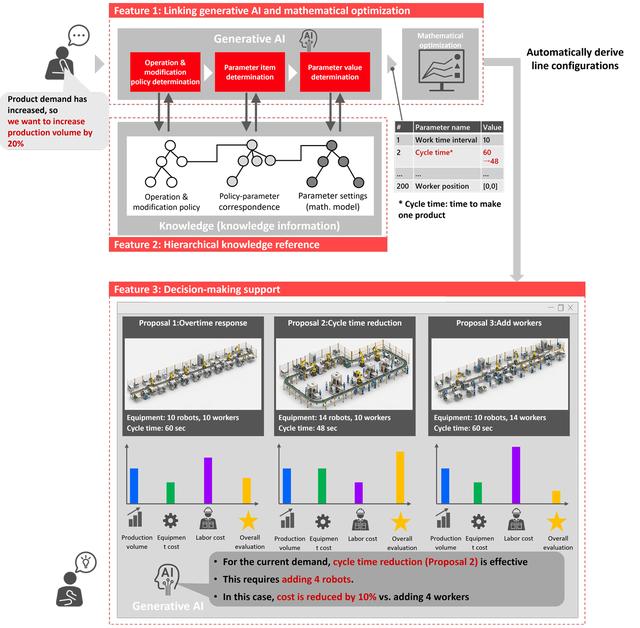
Figure 1. Example use of the technology that automatically plans from the formulation of production-line operation and modification policies, through parameter setting, to the derivation of line configuration proposals.
Confirmed results
The effectiveness of this technology was verified in battery production-line reconfiguration work. The verification confirmed that, for on-site requirements such as increasing production in response to rising demand or minimizing downtime in the event of equipment failure, the technology can automatically and consistently plan the process from organizing production-line operation and modification policies to setting the required parameters and deriving line configuration proposals. Furthermore, compared with the target work conventionally performed manually by experts, the technology maintained line configurations—including process division and equipment assignment—at a quality equivalent to the proposals prepared by experts, while reducing the labor required for review work by up to 87.3%.
Looking ahead
Going forward, Hitachi will advance verification of the scope of application and the benefits of implementing this technology through PoCs with manufacturing customers, while accumulating on-site knowledge obtained through its own operations as “Customer Zero.” Hitachi aims to expand the technology to production facilities and manufacturing lines across a wide range of industries, including battery, automotive, pharmaceutical, medical device, and industrial machinery manufacturing. In addition, Hitachi will position this technology as one of the domain-specific AI models that constitute the “IWIM (Integrated World Infrastructure Model) *5” proposed by Hitachi, and will support further advancement and acceleration of production-line operation and modification through the fusion of domain knowledge and AI. Through these efforts, Hitachi will contribute to strengthening the competitiveness of manufacturing and realizing sustainable manufacturing. Leveraging its research expertise in production systems and mathematical optimization, SZTAKI will continue to advance research and development to further enhance this technology, expand its scope of application, and explore the applicability of newer generative AI approaches.
Part of this achievement is expected to be published in the international academic journal Procedia CIRP in August 2026. *6
*5 IWIM: An intelligent foundation model announced by Hitachi in November 2025. It was developed to implement physical AI safely and reliably in mission-critical social infrastructure, based on multi-layered OT knowledge accumulated over many years and a deep understanding of physical phenomena. It integrally supports and advances the design, construction, and operation of equipment and systems through appropriate judgment and control even under complex conditions.
*6 Kaichiro Nishi, Daisuke Tsutsumi, Takahiro Nakano, Youichi Nonaka, Gianfranco Pedone, András Kovács, Krisztián Balázs Kis, Ágoston Dalotti, and József Váncza, “Automated Production Line Configuration Technology Through the Integration of LLM and Mathematical Optimization Techniques,” Procedia CIRP, 2026.
Related Information
SZTAKI-related page
https://sztaki.hun-ren.hu/en/current/news/2026/hitachi-project-at-hun-ren-sztaki-en
For more information, use the inquiry form below to contact the Research & Development Group, Hitachi, Ltd. Please make sure to include the title of the article.
https://www8.hitachi.co.jp/inquiry/hitachi-ltd/hqrd/news/en/form.jsp