
CAR-T cell therapy is an innovative cancer treatment that enhances the cancer-attacking ability of T-cells, the key cells to the patient’s own immune system. This therapy works by introducing Chimeric Antigen Receptor (CAR) genes into T cells—immune cells that recognize and attack various foreign substances via protein molecules called T cell receptors. Its strength lies in combining the advantages of antibodies, which recognize cancer cells with high specificity, and T cells, which have strong aggressive activity against cancer cells. However, challenges such as long lead times, high costs, and limited efficacy against solid tumors remain with this therapy.
To enhance the efficacy of such treatments, Hitachi is engaged in research and development involving cells that have been genetically modified to possess special functions, which they call “DesignCell®.” Tomohiko Okuda and his team at the DesignCell Project, Research and Development Group, have developed a groundbreaking platform that predicts the optimal gene sequences for improved CAR function on a computer by combining generative AI and protein language models. This technology dramatically increases the evaluation capacity from a few dozen cell types per year to the scale of 100,000, enabling a drastic reduction in experimental costs and the time needed for development. This approach, where digital and biotechnology are integrated, is expected to serve as a key to rapidly delivering safe and powerful next-generation immunotherapies to patients. We spoke with Dr. Okuda about the technological approaches for efficiently designing and optimizing next-generation CAR-T cell therapies utilizing machine learning.
By Kazumichi Moriyama, Science Writer
Mechanism of Chimeric Antigen Receptor T Cell (CAR-T Cell) Therapy, a Cancer Immunotherapy
Cancer treatments include surgery, radiation therapy, and chemotherapy, constituting the three major therapies. In addition to these therapies, immunotherapy, which uses the patient’s own immune system, has begun to gain widespread use in recent years. One such treatment is Chimeric Antigen Receptor (CAR) T-cell therapy, a method in which a patient’s own T-cells are extracted and genetically modified to specifically recognize and attack cancer cells before being returned to the patient’s body.
CAR protein is a type of transmembrane protein expressed on the cell membrane surface, mainly composed of three domains. First is the single-chain variable fragment (scFv) of an antibody, which specifically recognizes a specific cancer antigen. This fragment links the variable regions of the antibody’s H chains and L chains, and by incorporating a gene corresponding to a target marker, it can accurately recognize antigens on the surface of cancer cells.
The second is a domain that extends the recognition site outward from the cell surface and anchors the protein to the cell membrane. It functions to maintain an appropriate distance from the cell membrane, allowing flexible movement of the scFv.
The third is the intracellular signaling domain. Once a target is recognized, it sends activation signals (to start attacking cancer cells) to T cells.
CAR-T cells, which are created by introducing an artificial CAR gene into a patient’s T cells, are designed to specifically identify and destroy cancer cells using the immune system.
In 2012, a team led by Professor Carl June at the University of Pennsylvania, which had been conducting research for many years, administered the treatment to Emily Whitehead, who was suffering from acute lymphoblastic leukemia (ALL). Emily, then 6 years old, overcame severe side effects and conquered cancer. Professor June and his colleagues subsequently developed the CAR-T cell therapy drug Kymriah® in collaboration with Novartis. The drug was approved by the U.S. Food and Drug Administration (FDA) in 2017. This marked a major milestone in cancer immunotherapy.
Research and development on CAR-T cell therapy continue to advance and strengthen its persistence, targeting capabilities, and control mechanisms. As a form of personalized medicine that integrates immunotherapy, gene therapy, and cell therapy, it is bringing about dramatic progress, especially in the treatment of blood cancers.
The specific treatment process is as follows. First, T cells are isolated and collected from the patient’s blood, and then the CAR gene is introduced using a viral vector. The CAR-T cells created in this manner are cultured in large quantities and returned to the patient’s body via intravenous drip. Then, they directly target and destroy cancer cells in the body.
In Japan, too, multiple products have been covered by health insurance since 2019, primarily for relapsed or refractory blood cancers, providing new options for refractory diseases that resist conventional treatments. However, obstacles still remain: indications must be expanded for solid tumors such as stomach and lung cancers; side effects such as cytokine release syndrome must be controlled; the manufacturing process, which currently takes anywhere from several weeks to over a month for cell modification and proliferation, must be shortened; and high medical costs and regional disparities are caused by the concentration of certified medical institutions with advanced facilities in urban areas.
To overcome these challenges, Hitachi is accelerating research to integrate digital and biotechnology. Hitachi has been leading the development of automated culture equipment that replicates the expertise of skilled professionals with an aim to supply high-quality cells stably and in large quantities. It has a background in realizing practical applications such as iPS cell automated culture equipment. The company also has an integrated management platform using data that connects complex processes from cell collection, manufacturing, and transportation to administration, ensuring safety. Furthermore, it provides pharmaceutical companies with “B3 Analytics,” a biomarker discovery platform that uses AI to rapidly explore factors affecting drug efficacy from vast amounts of data and presents them as mathematical formulas. Hitachi also holds total engineering technology for cell culture processing facilities, and its initiatives in CAR-T cell therapy are an extension of their expertise.
Rapid Development Through the DesignCell® Development Platform and the DBTL Cycle
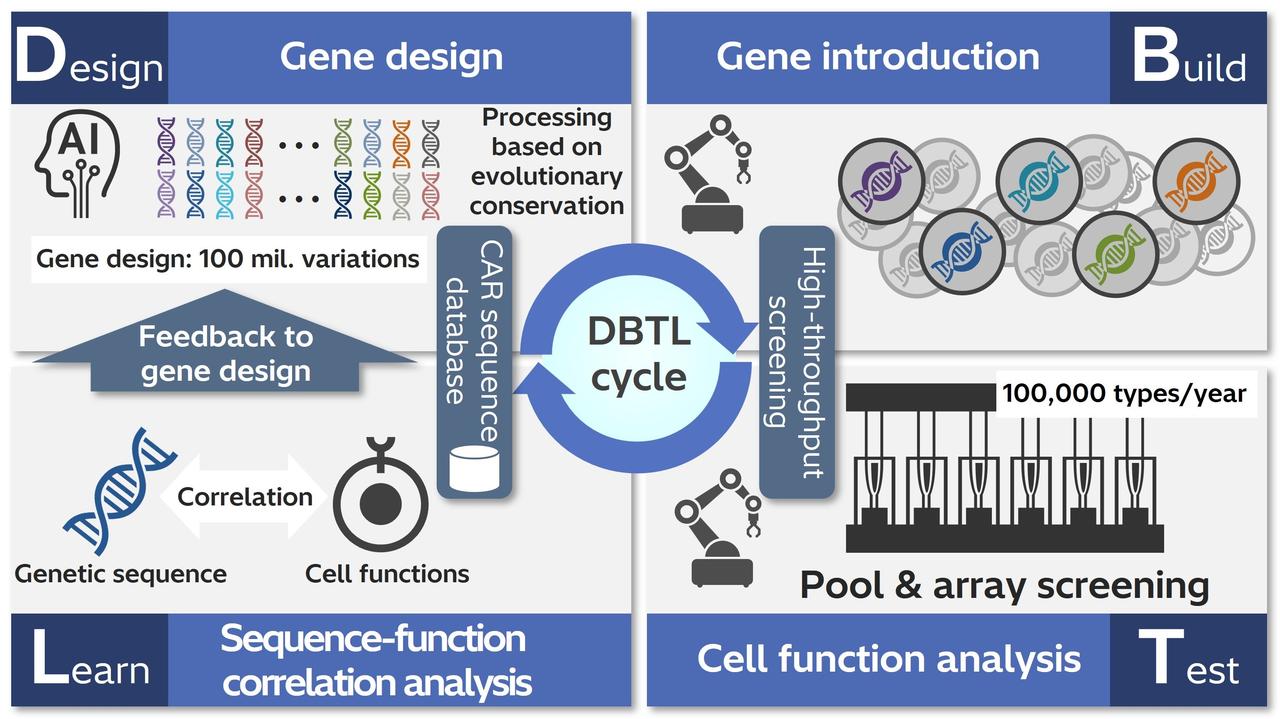
The “DesignCell® development platform” developed by Hitachi’s R&D group uses AI and automation technologies to efficiently search for optimal CAR-T cells. By combining automated gene sequence generation using generative AI with high-throughput cell evaluation, it is now possible to design and evaluate cell types at a scale of 100,000 types per year—over 1,000 times the conventional capacity—making the development of next-generation safe and effective CAR-T cells a reality.
The “DesignCell® development platform” maximizes drug efficacy by running the following Design-Build-Test-Learn (DBTL) cycles multiple times.
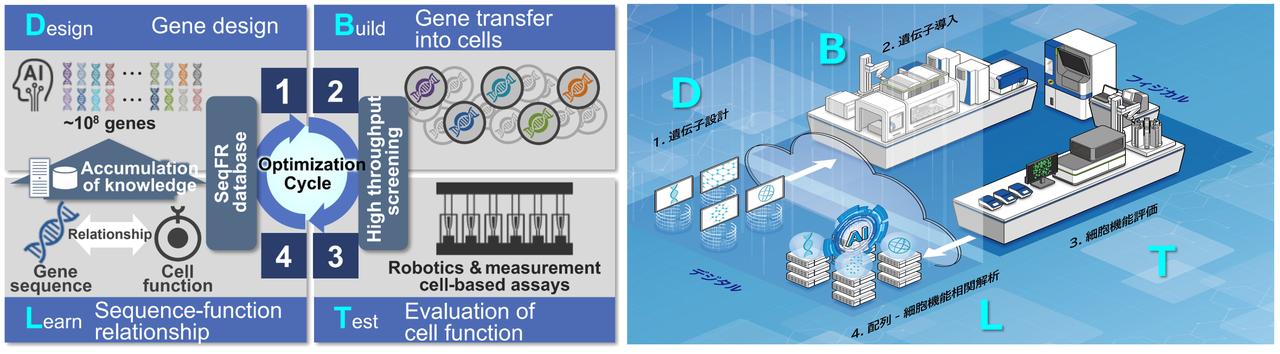
Design: Prepare a base gene sequence corresponding to the desired cell function, along with a group of gene fragments with sequence variations via mutagenesis.
Build: Using these components, a group of candidate design cells, each carrying a single distinct gene, is created. Gene introduction into cells is automated using a robotic system for high-throughput screening.
Test: High-throughput screening (large-scale automated evaluation) is used to identify cells that exhibit the intended functions and to assess the strength of those functions. By utilizing automated equipment such as cell sorters, it is possible to automatically evaluate the cytotoxic strength of CAR-T cells against cancer cells for up to 14,000 types of cells at once. In this way, by combining “pool screening (single-cell-level analysis)” and “array screening (automated functional analysis),” approximately 100,000 evaluations can be conducted per year.
Learn: Cells that exhibit high activity are isolated, and the specific gene fragment sequences they possess are identified. A large amount of data is obtained based on proprietary information linking gene sequences to functional activity, (e.g., which sequences confer high performance). By combining these data with information from open databases including academic literature, AI that uses machine learning to generate optimal gene sequences is built. Use of this gene sequence generative AI allows effective designing of new CAR gene sequences encompassing 100 million possible combinations.
By following these DBTL cycles, it is possible not only to create the targeted cells with high efficiency—achieving in a few months instead of 10 years it would take manually—but also to produce cells that are highly functional and safe. Furthermore, by utilizing the know-how from automated iPS cell culture technologies that Hitachi has researched and developed over the years in cell manufacturing, it will become possible to deliver “DesignCell®” more quickly and cost-effectively.
Fine-Tuning Protein Language Models Using “Artificial CAR Sequences” to Improve Performance for Predicting Protein Functions
Cellular functions are believed to vary depending on gene sequence design. However, it is often unclear which functions are associated with particular sequences. The advantage of this method lies in its ability to enable such designing using AI. The key is sequence design utilizing a CAR-specific protein language model, which leverages a large-scale language model specialized for proteins, known as the protein Language Model (pLM). The pLM is an AI model capable of designing novel proteins, predicting functions, and conducting homology searches by treating the amino acid sequences that make up proteins as word sequences. For example, ESM-2, an open-source model developed by Meta AI, enables highly accurate three-dimensional structure prediction from a single structure. As it can make predictions quickly with less computational power, it is widely used for predicting protein functions and identifying binding sites.
The project team at Hitachi performed fine tuning using various “artificial CAR sequences” created by generative models, adapting them to CAR-specific tasks. They trained the AI with the CAR-specific sequence features and functional patterns to enable highly accurate in silico prediction of cytotoxic activity (i.e., the ability to attack target cancer cells) prior to wet-lab experiments. Specifically, they extracted features (embedded representations) from fine-tuned ESM-2 and constructed an activity predictor by using the cytotoxic activity data of CAR mutants evaluated experimentally as the correct labels. This approach significantly improved the predictive performance of CAR-T cell activity (cytocidal effect).
A data-driven CAR design approach enables high-speed computational primary screening of promising variants with high therapeutic potential from millions of CAR sequence candidates on computers. By combining this approach with large-scale automated laboratory evaluation technology, it is expected that the drug discovery and development cycle for next-generation CAR-T cell candidates will be significantly shortened, leading to the development of more powerful and safer cell therapies. The team also intends to explore this base model for various options to suit specific applications.
Developing CAR-T Cells in Collaboration with Yamaguchi University, Aiming at Treating Solid Tumors
While showing high therapeutic efficacy against hematologic cancers, CAR-T cell therapy faces challenges such as side effects and limited efficacy against solid tumors, which account for the majority of cancers. In response, Hitachi, together with a research team led by Professor Koji Tamada from the Department of Immunology at Yamaguchi University Graduate School of Medicine, is advancing collaborative research toward the creation and practical application of next-generation CAR-T cells capable of exerting high therapeutic effects against intractable solid tumors.
(Yamaguchi University has begun joint research with Hitachi, Ltd. to improve CAR-T cell technology)
The “PRIME CAR-T cells” developed by Yamaguchi University are genetically modified T cells that produce two substances that further enhance immune responses: IL-7 and CCL19, in addition to CAR. Along with the functions of conventional CAR-T cells, this technology promotes the accumulation and proliferation of various immune cells at tumor site within the patient’s body. To date, data suggesting therapeutic effects against solid tumors have been obtained from multiple animal models and early-stage clinical trials.
As of May 2026, the project team is in the preparation phase of establishing concepts and research materials, with concrete results yet to come. By combining Yamaguchi University’s “Next-generation CAR-T technology for solid tumors” with Hitachi’s “DesignCell® development platform”, they aim to achieve both improved safety and high therapeutic efficacy, thereby contributing to the treatment of solid tumors.
Aiming for Cross-Disciplinary Contributions, from Seed Discovery to Manufacturing Support
Hitachi has no plans to directly involve in mass production of CAR-T therapeutics. Instead, it focuses on cross-disciplinary contributions spanning seed discovery to manufacturing support through automated cell culture equipment, and plans to support the creation of cell-based medicines through AI-driven design and high-throughput evaluation technologies. Dr. Okuda stated that the first goal is to achieve tangible results in the CAR-T field. Hitachi’s strength lies in the comprehensive capabilities of AI-based sequence design, high-throughput evaluation, and manufacturing automation equipment.
DesignCell® Development Platform to Realize Well-Being - Hitachi
youtu.be