The facility was reorganized into a hub of collaboration linking government, industry, and academia under the name “Kyōsō-no-Mori”—the “forest of co-creation”—in 2019 and certified as a Sustainably Managed Natural Site by the Japanese Ministry of the Environment in 2023. But as the trees age, a new challenge has arisen: how to reconcile the need to ensure safety with conserving nature. In response, the 100-Year Future Vision Project was launched in 2025 to preserve the forest for the next generation.
This article presents an in-depth discussion between two figures involved in the project. Seishi Hanaoka is Managing Director of the Research & Development Group and Director of the Kokubunji Site (Central Research Laboratory). Yohei Suzuki is CEO of landscaping company Suzuki Zoen Co., Ltd., a partner organization that has worked on conserving and maintaining the forest for over 60 years. They look back on the forest’s history and share their thoughts on the sustainable future Hitachi envisions.
NOTE: The titles and affiliations given in this article were current as of February 2026, when the conversation was recorded.
Discovering the Forest and Its Enduring History as Part of the Community’s Heritage
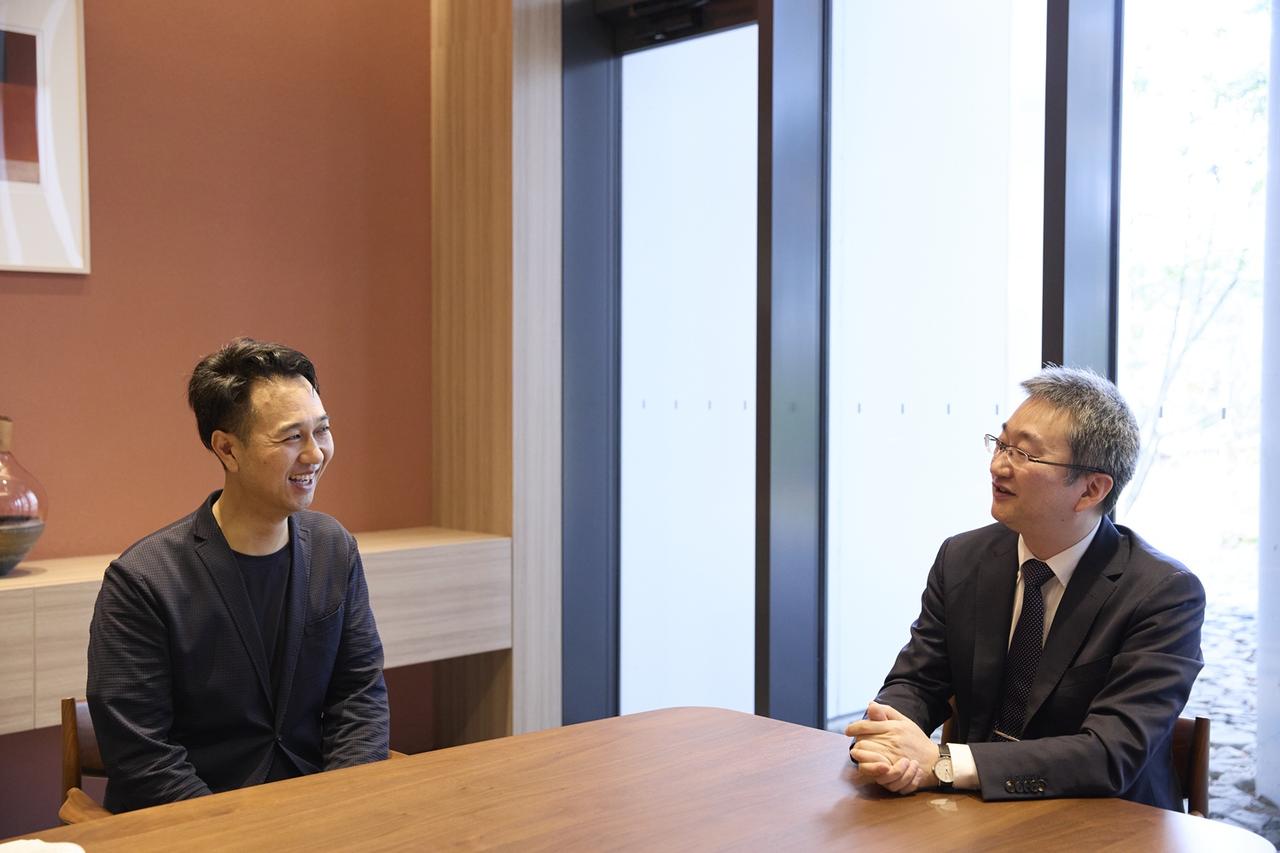
Hanaoka: I first set foot on these grounds in 1995, when I was in graduate school and came to get an idea of what it would be like to work at Hitachi. At any other company, the building is right there as soon as you pass through the entrance; here, though, you have to walk through the forest to get to the building. The people who showed me around talked about the forest before they even mentioned the research going on at the lab. Their words left a lasting impression on me. “When our research hits a dead end, we can just take a stroll through the forest and let our thoughts run free. If you’re a researcher, there’s no better environment than that.”
I joined Hitachi the next year. When I introduced myself in the company newsletter, I even wrote about how happy I was to be able to conduct research in this wonderful environment, surrounded by greenery. Even though I was under a strict word limit, I purposely included the word “greenery” anyway. That’s how deep an impression the forest made on me at the time.
Suzuki: As someone who works with plants, I’m delighted that you find the surroundings so pleasant.
Suzuki Zoen has been in business for some 80 years now, and we’ve been involved in managing Hitachi’s Kokubunji Site for most of that time. I first started doing the job myself about 15 years ago. When you joined Hitachi, I was still nine years old. My grandfather and father would bring me on days the garden was open to the public.
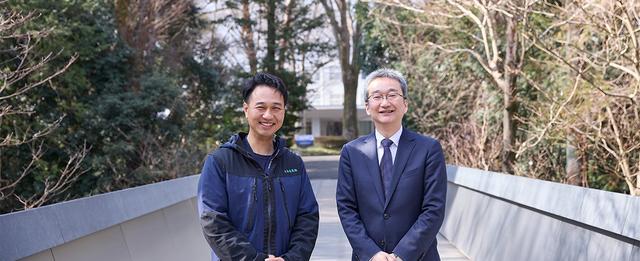
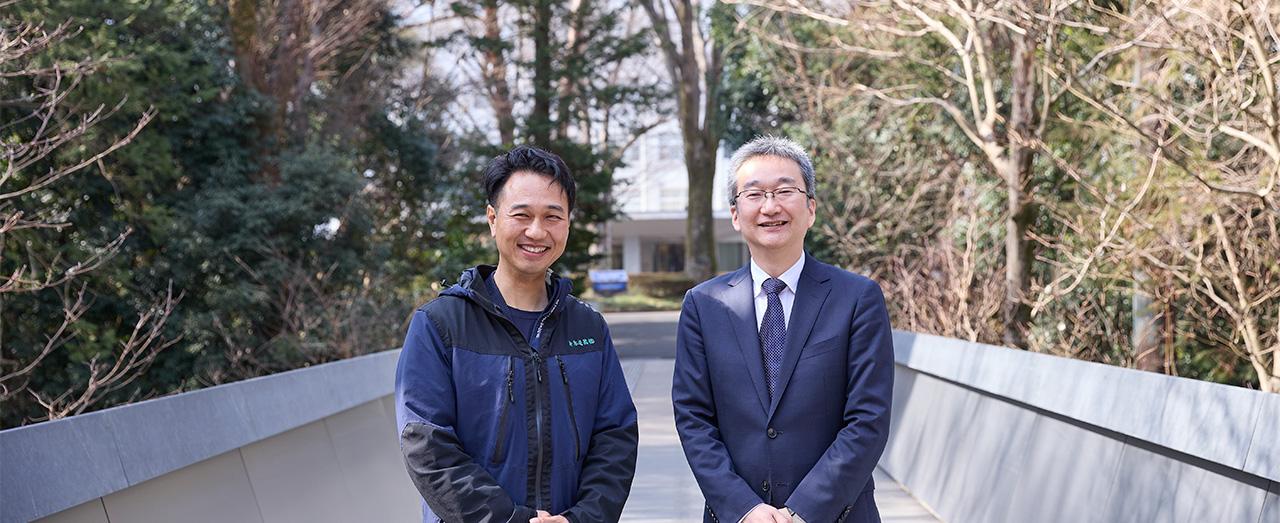
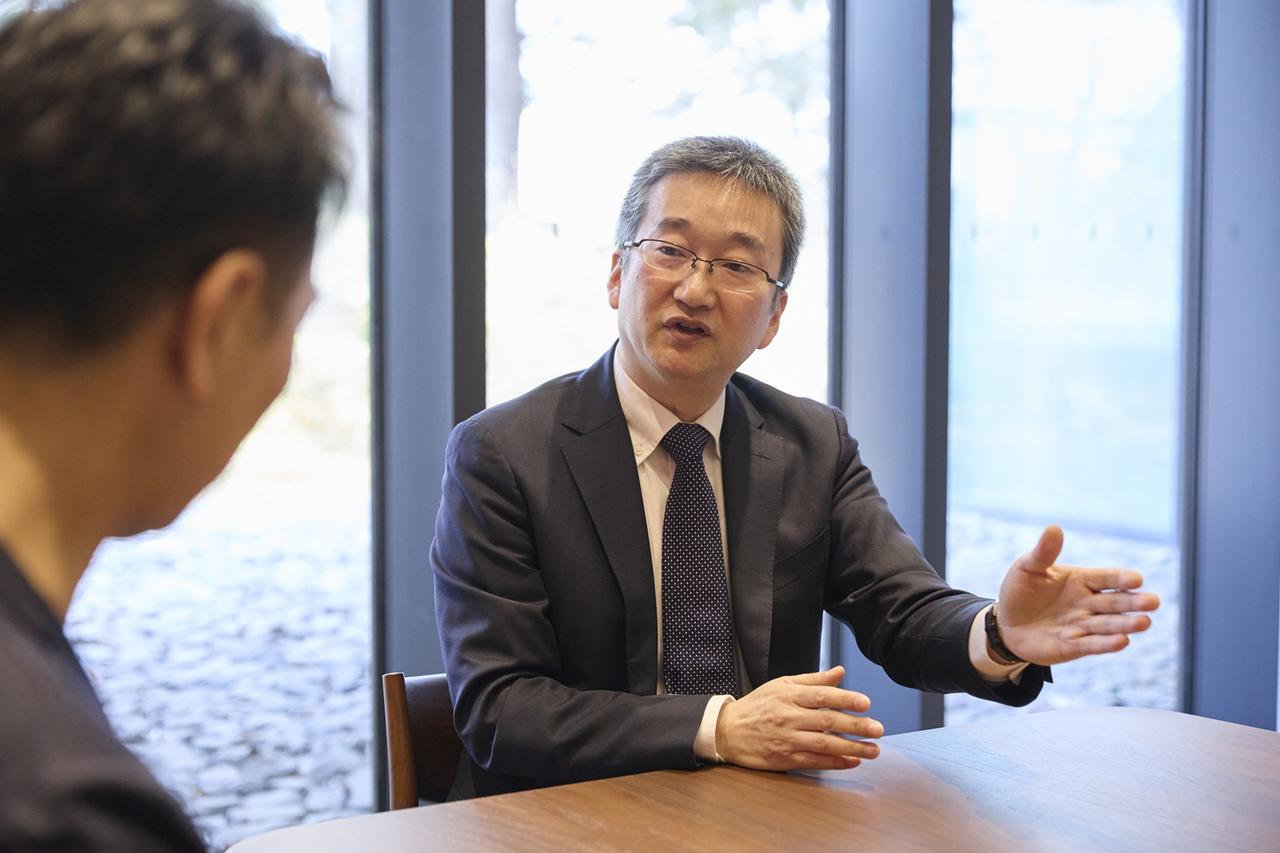
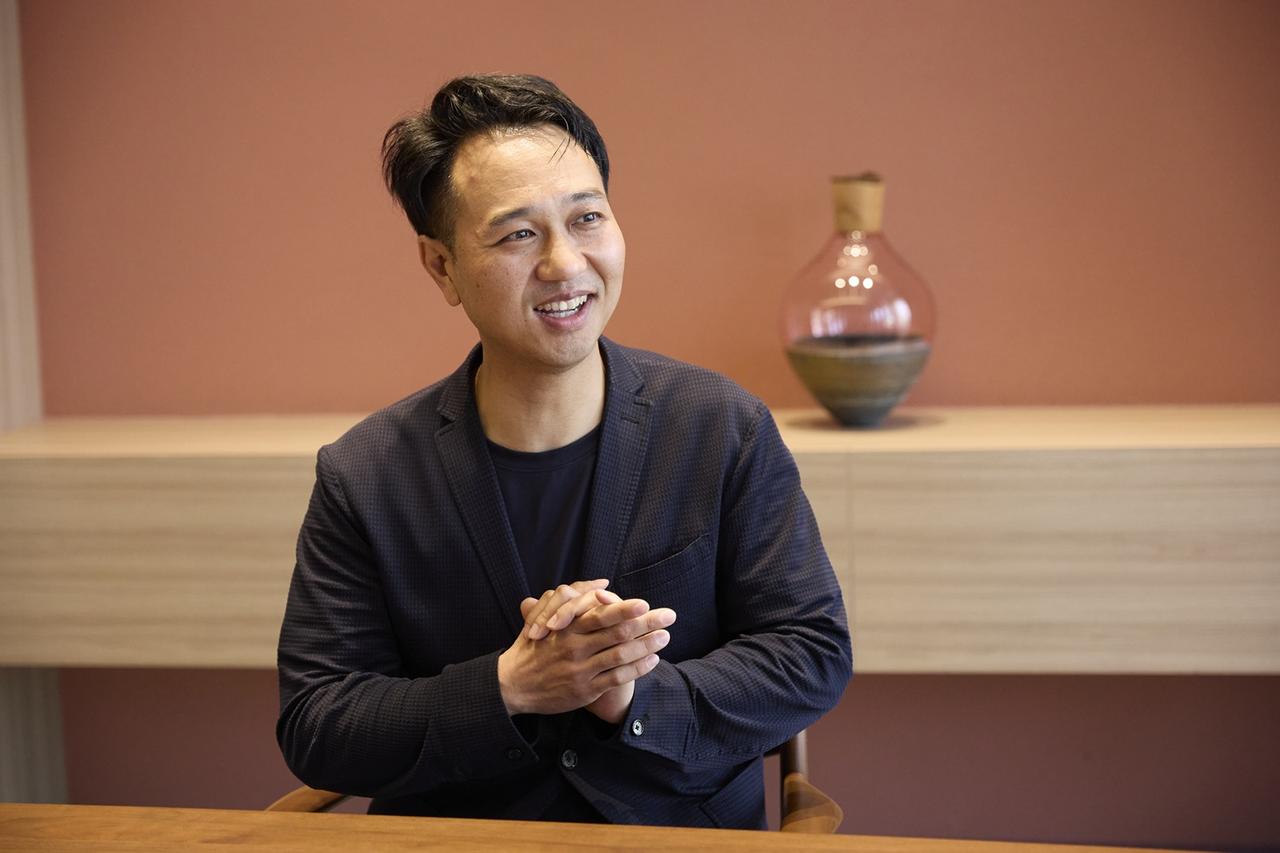
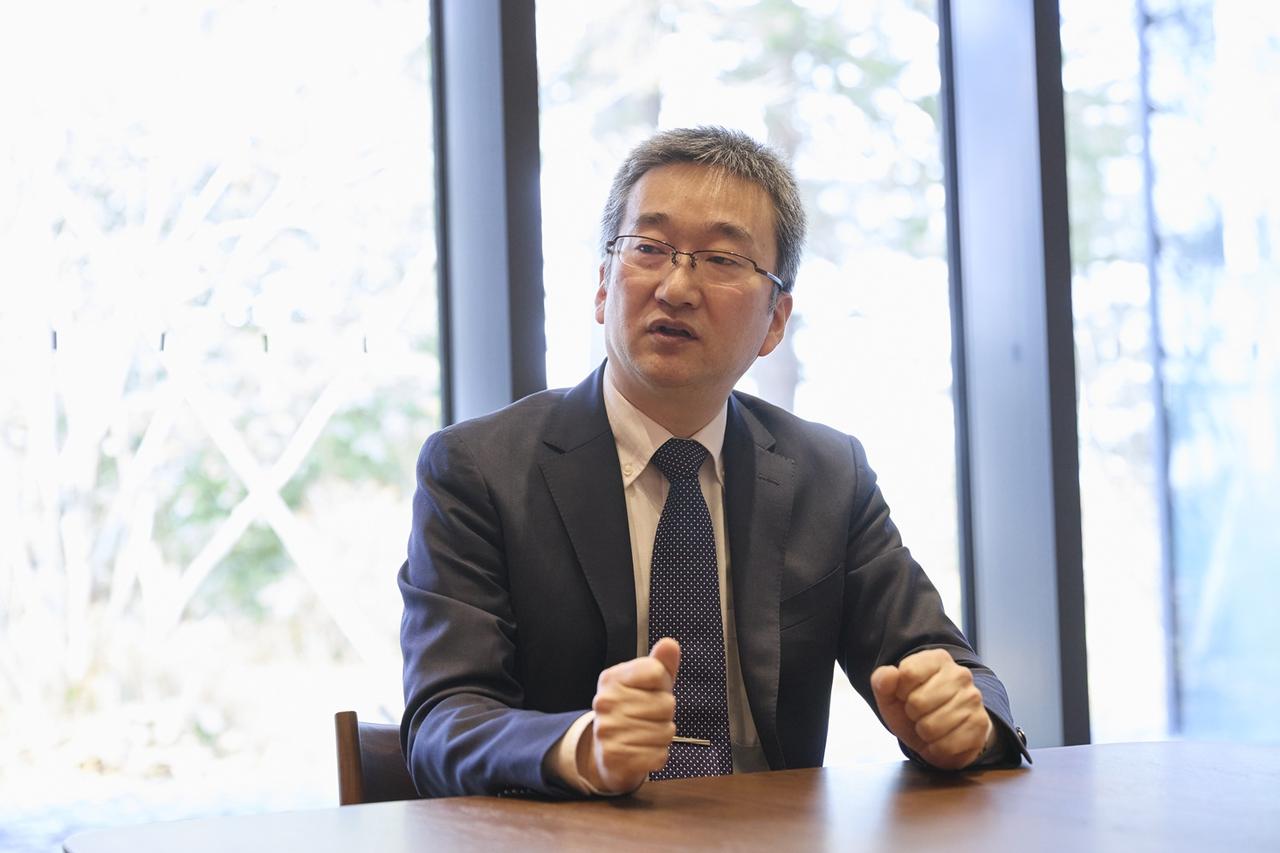
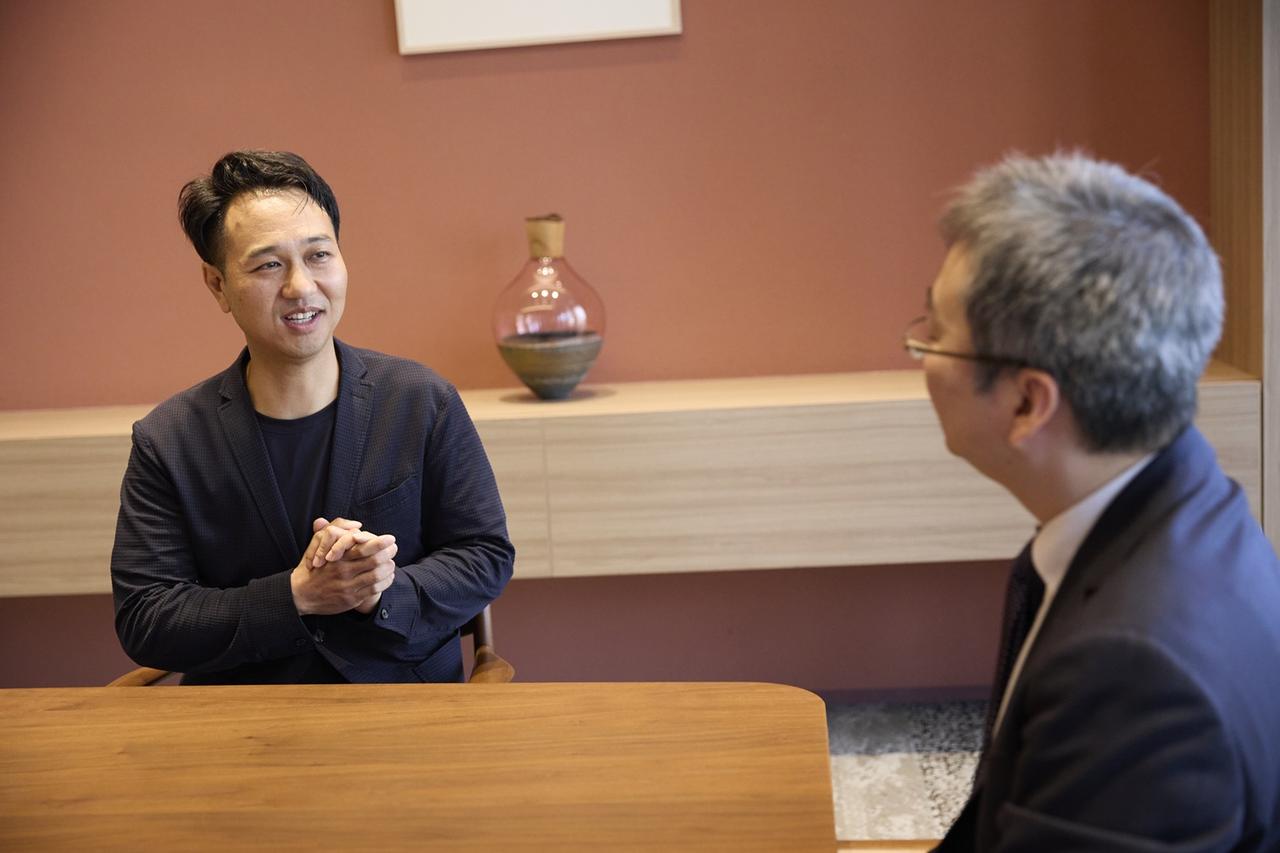
Left: Yohei Suzuki, CEO, Suzuki Zoen. Right: Seishi Hanaoka, Managing Director, Research & Development Group.
Hanaoka: Oh, really? Well, the garden is open to the public twice a year, in the spring and fall, and we get a lot of visitors from the area, including the mayor of Kokubunji. The place is so bustling with people that you might mistake it for an outdoor music festival. It certainly brings home how this forest doesn’t just belong to Hitachi; the people of the community treasure it as part of their heritage.
Suzuki: Kokubunji has been gradually losing greenspace, but this lab has steadily maintained it. As you can see from a look at old aerial photos, the configuration of greenspace has hardly changed at all. The approach leading from the main entrance to the building isn’t just a route for getting from A to B; it lets you cherish the time you spend walking by experiencing the forest. It seems to be telling you that making a beeline for your destination isn’t necessarily best option. That’s the striking thing about it.
With how urban Kokubunji is now, the traditional woodlands and farmlands are disappearing—but Hitachi still maintains this massive old-growth forest. As a resident of the community myself, I feel that’s something to be truly grateful for. It’s a valuable service.
“Don’t Cut Down Good Trees; Build Around Them.”
Hanaoka: When Kyōsō-no-Mori was established in 2019, one of our guiding principles was something Hitachi’s founder and first president, Namihei Odaira, said: “Don’t cut down good trees; build around them.”
To that point, the research laboratory was, in a way, an inner sanctum. From the outside, it was hard to tell what was happening there. Sitting behind business and sales, it was, I suppose, the furthest removed from the customer. But in the coming era, researchers will need to engage with customers’ concerns directly and work alongside them in creating new value.
We therefore established Kyōsō-no-Mori in a bid to fundamentally reposition our resources from internal Hitachi assets to a means of co-creation with customers.
Suzuki: Those words reflect the same spirit that has always inspired us when we’re working on-site. When I first started working on-site, my mentor would tell me in no uncertain terms not to go overboard when I did pruning. I didn’t really understand why at the time, to be honest, but as I built up work experience, I gradually came to realize how much loving care has gone into this forest.
Hanaoka: When designing the new Kyōsō-tō complex for the opening of Kyōsō-no-Mori, we adopted a layout that left as many of the existing trees in place as possible. The structure was segmented into four blocks. Instead of constructing a single monolithic cuboid building, we laid out the architecture to avoid the existing trees, resulting in a space with the forest extending into the building’s recesses. And the walkways connecting the pre-existing buildings with the Kyōsō-tō zig and zag, which also comes from going around the trees.
We also took care to protect underground water sources—including spring water from the Kokubunji Escarpment—and the archaeological remains from the Jomon era. To that end, the foundations of the existing building stayed in place below the two-meter level, forming the bearing stratum. We made every effort to avoid driving piles deep into the ground or performing other extensive excavation work when laying the foundations.
Still, for construction reasons, there was no way to avoid chopping down two large zelkova trees. But instead of consigning them to the scrapheap, we sawed them into boards and recycled them into a large table and wall paneling for the Kyōsō-tō. When we show customers around and tell them about that approach, it often resonates with them. This commitment to forest stewardship, I feel, really builds trust with customers.
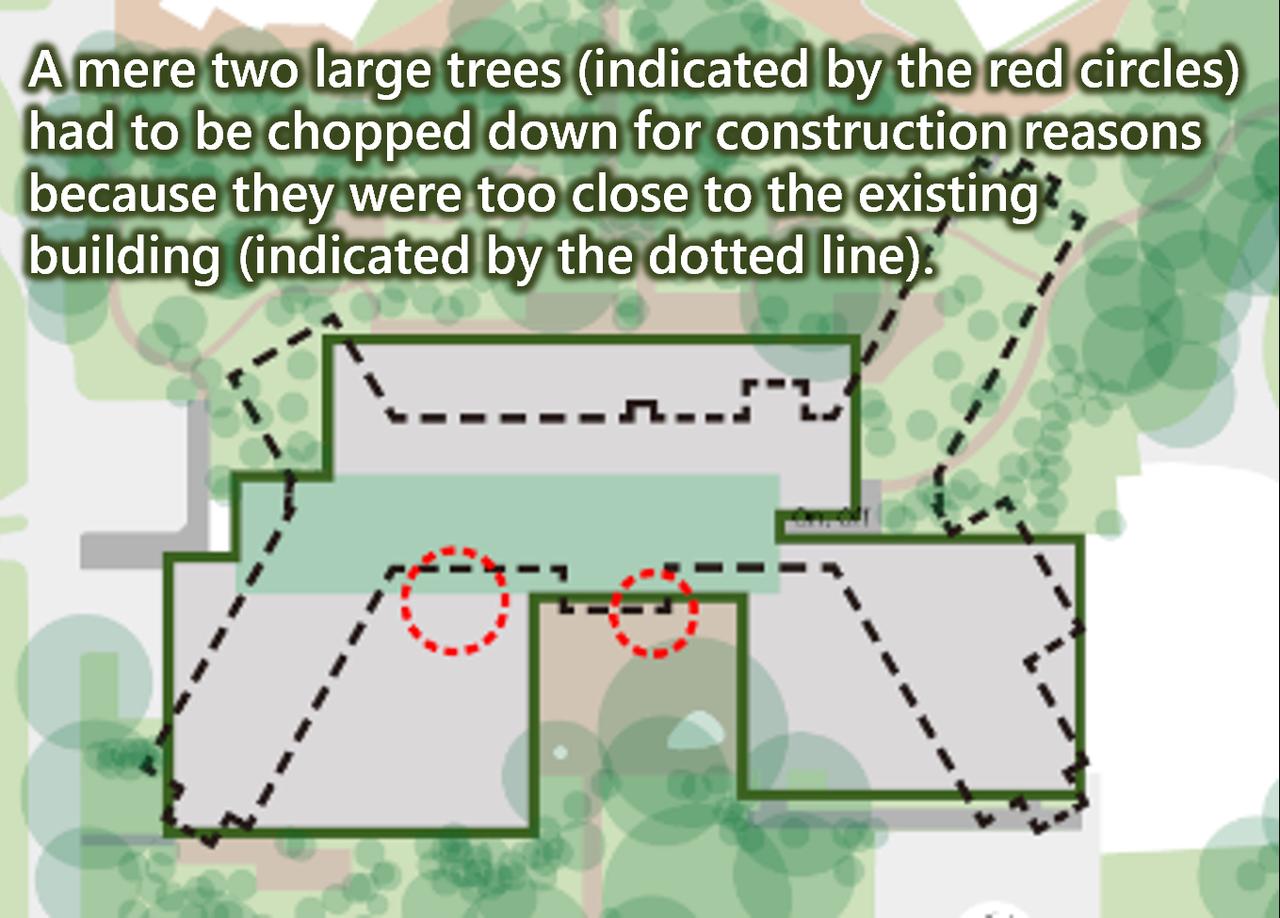
Suzuki: Trees that could be transplanted were dug up, roots and all, and temporarily planted elsewhere. Then, two or three years later, once construction work was completed, they were restored to their original location. That was our job.
Digging up trees and then restoring them actually takes much more effort, time, and money than buying and planting new trees from scratch. The reality is, fewer and fewer companies these days are willing to go that far to leave trees intact. That’s why, as landscapers, we were so delighted at Hitachi’s strong commitment to preserving every tree it could.
Certification as a Sustainably Managed Natural Site—and the Challenge of Living Up to It
Hanaoka: In October 2023, the Ministry of the Environment certified Kyōsō-no-Mori as a Sustainably Managed Natural Site. This certification is part of an effort to achieve the “30 by 30” target, an international target calling for the conservation of at least 30 percent of land and sea areas as healthy ecosystems by 2030. These sites, excluding where they overlap with protected areas, go into an international database. Kyōsō-no-Mori has been recognized as a site where biodiversity is protected through private-sector action, and the governmental certification is an acknowledgement of how it makes a positive impact in protecting biodiversity.
When I attended the certification ceremony as director of the laboratory, I thought to myself, “This isn’t the goal. It’s just the beginning.” Now that we’ve earned recognition from the government, we’ll need to maintain the forest certification-worthy into the future and keep it growing. Being there at the ceremony exactly six months after I assumed the directorship was a moment that really brought home the responsibility I have.
Suzuki: It’s impressive that a single company’s site has earned Sustainably Managed Natural Site recognition. I would bet that it’s the only certified site in Kokubunji. I think the place will eventually become a national treasure—a place that preserves the centuries-old landscape of the Musashino Plateau. Being involved in conserving and managing the forest is a source of so much pride for us.
In Kokubunji, momentum is building behind a push to restore the traditional woodlands that once existed here as part of a project to redevelop the area around the railway station. While it’s a wonderful idea, there’s a big difference between restoring what’s been lost and conserving what’s existed all along. The Hitachi site here is the only place in the city where a genuine old-growth forest survives, I would say. The service you’re doing in conserving it is of incalculable value.
Hanaoka: Yes, but I’ve had to deal with some really practical issues since becoming director. One of my jobs as director is to approve the removal of hazardous trees.
Of course, dead and insect-infested trees have to be removed to protect the safety of employees and members of the community. It put me in an agonizing dilemma, though. Ever since our founding president, there’s been a precept against cutting down trees—but here we had this hazardous tree right in front of us. Until then, I’d been on the asking end as an employee. “For safety’s sake, you’d better cut down that tree soon.” Now I was suddenly the one having to decide.
Since 2023 alone, we’ve had to remove a fair number of hazardous trees, including some magnificent konara oak, cherry trees, and bamboo-leaf oak due to Japanese oak wilt, decay, or age.
Still, we realized something important. Just chopping down trees for safety reasons will gradually shrink the forest. If you do decide to chop down trees, you need to plant new trees at the same time to nurture the forest sustainably. That idea ultimately became its own project: the 100-Year Future Vision Project
Suzuki: Instead of just chopping down trees because they pose a hazard, you operate on the principle of chopping down trees and planting new ones as a means of leaving the forest in better condition in the future. For people like us who are actually doing the work, that’s something that gives us hope.
In a natural forest, sunlight penetrates the moment a tree topples over, leading to the growth of new vegetation. That cycle has continued for tens of millions of years, but keeping it up in a limited area while ensuring safety requires human intervention. And you, Hanaoka-san, understand that, which is so reassuring to know.
Learning from the Meiji Shrine Forest and How Trees “Fulfill Their Destiny”
Hanaoka: The 100-Year Future Vision Project doesn’t just involve cutting down hazardous trees. It involves continually planting trees over several years so that the forest can be passed on to the next generation. When conceiving the project, I had several major inspirations.
One was my memories of my grandfather. In his hometown, my grandfather enthusiastically threw himself into the “Flowers Everywhere” campaign when it swept Japan in the 1950s. It was a grassroots regreening movement designed to brighten up war-ravaged communities with flowers and thereby enrich people’s emotional lives. I guess the same spirit took root in me as well.
The second inspiration was the story behind the forest on the precincts of the Meiji Jingu (Shrine) in Tokyo. The forest in the Inner Garden of the Meiji Jingu isn’t actually a natural forest; it was created a century ago by forestry expert Dr. Seiroku Honda and his team, working with some 100,000 trees donated from all over Japan. Their idea was to create what would be a fully grown natural forest in a hundred years, not a forest that appealed to the eye right now. They even calculated the succession of vegetation as they planted the trees. That far-reaching sense of time made a deep impression on me. It’s been over 80 years since our laboratory was founded in 1942. “If we’re going to act, we better act now,” I told myself. “Let’s enlist some expert help so we can give the forest a new lease on life for another hundred years.”
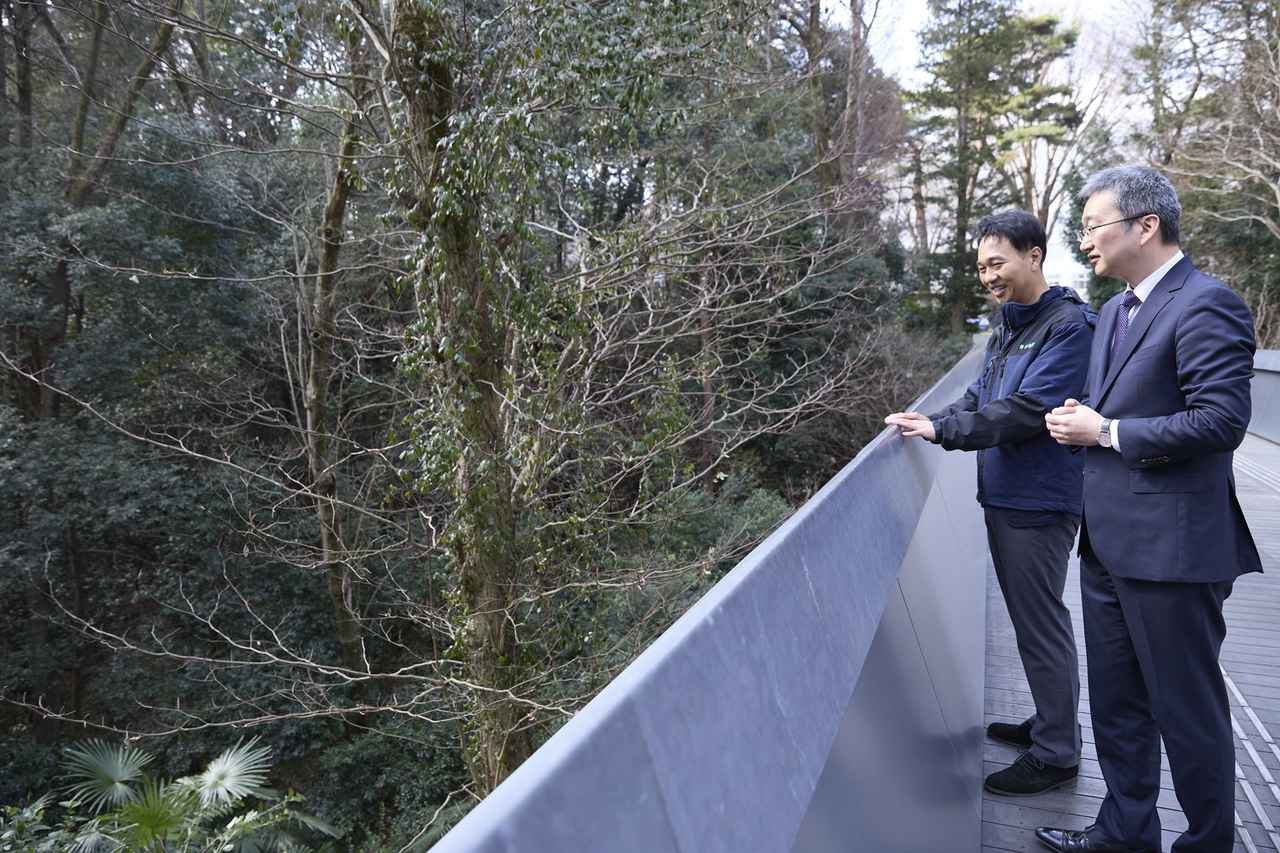
Suzuki: Plants are living things that change form over decades and centuries. It’s extremely difficult to develop plans for planting trees while imagining what they’ll look like once they’ve grown in the future as opposed to what they look like now. By the same token, for someone who works in landscaping, nothing is more enjoyable or rewarding. It’s a real inspiration to us that Hitachi has such a long-term perspective on developing the forest.
Hanaoka: And then there was another thing—a comment—that made up my mind. In August 2025, we invited Masataka Hata, president of Shoyeido Incense Co. in Kyoto, which has been in business for over 300 years, to give a talk. President Hata spoke of what it meant for a tree to “fulfill its destiny.” Even after its blossoms scatter and it withers away, he said, its roots and whatever else remains of it become a bequest to the next generation—though who will use them next is unknown. Such is the lifecycle of a tree: the fulfillment of its destiny. Those words really resonated with me.
Sadly, President Hata suddenly passed away immediately afterward. I was determined to ensure that his words would live on in Kyōsō-no-Mori. That was the final nudge that got the project up and running.
Suzuki: Don’t just pass it on because it’s always been there. Pass it on with the foundations for making it better. That mindset does strike a chord.
When the new city hall was built in Kokubunji, workshops were held on making birdhouses out of timber from cherry trees that had outlived their usefulness, and cryptomeria wood from Iiyama, Nagano Prefecture (which has a friendship-city relationship with Kokubunji), was used for the benches at the new city hall. The 100-Year Future Vision Project is another example of such a project aligned with trends in the community and society at large. As a resident of Kokubunji myself, that’s gratifying.
Envisioning a New Relationship between Forests and People
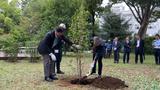
Hanaoka: We held a tree-planting event on October 7, 2025, to mark the project’s launch, with employees taking part in planting Japanese dogwood and flowering dogwood seedlings. We have plans to plant about a hundred trees at the Kokubunji Site over the next three years.
Under Suzuki-san’s guidance, I shoveled in soil and watered the tree and performed the rest of the routine myself, and I was amazed at how into it I got. That process gives you a completely different bond with a tree. I’d like as many employees and their family members as possible to experience that—not just a select few.
Suzuki: You develop a special feeling for a tree you’ve planted yourself, that’s for sure. You keep wondering how much it’s grown as you go about your daily life. That’s the first step to taking a personal interest in the forest.
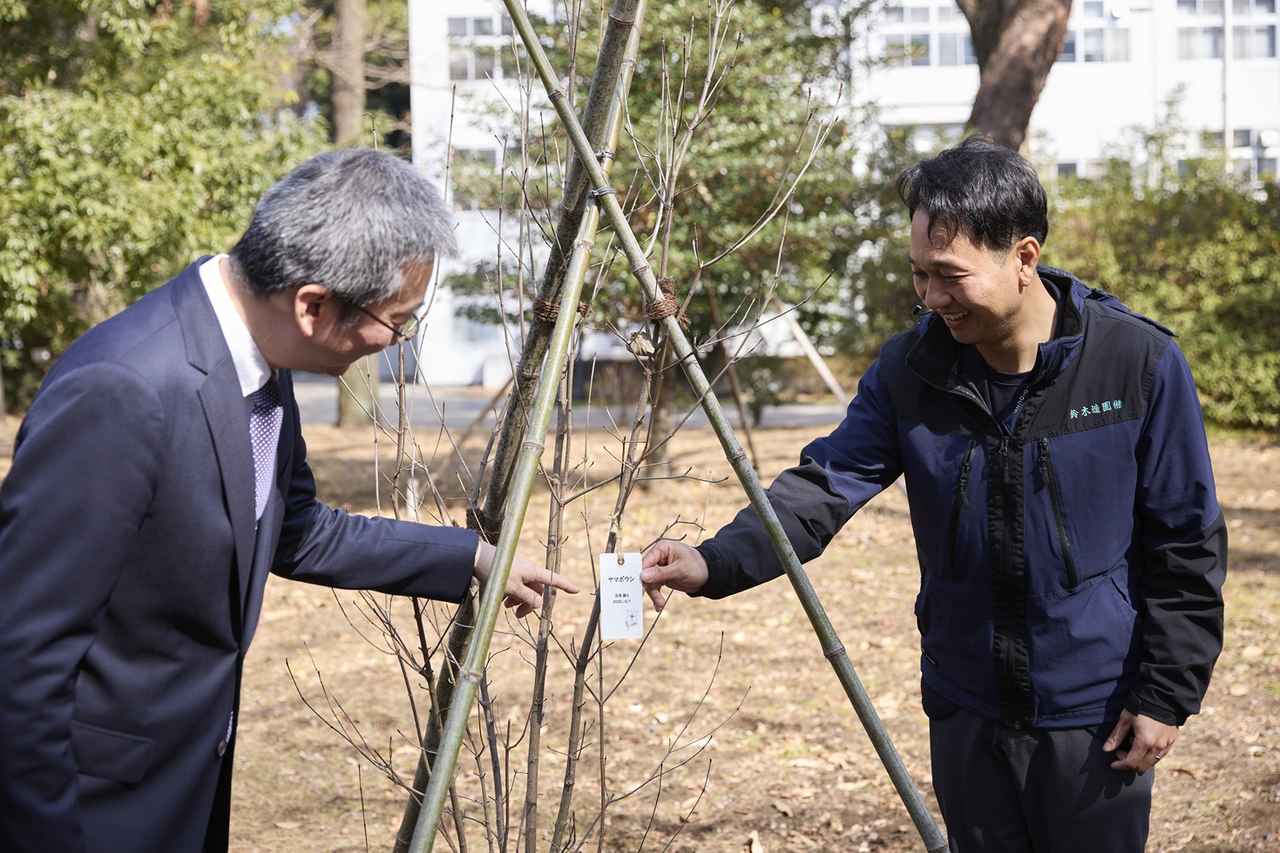
Hanaoka: Absolutely. It’s not just me and small group pushing this project forward; the effort involves the entire workforce. That’s what makes it so meaningful. I want to foster the sense that it’s our responsibility to conserve this forest.
That’s why we’re thinking of turning trees that have to be cut down into coasters and other promotional items to give away. Then they’ll be used every day in a tangible, visible way. Hopefully they’ll bridge the forest with people’s everyday lives. As you sip on your drink, you’ll wonder how the forest is doing. Another thing we plan to explore is building a small communal facility using timber from felled trees. With luck, things will ultimately move beyond my control; employees will start spontaneously coming up with ideas on what to do next, what action to take on the forest’s behalf. Then the project will have been a tremendous success.
Suzuki: Taking a personal interest in the forest should enrich how employees each approach their lives and engage with society. At that point, you’ve transcended the level of a corporate conservation program. Spending time in nature is an enormous benefit in fostering new ideas and refreshing the soul.
Passing a Sustainable Natural Environment on to the Next Generation
Hanaoka: Talking with you today has been a timely reminder that this forest doesn’t belong to Hitachi alone. It’s now in such good condition because the Suzuki family has been looking after it since your grandfather’s and father’s day. People in the community looked forward to days when the garden was open to the public, which made it something to really cherish.
Hitachi’s mission is to “Contribute to society through the development of superior, original technology and products.” Looking a century or two ahead as we nurture the forest is, I’d say, a natural extension of that mission. It’s a way of making a difference to the local community and the global environment. I hope you’ll stick beside us for the long haul.
You mentioned that Suzuki Zoen has safeguarded this forest for over 60 years, and for that I’m so grateful. The forest is always in a condition that we can welcome customers to. That, too, is thanks to you and the conscientiousness you put into your care.
I look forward to continuing to work with you on ensuring that this wonderful forest endures. After all, these trees will outlive us all.
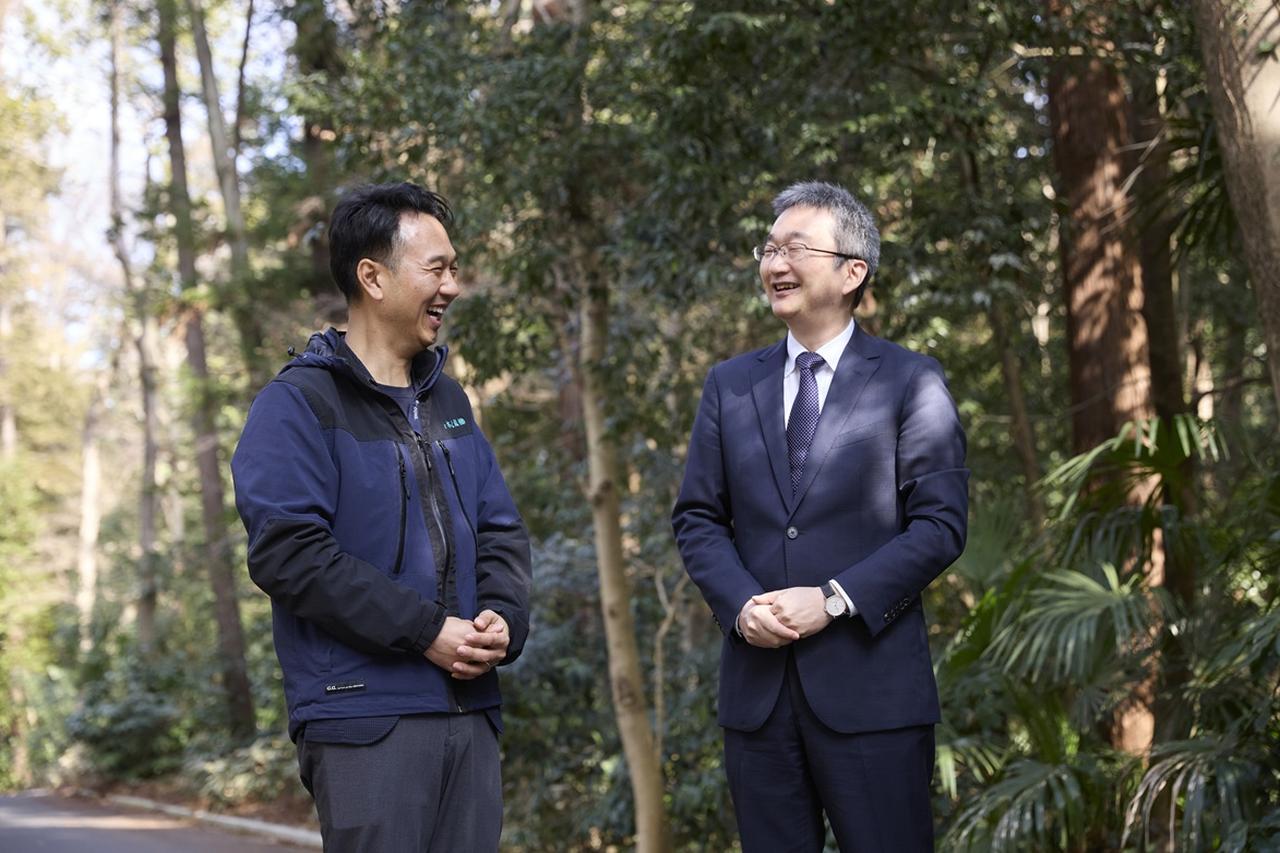
Suzuki: No, no, we should thank you. We’ve learned a lot over the past 60 years. You’ve taught us so much, which is why we’re able to conserve it with you now.
Hopefully, subsequent generations will look even further ahead and decide what to do in the future. It’s vitally important that we leave them a foundation that they can build on to make the forest better. Trees are being lost at such a rate that I wouldn’t be surprised if there came a day 50 or 100 years from now when leaving nature intact became mandatory. In that regard, it really is heartening that a major corporation like Hitachi is taking the initiative in pushing ahead with a project like this.
I’m optimistic that the project to conserve this forest will inspire many others like it. We look forward to working alongside you in the future.
Profile
Note: Titles and affiliations are as of the time of the interview.
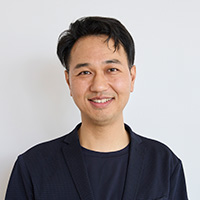
Yohei Suzuki
CEO
Suzuki Zoen Co., Ltd.
Yohei Suzuki is with Suzuki Zoen, a landscaping company based in Kokubunji, Tokyo, that manages planting projects at public facilities and designs and manages regreening projects at private-sector facilities and residences. He has been on-site manager and engaged in on-site operations since 2011, becoming CEO in 2021.
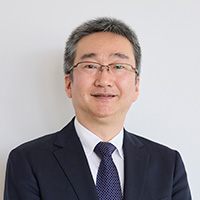
Seishi HANAOKA
General Manager, Digital Innovation R&D
Hitachi, Ltd.
Hanaoka joined the Central Research Laboratory of Hitachi after completing his master’s degree in telecommunication engineering at Osaka University in 1996. After engaging in R&D for next-generation wireless communication systems (3G, 4G, 5G, cognitive radio) and in international standardization activities, he changed his area of research focus to network systems, connectivity, IT platforms, and their management. From 2018 to 2019, he worked as a senior manager in the Management Planning Office of the Strategy Planning Division at Hitachi headquarters before returning to the Research & Development Group in 2020 to serve as the Head of the Digital Technology Innovation Center, and in 2021 as the Head of the Digital Platform Innovation Center.
From 2023, he served as General Manager of the Center for Digital Services, and since April 2025 he has held his current position.